Deutsch
 Français
 Türkçe
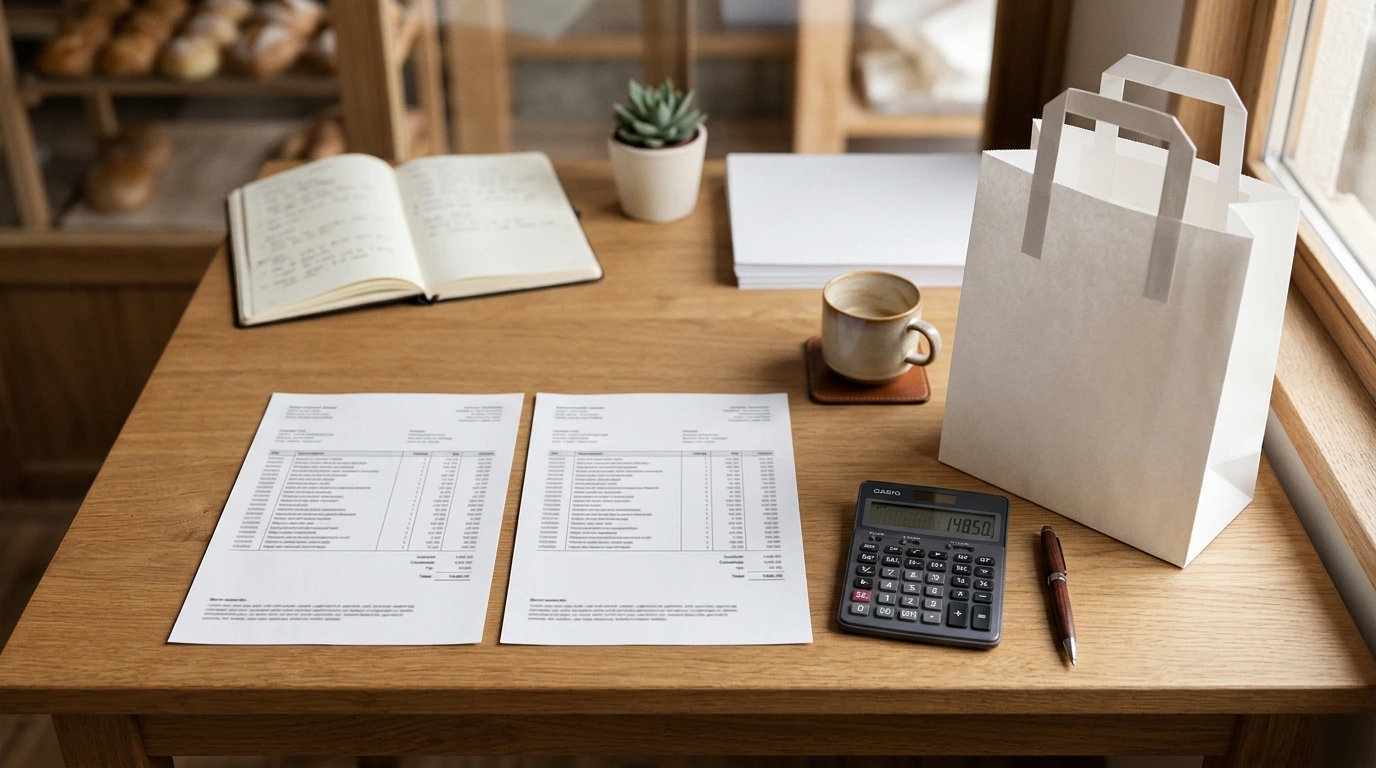
Tuesday morning, two quotes in the inbox of a three-site bakery in Leeds. Both for 10,000 flat-handle paper carrier bags, white kraft, printed in one colour, for the weekend delivery orders. One unit price is a good way below the other. The owner is ready to place the order. Her accountant asks what “EXW” stands for.
The cheaper quote is five lines shorter. No plate charges, no delivery term, no tolerance, no validity date, no payment terms. The unit price is accurate. It is just not what she will pay.
The cheapest unit price is often the dearest quote, because it leaves out the other five lines. A packaging quote is made of six lines, and the unit price is the one that tells you the least about the invoice. We write quotes like these every week, and the questions that come back a few weeks later tell us which lines were read and which were skipped. This article walks through the six. We do not quote prices here; the structure is much the same wherever you buy, and once you know it you compare quotes rather than numbers.
Which six lines does a packaging quote need?
Unit price with its quantity, one-off charges, delivery term, quantity tolerance, validity and payment terms. If one is missing, the quote is not shorter but dearer than it looks. The six lines answer six questions that get asked on every order sooner or later. How much is one piece, and at what quantity? What is paid once, before the first piece is printed? Where does the price stop? How many pieces may actually be delivered? How long does the number hold? When is it paid? There is a seventh figure that good quotes rarely leave out, which is why it is not counted here: the lead time from artwork approval.
Buyers often forward us a competitor’s quote for comparison. In our experience the line most often missing there is the tolerance, followed by the delivery term. Neither is noticed while everything goes smoothly. They are noticed when a forwarder sends an invoice nobody budgeted for, or when a few hundred bags more arrive than were paid for. That is why the comparison table at the end of this article has six rows, and only the first of them carries a price.
Unit price: which quantity does it apply to, and what changes at 25,000 instead of 10,000?
The unit price applies to exactly the quantity printed beside it; at 25,000 pieces a different, usually lower, price applies. The reason is the press. A flexographic press is set up for every job: plates mounted, ink matched, the paper web threaded from the reel, the first metres checked for colour and register. Those hours cost the same whether 10,000 or 25,000 bags follow. The more pieces the set-up is spread across, the smaller its share of the unit price. That is why every manufacturer has a minimum order quantity below which the set-up does not pay. Ours is 10,000 pieces for paper carrier bags, bakery bags and paper cups, 25,000 for pizza boxes and kebab boxes and 50,000 for sauce cups; below those figures we do not quote.
For your enquiry this means one thing: ask for the unit price at two or three quantity breaks, say 10,000, 25,000 and 50,000. The breaks show how much of the price is set-up, and where the next step up stops being worth it. A manufacturer who gives you one number has not hidden anything. They have just not shown you how their costing works.
Plates and cutting dies: one-off charges, and who owns the tooling?
A plate is the printing plate for one colour. Six colours, six plates, paid once, for as long as the artwork and the format stay the same. Our product page for flat-handle bags lists the specification “Up to 6-colour flexographic printing; Pantone colour matching available”. On a quote that line is a cost line. Every colour in your design is a plate that is made, mounted and stored. A two-colour logo is two plates, a CMYK photograph is four, a design with two spot colours on top is six. Drop one colour at the design stage and you drop one plate, in every format that design is ever printed on.
Paid once means on the first order. On a repeat order the plates are sitting in the plant and the line disappears, provided nothing has changed. Change the phone number on the bag and the plate for that colour changes with it. On die-cut products such as boxes there is a cutting die as well, a second one-off tool. The question hardly anyone asks is the one that matters most: who owns the tooling after production? If you paid for it and later want to move to another manufacturer, that line decides whether the plates go with you. One sentence on the quote is enough: “Plates and die: one-off charge, property of the customer, stored at the manufacturer”.
One more line that gets overlooked: the custom size. The bakery from the opening asks for 320 × 220 × 250 mm because its meal boxes have to fit inside. The nearest standard sizes on our list are 300 × 180 × 320 and 320 × 200 × 320. The standard size runs on a machine that is already set; the custom size means a new machine format, often a different reel width with more waste and sometimes its own tooling. A manufacturer who quotes both, with the dimensions written out, saves you the arithmetic. Ask for it before you lock the custom size in.
EXW, DAP or DDP: what is in the price and what the border adds
Ex-works means the price ends at our loading bay in Istanbul; freight, import clearance and import VAT are yours. That is normal in export trade and, for a buyer with a forwarder of their own, the most transparent term. It does have consequences that are not on the quote, because they do not arise at the manufacturer. For UK buyers, paper packaging of Turkish origin enters duty-free under the UK–Turkey trade agreement, against an origin declaration on the commercial invoice; there is no A.TR for the UK, that certificate belongs to EU consignments. Import VAT at 20 per cent is still due. A VAT-registered business can usually declare and recover it on the same VAT return under postponed VAT accounting rather than paying it at the border; how that works in your books is a question for your accountant. Either way, it appears on no ex-works quote. One trap worth naming: a quote marked FOB is not an ex-works quote. FOB is a sea-freight term that puts the goods on board a vessel; a lorry from Istanbul is EXW, FCA or DAP.
DAP means the manufacturer carries the goods to your address; import clearance and the taxes stay with you. DDP means everything sits with the seller, right up to cleared goods at your door. A Turkish manufacturer can only offer DDP with a customs representative in the UK; we do not, and those who do have to price the import VAT and the risk into the quote. A note on freight that fits the scene: 10,000 bags are about 40 cartons, a few pallets, not a full lorry. A full load to Germany takes around five to seven working days; for a few pallets to the UK as part-load or groupage, with the Channel crossing and clearance, ask your forwarder for a door date rather than relying on a transit figure. What each delivery term contains in detail is set out in our article on EXW, FCA and DAP. For comparing quotes one rule is enough: two quotes with different delivery terms are not comparable until freight and import costs for both have been worked out to the same delivery point.
Overs and unders: why 10,000 rarely means exactly 10,000
Printed packaging is made in runs, and a run never stops on exactly the piece you ordered; that is why every proper quote gives a quantity tolerance. The press produces waste while ink and register settle. The paper reel has a length that is not divisible by your order quantity. At the end of the run there are either a few hundred pieces more on the pallet or a few hundred fewer. Manufacturers reserve a tolerance of a few per cent either side of the order quantity for this. The exact figure is on our quotes and should be on every quote you compare. Two questions go with it: are overs invoiced, and are unders credited?
For chains with a central store the tolerance has a side effect: it changes the carton count. Order 10,000 bags at 250 per carton and you plan for 40 cartons; with a few hundred overs it is 41 or 42. That sounds like nothing until the pallet no longer fits the racking slot reserved for it. Ask for pieces per carton and cartons per pallet to be written on the quote; then you know what is on the lorry before it arrives.
Validity, payment and lead time: how long does the price hold, and when does the pallet land?
Our quotes are valid for seven days. A quote without a validity date is not open-ended; it is simply unclear when it stops being valid. Paper and freight prices move, and a quote from March cannot be held in October. Seven days is short, but it is a date, and a date can be extended in writing. What should not happen is an invoice that differs from the quote because two months have gone by. For a quote from abroad, validity also means currency: which currency is the price in, and who carries the exchange risk up to the invoice?
Payment terms are the sixth line. On first orders from abroad a deposit on order and the balance before dispatch is common; in an established relationship credit terms are agreed. Both are fine. What is not fine is a payment term that first appears on the pro forma invoice. A quote with a deposit and a quote with thirty days’ credit tie up different amounts of cash at the same unit price, and that belongs in the comparison. The seventh figure is the lead time. Ours is on every product page, for paper carrier bags “Approximately 15–20 working days after artwork approval”. The last three words are where the clock starts: not the order, the approval of the print files. Transit comes after that. Ask for both parts separately, because an ex-works quote only gives the first.
Two quotes side by side: the comparison table
The table has six rows and one column per quote, and it is only complete when every cell is filled. Above the table belongs the product description, which has to be identical for both: format, paper and grammage, handle, number of colours and printed sides. Only then are the rows comparable.
| Line | Quote A | Quote B |
|---|---|---|
| Unit price, valid for quantity | at 10,000 / at 25,000 | at 10,000 / at 25,000 |
| One-off charges (plates per colour, cutting die), ownership | amount, owner | amount, owner |
| Delivery term and delivery address | EXW / DAP, place | EXW / DAP, place |
| Quantity tolerance, overs invoiced | ± … %, yes / no | ± … %, yes / no |
| Validity and currency | date, currency | date, currency |
| Payment terms | deposit / credit days | deposit / credit days |
Only when both columns show the same delivery term is the first row worth looking at. For ex-works, add the freight and import costs your forwarder gives you and compare the price at your goods-in door. Spread the one-off charges over the quantity you realistically expect to order in the first year, not over the first order alone. The table then shows a price per piece at your door, tooling included, and that is comparable. The answers to the following five questions fill the empty cells; a manufacturer who would rather not give them has probably not costed them yet.
- Which quantity does the unit price apply to, and what is it at the next break?
- Which one-off charges apply, for which colours and tools, and who owns them after production?
- Which delivery term is the quote based on, and what is added up to my door: freight, import clearance, import VAT?
- What quantity tolerance applies, are overs invoiced, and how many pieces are in a carton?
- How long is the quote valid, in which currency, what are the payment terms on the first and second order, and how long is production from artwork approval?
To be fair, this comparison can go against us. A manufacturer near you delivers without a border, a forwarder or customs paperwork, and at small quantities the freight from Turkey eats the advantage in unit price. We quote ex-works, not DDP; a DAP quote with the forwarder named is available on request. Our tolerance is on the quote, and it is not zero. A buyer who knows this allows for the lead time and gets no surprises. What an enquiry has to contain so that a manufacturer can fill in all six lines is the subject of our article on what a packaging quote needs from you; the short version is quantity, format, paper with grammage, colours, printed sides and delivery postcode. Send us those six and you get a quote with all six lines on it, including the ones that can count against us. Sizes, grammages and print colours for the bag in this example are on our page for custom printed flat-handle paper bags.
In short
- A packaging quote has six lines: unit price per quantity, one-off charges, delivery term, quantity tolerance, validity and payment terms; the cheapest unit price is often the dearest quote because it leaves the other five out.
- A plate is the flexographic printing plate for one colour; six colours are six plates, paid once and reused on repeat orders while artwork and format stay the same.
- Minimum order quantities are given per product group; at Bas Packaging 10,000 pieces for paper carrier bags, bakery bags and paper cups, 25,000 for pizza boxes and kebab boxes, 50,000 for sauce cups.
- Ex-works ends at the manufacturer’s loading bay; Turkish-origin paper packaging enters the UK duty-free under the UK–Turkey trade agreement with an origin declaration, and import VAT at 20 per cent is still due.
- Printed packaging is made in runs; a tolerance of a few per cent over or under the order quantity is normal and belongs on the quote with the question of whether overs are invoiced.
- Lead time counts from artwork approval, around 15 to 20 working days for paper carrier bags, with transit on top; a quote without a validity date is not open-ended.
Frequently Asked Questions
- Do I pay plate charges again on a repeat order?
- Not while the artwork, colours and format stay the same. A plate is the flexographic printing plate for one colour; it is made on the first order and stored at the manufacturer. If anything on the artwork changes, a phone number or a colour, a new plate is needed for the colour concerned. Ask for the quote to confirm that the plates belong to you after production and are kept at the plant.
- What does ex-works mean on a quote from Turkey?
- Ex-works, or EXW, means the price ends at the manufacturer’s loading bay in Turkey. Freight, import clearance into the UK and import VAT are added on top and are organised by you or your forwarder. Paper packaging of Turkish origin enters the UK duty-free under the UK–Turkey trade agreement against an origin declaration on the invoice; import VAT at 20 per cent is still due, and a VAT-registered business can usually account for it on its VAT return under postponed VAT accounting. If you want freight in the price, ask for a DAP quote; import clearance and VAT stay with you even then.
- Can I send back overs that were delivered?
- Usually not, because printed stock cannot be passed on to another customer. That is why a proper quote gives an over and under-run tolerance of a few per cent either side of the order and says whether overs are invoiced. Check both points before you order and plan your storage on the upper limit, not on the order quantity.
- How long is a packaging quote valid?
- Only as long as the quote says; ours are valid for seven days because paper prices and freight rates move. If there is no date, ask for the price to be confirmed in writing before you order. A quote without a validity date is not open-ended; it is simply unclear when it stops being valid.
- What do I need to send so that two quotes are comparable?
- The same quantity, the same format, the same paper and grammage, the same number of print colours and printed sides, the same delivery term and the same delivery address. A quote for 10,000 pieces ex-works in two colours cannot be compared with one for 25,000 pieces delivered in one colour. Send both manufacturers the same enquiry and ask for the six lines: unit price per quantity, one-off charges, delivery term, tolerance, validity and payment terms, plus the lead time from artwork approval.
Related Articles

EXW, FCA or DAP: what the ex-works price does not include
Paper packaging from Turkey reaches an EU warehouse duty-free thanks to the customs union, and a UK warehouse duty-free under the UK–Turkey trade agreement, but neither route is cost-free. Between the ex-works unit price and the pallet at your dock sit an Incoterm, a certificate, import VAT, loading metres and the question whether your cups travel nested or your boxes flat. What EXW, FCA and DAP really allocate, how long the lorry takes and what a ten-line landed-cost sheet looks like.

What Your Packaging Supplier Needs Before They Can Quote
Three suppliers, three prices, three different bags. Most packaging quotes are unusable because the enquiry described a logo instead of a product. Here is the brief that gets you comparable numbers.
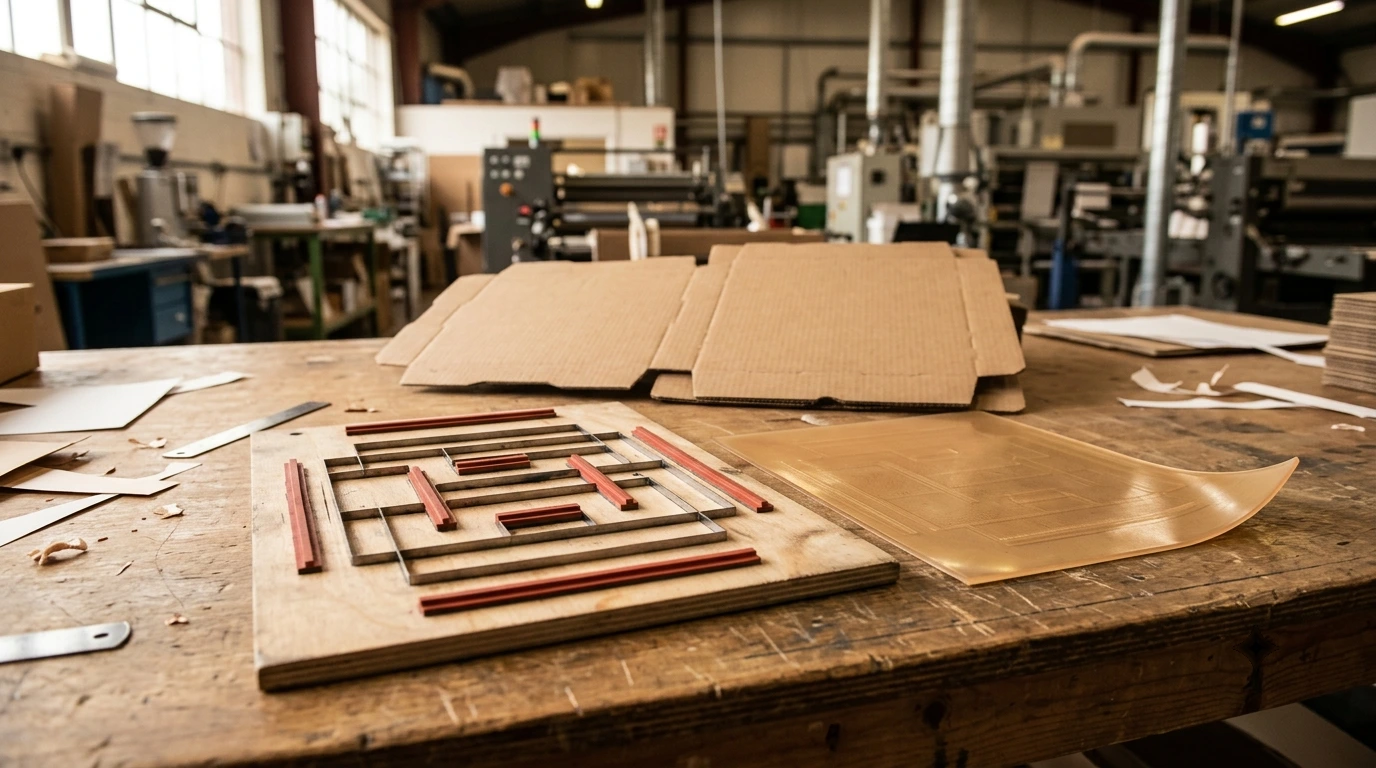
A second packaging supplier: who owns the tooling?
A second supplier rarely fails on price and often on a question nobody asked in the first contract: who owns the cutting die and the printing plates, and what of that fits another plant at all. When a second supplier becomes a must, what data it really needs, where two plants differ on the shelf, what happens to marking and conformity, and from what volume a business can carry two minimum runs.