Deutsch
 Français
 Türkçe
Three quotes for the same meal box, 60,000 pieces, three figures per piece. The first is the lowest and says “EXW Istanbul”. The second sits four per cent higher and says “FCA Istanbul”. The third is the highest and says “DAP central warehouse Birmingham”.
The buyer for a contract caterer with twelve kitchens lays them side by side and spots the error only at the third look. She is comparing three prices for three different services.
The ex-works unit price is honest. It just does not say what a meal box costs once it stands on the dock in Birmingham. Between the two lie an abbreviation, a certificate, a tax rate, a transit time and the question of how the box fits in the lorry.
We describe that stretch from the side of the plant that runs it every week: what EXW, FCA and DAP really allocate, why Turkey’s customs union with the EU and its trade agreement with the UK make the goods duty-free but not charge-free, how the lorry counts, how long it takes, which Incoterm suits which operator and what a landed-cost sheet looks like that makes three quotes comparable.
Why are three quotes with three Incoterms not comparable?
Because each Incoterm names a different handover point, and the unit price holds only up to that point. There cost and risk pass from the seller to you. EXW ends at the factory gate, FCA at the carrier, DAP at your dock. What one price includes, the other leaves for you to buy yourself, and not at the plant’s rates but at yours. An EXW quote is therefore not a cheap quote but an incomplete one: it lacks freight, export clearance, insurance and the hours your buying team spends with the forwarder. A DAP quote includes all of that, but on terms you cannot see.
From our experience with chains the distortion arises at one specific point: the buyer collects three quotes without prescribing the Incoterm, and each plant picks the one that makes its price look smallest. We say so openly because we would do the same. The remedy is one line in the enquiry: “Please quote FCA plant, plus DAP to the following address.” Then two prices per plant exist that mean the same thing, and the comparison begins. Which documents to demand from a Turkish supplier in general is set out in our guide to buying food packaging from Turkey; this guide takes apart the stretch from factory gate to dock.
EXW, FCA, DAP: who pays what on the way from Turkey?
Under EXW you pay everything from the factory gate, under FCA from handover to the carrier, under DAP only the import. EXW also leaves you the export clearance in Turkey; FCA puts it on the seller; DAP brings the goods to your dock and leaves the import with you. Incoterms 2020 govern only cost, risk and clearance duties, not transfer of title and not payment. Three things about this are regularly overlooked. Under EXW you must arrange the Turkish export declaration, which is hardly possible without a Turkish forwarder; for a UK or Irish buyer EXW is therefore almost always the wrong rule in practice, even when the price is smallest. Under FCA the handover point decides: FCA plant means your forwarder’s lorry loads at our gate, cleared for export; FCA terminal means we bring the goods to the groupage terminal. Under DAP the seller’s duty ends with the goods ready for unloading on the lorry at your named place; unloading and import clearance are yours, even if the seller’s forwarder does them for a fee.
And then FOB. We regularly receive enquiries demanding “FOB Istanbul”, most recently from a buyer who wanted 115,000 tray papers. FOB is a sea and inland-waterway rule: the goods are delivered when on board the vessel. For goods that travel by lorry across Bulgaria and Austria, or on to the Channel, there is no “on board”, and an FOB quote for a lorry is an agreement nobody can interpret when something goes wrong. The matching rule is FCA. Whoever writes FOB usually means FCA, and a supplier who quietly quotes FOB has not read the rule.
Customs union and trade agreement: duty-free, but not charge-free
Into the EU, paper packaging from Turkey is duty-free with an A.TR movement certificate; into Great Britain it is duty-free under the UK–Turkey trade agreement with an origin statement; import VAT applies on both routes. The customs union between the EU and Turkey has existed since 1996 and covers industrial goods; agricultural goods and certain steel products are excluded, paper and board from chapter 48 of the tariff are in. The A.TR shows that the goods are in free circulation in the country of dispatch and replaces proof of origin: where the paper came from does not matter for duty, only that it was in free circulation in Turkey. It must be issued for every consignment; there is no minimum value below which it could be dropped. A supplier who wants to send the A.TR “next time” has cost you duty. For an Irish kitchen, this is the route.
Great Britain left the customs union with the EU, so the A.TR means nothing at Dover. What applies instead is the UK–Turkey trade agreement, under which goods of Turkish preferential origin enter duty-free with the appropriate origin statement, and a UK import declaration is due in every case. Charge-free the import is not on either route. The UK levies import VAT of 20 per cent on the customs value, which includes freight to the border; Germany levies 19 per cent. For a VAT-registered business it is a pass-through item, but it is first a payment that ties up cash and then a declaration someone must file. Under DAP the seller’s forwarder usually files it in your name and invoices you; under FCA your forwarder does. Two things therefore belong in the contract: who files the import declaration and whose EORI number is on it. For paper packaging sold into the EU and covered by the EU deforestation regulation, the reference number of the due-diligence statement joins the declaration from 30 December 2026; whoever files must enter it. That duty hangs on the Incoterm, because the Incoterm decides who files.
The lorry counts in loading metres, not in pieces
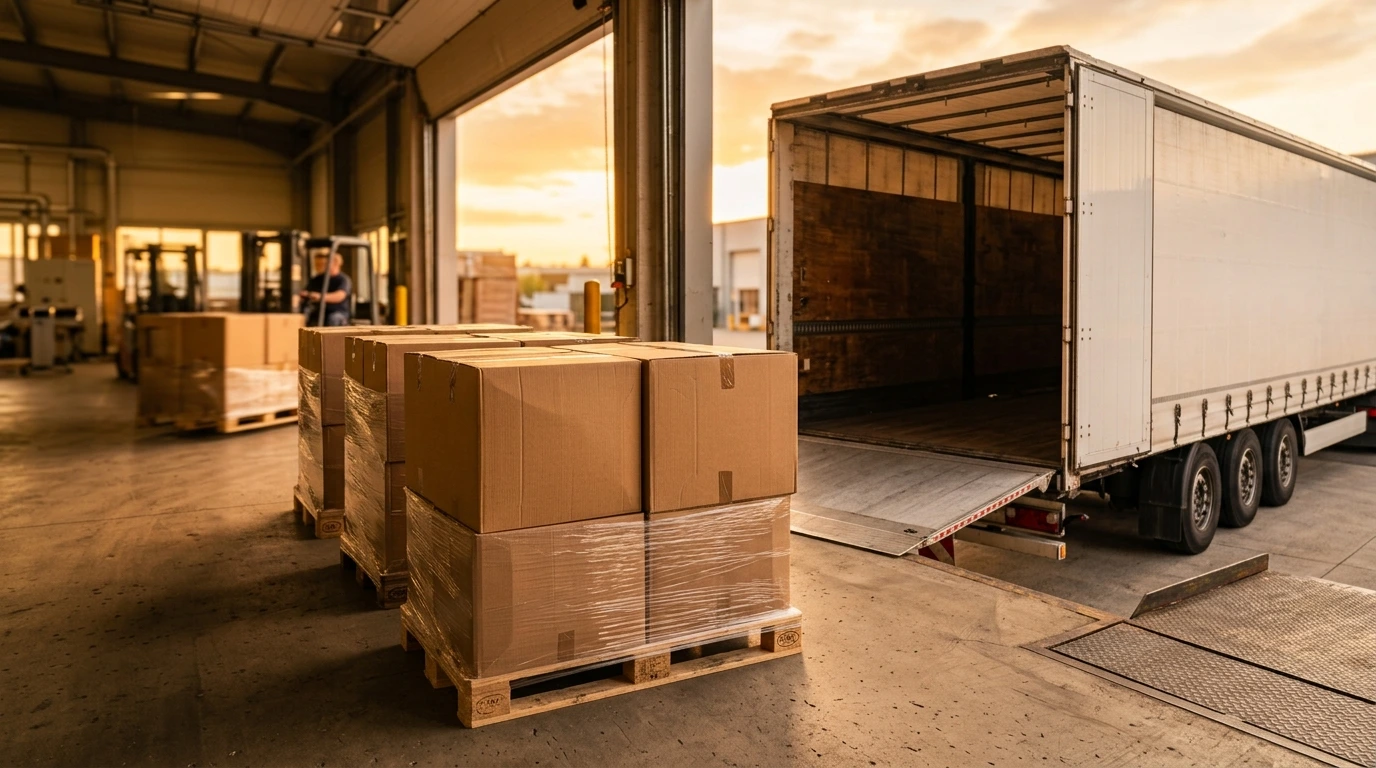
Freight does not hang on 60,000 pieces but on the number of pallets those pieces make, and that hangs on the construction. Forwarders price groupage by loading metres, the length of trailer floor a consignment occupies, and by weight; a full load is a whole trailer, which takes a good thirty Euro pallets of 1,200 by 800 mm in one layer, more if the pallets stack, and for the UK the 1,200 by 1,000 mm pallet changes the pattern again. Packaging is light and bulky, so volume almost always decides, not weight. And volume is decided by the construction.
Our product page for paper cups says, in the line on stackability, that the cups are designed for efficient nesting, storage and high-volume beverage service. On the product page that is a note for the counter; on the loading dock it is a freight line. Nested cups travel as dense sleeves, and a carton of custom printed paper cups contains cups, not air. For burger boxes the product page says folding clamshell box with integrated locking tabs, with its own line on stackability: the box travels flat and is only erected at the site. Flat it is dense; erected it would be nine-tenths air. Whoever orders custom printed burger boxes and cups in one consignment therefore gets two different ratios of pieces to pallet, and the freight per piece differs although both ride in the same lorry. The lines you need from the manufacturer are therefore not the unit price but pieces per carton, cartons per pallet, pallet height, pallets per lorry. A hint from production: pallet height is negotiable. A pallet at 1.8 metres does not fit many racks; one at 2.4 metres saves loading metres. Which height your central warehouse takes is something the manufacturer should know before it packs.
How long does the pallet really take?
To Germany, a full load takes about five to seven working days and groupage about seven to ten from collection at the plant. The UK adds the crossing and clearance; production time comes before all of it. The route usually runs through Bulgaria, Serbia, Croatia and Austria, with the Turkish–Bulgarian border as the point where transit times vary most, and for the UK on through France or Belgium to the Channel. Groupage runs to a timetable, usually with fixed departure days from Istanbul, and whoever is ready the day after departure waits a week. These transit times are forwarders’ figures and move with season, holidays and border conditions; they are planning values, not promises.
For your scheduling that means: the lead time on a product page, for most of our items about 15 to 20 working days after artwork approval, is the time to the finished pallet at the plant. Add transport, add a reserve for customs and borders. Whoever knows the shelf date and counts backwards needs three times in one line: approval to pallet, pallet to dock, reserve. A DAP quote includes the middle one in the price but not as a promise; ask for both.
Which Incoterm suits which operator?
Without your own forwarder or customs experience, DAP to the central warehouse; with your own forwarder and regular Turkey traffic, FCA. EXW only with a Turkish forwarder. The rule follows from who does what better. A caterer with twelve kitchens has no forwarder loading weekly in Istanbul; under FCA it pays the freight of a single consignment, under DAP the freight the plant buys through its groupage lines. A chain with 200 sites and its own central warehouse often has a framework with a forwarder that runs from Turkey anyway; for it FCA is cheaper because it consolidates freight and files the import itself. EXW remains the rule for buyers with their own logistics in Turkey, mostly importers and wholesalers.
Here is the counter-argument we owe you: we happily quote EXW because it is the least work for us, and our DAP price carries a margin for the effort. Both are legitimate, neither is automatically cheap for you. What you want is a plant that quotes FCA and DAP side by side and shows both lines, so you can see what you pay for. A plant that offers only one rule has decided for you.
Landed-cost sheet: ten lines instead of one
Ten lines, filled in per quote, turn three unit prices into three comparable prices at the dock.
- Unit price as quoted, with Incoterm and named place.
- Pieces per carton, cartons per pallet, pallets per lorry at your quantity, pallet height and pallet type.
- Freight to destination, under FCA your forwarder in loading metres, under DAP included in the price.
- Export clearance in Turkey: your cost under EXW, included under FCA and DAP.
- Customs document for your destination confirmed, A.TR for the EU or origin statement for the UK, so that duty stays at zero.
- Import VAT, 20 per cent in the UK or 19 per cent in Germany, on the customs value, as a cash-flow line, not a cost line.
- Import declaration: who files it and what they charge.
- Transport insurance, under DAP check whether included, under FCA your matter.
- Unloading, pallet exchange or one-way pallet, wrapping.
- Transit time and reserve in days, not in money, so that the date holds.
The caterer’s buyer recalculated the three quotes with this sheet. The EXW quote was the dearest at the dock, because export clearance and a single-consignment freight were added; the DAP quote was the middle one; the FCA quote was the cheapest, because her forwarder already ran weekly from Istanbul. The ex-works unit price was the smallest part of that order. What you have read is the practice of a plant at the loading dock; whether a rule in your contract does what you think it does is for your forwarder or customs agent to check, not your supplier.
In short
- EXW ends at the factory gate, FCA at handover to the carrier with export cleared, DAP at the buyer’s dock with import still open; three quotes with three Incoterms are comparable only after conversion to one point.
- FOB is a sea and inland-waterway rule; for road freight from Turkey the matching rule is FCA.
- Industrial goods such as paper packaging from chapter 48 have been duty-free in the EU–Turkey customs union since 1996 with an A.TR movement certificate, which has no minimum value; into Great Britain the UK–Turkey trade agreement applies instead, with an origin statement rather than an A.TR.
- Duty-free is not charge-free: import VAT of 20 per cent in the UK and 19 per cent in Germany is levied on the customs value, reclaimable but to be paid and declared first.
- Forwarders price groupage in loading metres and weight; a trailer takes a good thirty Euro pallets of 1,200 by 800 mm in one layer, and nested cups or flat-packed boxes decide how many pieces fit on a pallet.
- Full load Turkey to Germany about five to seven working days, groupage about seven to ten, plus the Channel crossing for the UK, after production time from artwork approval and before a reserve for borders and customs.
Frequently Asked Questions
- Is there customs duty on paper packaging from Turkey?
- Into the EU, no, provided the consignment carries an A.TR movement certificate: the EU–Turkey customs union has covered industrial goods since 1996. Into the UK, no, provided the goods qualify for preferential origin under the UK–Turkey trade agreement and come with the right origin statement; the A.TR does not apply to the UK. What does arise on both routes is import VAT, 20 per cent in the UK and 19 per cent in Germany, which a VAT-registered business reclaims. Ask the supplier which document it issues for your destination.
- Why does my supplier offer FOB when the goods come by road?
- Because FOB is the better-known term. FOB is a sea and inland-waterway rule: the goods are delivered when they are on board. For road freight the matching rule is FCA, under which the seller hands the goods to the carrier and clears them for export. Ask for an FCA quote with a named handover point and risk and cost are cleanly split.
- How long does a pallet take from Turkey to the UK or Germany?
- To Germany, a full load takes about five to seven working days and groupage about seven to ten, depending on departure day, border and receiving terminal. To the UK add the Channel crossing and UK customs clearance, so plan a further few days. Production time comes before that: it starts at artwork approval and ends when the pallet stands at the plant. Add both and a week of reserve for borders and customs.
- Which Incoterm suits a multi-site operator?
- For an operator without its own forwarder or customs experience, usually DAP to the central warehouse: the supplier organises transport, you handle import declaration and import VAT, often through the supplier’s forwarder. For an operator with its own forwarder and regular traffic from Turkey, FCA is cheaper because freight can be consolidated. EXW only makes sense if you can arrange export clearance in Turkey yourself.
- What do I need from the manufacturer to calculate landed cost?
- Pieces per carton, cartons per pallet, pallet size and height, pallets per lorry at your quantity, weight per pallet, the Incoterm with named place, which customs document is issued for your destination and whether the price includes pallet and wrapping. With those lines your forwarder can quote freight in loading metres, and only then is the unit price comparable.
Related Articles

Buying Food Packaging from Turkey: An Honest Guide
A quote from a Turkish packaging manufacturer can look very attractive, and it can be exactly as good as it looks, if the paperwork holds up. The documents to demand, how sampling and customs work, and the red flags that separate a partner from a problem.

Framework agreement for packaging: call-offs, stock, leftovers
A framework agreement does not lower the minimum run; it spreads it over twelve months. Whoever does not call off still buys in the end, and whoever leaves the leftover unregulated pays for the next menu change with a pallet. What the agreement settles and what only the call-off does, why the supplier prints the annual volume in one run, who stores and bears the risk, how many call-offs a chain needs and which lead time the contract actually means.

How to read a packaging quote: unit price, plates, EXW, tolerance
The cheapest unit price is often the dearest quote, because it leaves out the other five lines. What plates cost and who owns them after the run, why 10,000 bags ordered seldom means exactly 10,000 delivered, what an ex-works price leaves open at the border and how long a price actually holds. With a comparison table that makes two quotes readable side by side.
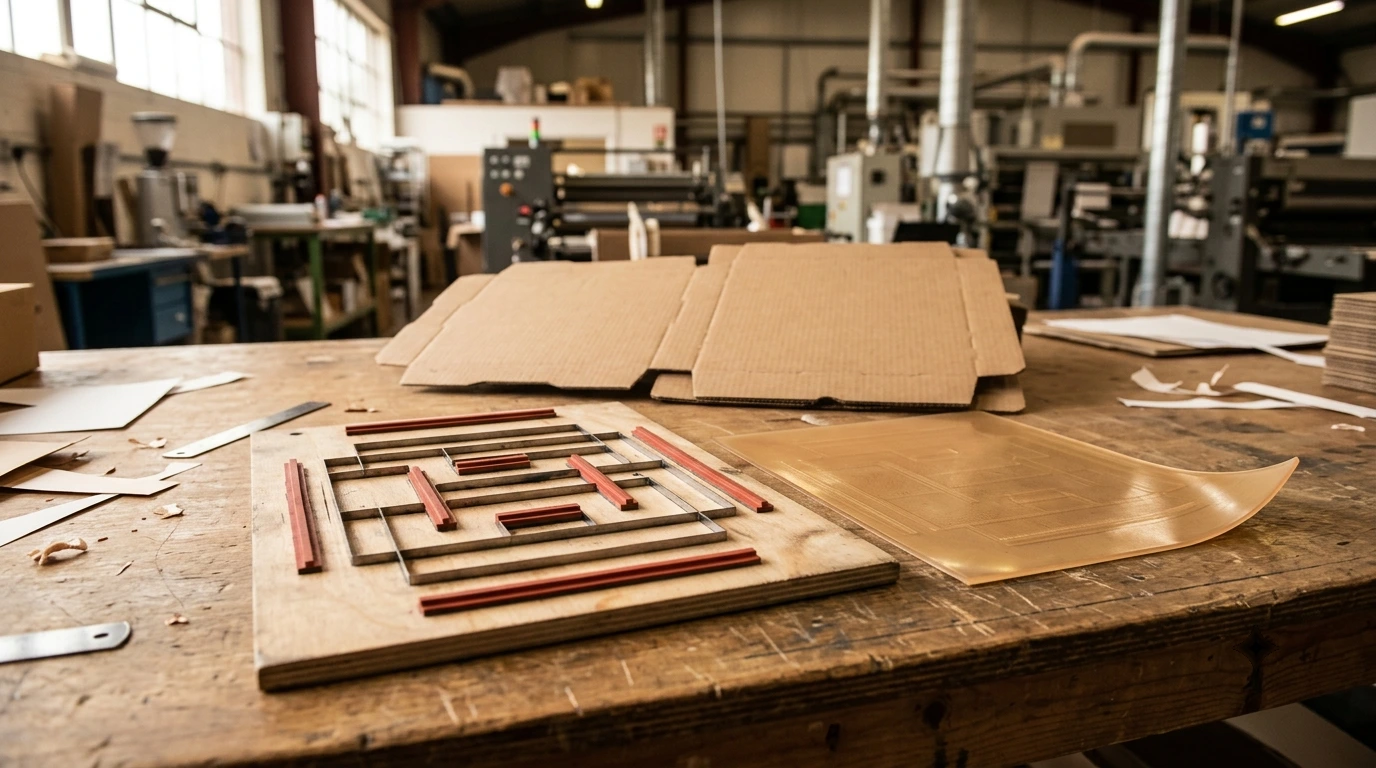
A second packaging supplier: who owns the tooling?
A second supplier rarely fails on price and often on a question nobody asked in the first contract: who owns the cutting die and the printing plates, and what of that fits another plant at all. When a second supplier becomes a must, what data it really needs, where two plants differ on the shelf, what happens to marking and conformity, and from what volume a business can carry two minimum runs.