Deutsch
 Français
 Türkçe
On a Tuesday morning a coffee shop owner in Leeds sends the same message to three suppliers: 10,000 kraft bags, printed with our logo, what is your price. By Wednesday all three have answered. The numbers sit so far apart that one of them looks like a typing error.
None of them is an error. The three suppliers quoted three different bags, because the message never described one.
A vague enquiry still gets a fast answer, and that is the problem
Nobody in this trade wants to be the supplier who takes four days to reply. So when an enquiry arrives without a product behind it, most of us do the same thing: we quote the nearest item already running on our machines. It is an honest guess, and it lands in your inbox quickly, which makes it feel like an answer.
What you are actually holding is three different assumptions about paper weight, bag format, print coverage and run length, all dressed up as one comparison. The cheapest of the three is usually the lightest paper and the simplest print, and you will only find that out when the pallets arrive. The fix is not to chase more quotes. It is to make the three suppliers quote the same bag.
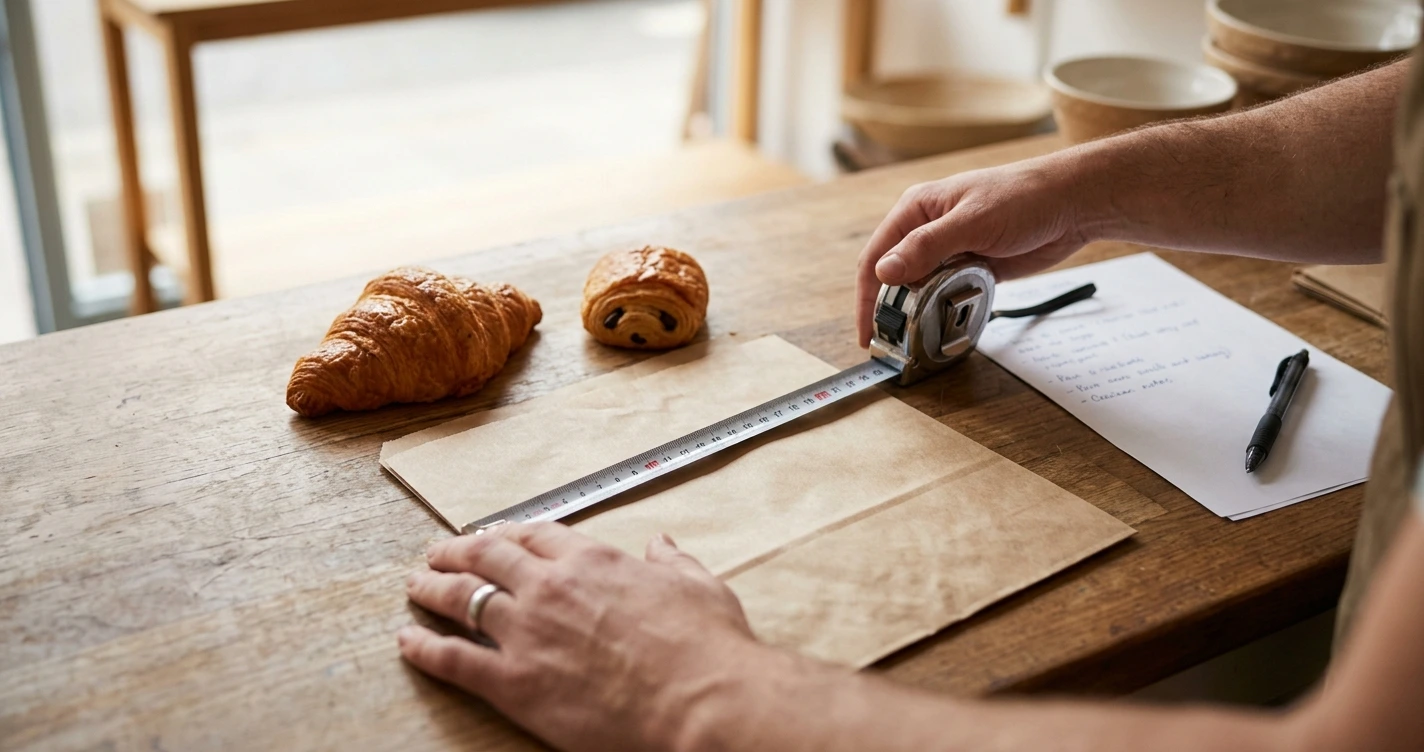
The enquiries that turn into a clean first order almost always arrive with a photograph of the product next to a ruler, or next to the bag the business already uses. That single image removes about half of the back and forth.
Start with what goes in the bag, not the bag
Packaging is a container for something specific, and every real decision follows from that something. Before you write a word about the bag, write five lines about the product.
- What it is, roughly what one unit weighs, and how many go into one bag.
- Its state when it is packed: hot from the oven, warm, chilled, ambient.
- What it gives off: steam, butter or oil, moisture, sugar glaze, crumbs.
- How long it sits in the bag: two minutes to the car, twenty minutes on a bike, three days on a shelf.
- How it travels: carried by hand, stacked in a delivery bag, shipped in an outer carton.
Those five lines change more than most buyers expect. A warm butter croissant and a cold flapjack of identical size need different paper. A bag that is carried out of the door and eaten in five minutes has a different job from one that sits on a shelf with a best-before date printed on it. If your supplier knows only the second half of that, you get packaging designed for the wrong half of the day.
Write the size so it cannot be misread
A size written as 25 x 32 is not a size. It is a riddle. Is 32 the height, or is it the depth of the base? On a flat pouch there are two numbers and no ambiguity. On a bag with a squared base there are three, and the middle one is the part most enquiries leave out.
State the convention in the message itself. Width across the front, then the gusset or base depth, then the height to the top edge, all in millimetres. Then say it in plain words as well: the opening is this wide, the base opens this deep, the bag stands this tall. Twelve extra words remove an entire round of emails. This matters most on formats with a squared base, where the depth decides whether the bag stands up on a counter at all, which is why our SOS block bottom bags are always specified with three figures rather than two.
If you already use a bag and want something close to it, send the bag itself, or a clear photo of it flattened next to a tape measure. Then say what is wrong with it: too tight for two pastries, too tall so the product falls over, base too narrow for a tub. A supplier can size around a complaint far more accurately than around an adjective.
Describe the job, not the material name
Material names travel badly. Greaseproof, grease resistant, glassine and coated kraft mean slightly different things in different mills and different countries, and two suppliers can both be telling you the truth while offering you different papers. So describe the failure you want to avoid instead.
Write it as a sentence: the outside of the bag must not show an oil patch before the customer gets home. That sentence is testable, and it forces a specific recommendation instead of a category. The same applies to moisture. If the crust has to stay crisp for a fifteen minute walk, say so; if the product is dry and the bag only has to look right, say that too, because you should not pay for a barrier you do not need. When the product is genuinely fatty, the honest answer is usually a treated paper rather than heavier kraft, which is why greaseproof bakery bags exist as a separate item rather than as a thicker version of the plain ones.
Give grammage as a range if you have a preference, or leave it to the supplier and say what the bag has to survive. A number copied from a competitor sample is not a specification; it is a clue, and it is worth sending as one.
Here is the part suppliers do not always volunteer. Barrier and recyclability pull against each other. The more you ask a paper bag to hold back oil and moisture, the more you are adding something that the paper stream may not want back. There is no universal winner, only a decision about which matters more for your product and your market. Say which one you would sacrifice, and the recommendation you get back will be far more useful.
Quantity is per version, not per order
This is where most first orders go sideways. An enquiry says 10,000 bags. The buyer means 10,000 bags in total: three sizes, two artworks, one lovely round number. On the production floor that is six separate set-ups, each with its own plate change, its own start-up waste and its own minimum. The total has not changed; the job has.
Write the quantity as a small table instead. Small bag, design A, this many. Small bag, design B, this many. Medium bag, design A, this many. It looks fussy. It is the single fastest way to get a quote that survives contact with reality, and it lets a supplier tell you something genuinely useful: which of your versions is the one making the order awkward.
Then ask the questions that follow from it. What is the minimum per size and per design, rather than per order. What changes if one size is dropped for the first run. Whether a single artwork used across all sizes would help, or whether it makes no difference on your press. None of that requires anyone to talk about money yet, and all of it changes the shape of the order.
Send artwork a printer can actually use
A logo lifted from a website, or photographed off the shop sign, is a picture of your brand rather than a printable file. What a printer needs is the original vector or layered file, the exact colour reference if the brand colour is not negotiable, and a note about which faces are printed.
Kraft paper is not white, so a colour that looks right on a screen or on a white card lands warmer and duller on brown paper. If the shade genuinely matters, say so before the plates are made, not after the first sample. Say also what must stay clear: a window, the fold line of the gusset, the glue seam, the area a label will cover later. We have written separately about what goes wrong between artwork and approval, and most of it is avoidable in the enquiry stage rather than at proof stage.
Dates, samples and the paperwork nobody mentions early
Give a date you actually need stock on the shelf, and say what happens if it slips: a shop opening that cannot move, a seasonal window that closes, or simply a stockout you can absorb. The word asap tells a planner nothing, so the schedule that comes back gets built around the factory diary rather than around your opening date.
Ask for a sample, and ask what the sample is produced on. A sample that comes off a different process from the bulk run tells you about the paper and the format but not much about how the print will finally sit. Knowing which of those a sample proves is more useful than simply holding one.
Say where the goods are going, in the enquiry rather than at the end. The destination country decides which marks belong on the pack, who is registered as the party that puts packaging on that market, and how the transport is planned. In Germany that registration question comes up early and specifically; in France the on-pack sorting information is part of the artwork rather than an afterthought; for goods entering the UK the reporting duty sits with a defined party. Your supplier cannot decide any of it for you, but a supplier who knows the destination will raise it while it is still cheap to fix. This is a practical account from the production side and not legal advice, and for anything with a threshold in it you want your own confirmation.
Finally, ask for the food contact declaration for the exact material you are buying, not for the supplier catalogue in general. A declaration that names the paper and the coating is a document. A logo on a website is not.
The one-page brief you can copy
Everything above fits on a single screen. Send this to every supplier you are asking, unchanged, and the replies become comparable for the first time.
- Product: what it is, unit weight, units per bag, photo attached.
- State when packed: hot, warm, chilled or ambient.
- Grease, moisture or steam: yes or no, and how much.
- Time in the bag: minutes, hours or days, and how it travels.
- Format: flat pouch, squared base, window, handle or none.
- Size: width x base depth x height in millimetres, with the convention spelled out.
- Reference bag or product sample: attached or posted, with what is wrong with the current one.
- Paper and barrier: the failure to avoid, plus any grammage preference.
- Quantity: per size and per design, as a short table.
- Print: number of colours, faces printed, colour references, vector file attached.
- Dates: stock needed on shelf by, and what depends on it.
- Destination country and who imports.
- Documents required with delivery.
What a good brief cannot fix
A precise enquiry buys you comparable numbers and a supplier who has understood the job. It does not buy you certainty. A lead time is a plan, not a promise, and paper mills have their own queues. A first sample can differ from the bulk run on colour, particularly on unbleached kraft where the base shade varies between reels. And a supplier who will not put the specification back in writing, in the same words you sent, has told you something important regardless of how good the number looks.
None of this takes long. Five lines about the product, three dimensions written out in full, the quantity split by version: that is one screen of typing. It is also the difference between holding three prices and being able to make one decision.
Frequently Asked Questions
- Do I need a technical drawing to get a quote?
- No. A photograph of the product, a reference bag and three dimensions with the convention spelled out are enough for a serious quote. Drawings become useful later, when the format is agreed and the print position needs fixing.
- What if I do not know what size I need yet?
- Send the product itself or its measurements and let the supplier size the bag around it. That is normal, and it usually produces a better fit than a size copied from another shop, because bag sizes are built around a product rather than a catalogue.
- Should I send the same brief to several suppliers?
- Yes, and send it unchanged. If each supplier receives a slightly different description you are not comparing quotes, you are comparing interpretations. The identical brief is what makes the numbers mean something.
- Can I get a sample before committing to a full order?
- Usually yes. Ask what the sample is produced on and whether the print reflects the bulk process, because a sample can confirm the paper and the format while still leaving colour open. It is worth asking what happens to the sample cost if the order goes ahead.
- My total quantity is fine but one size is small. What happens?
- Minimums generally apply per size and per artwork rather than per order, so a small version can hold up the whole job. Ask the supplier which version is the awkward one and whether dropping or merging it for the first run makes the order work.
Related Articles
Buying Food Packaging from Turkey: An Honest Guide
A quote from a Turkish packaging manufacturer can look very attractive, and it can be exactly as good as it looks, if the paperwork holds up. The documents to demand, how sampling and customs work, and the red flags that separate a partner from a problem.
Packaging: Buy Direct From the Manufacturer or Through a Wholesaler?
The cash and carry is convenient and the manufacturer is cheaper per unit, which makes them look comparable. They are not. When going direct genuinely pays, why minimum quantities exist, and the split most operators never think to ask for.
Packaging specification: agree tolerances before the pallet lands
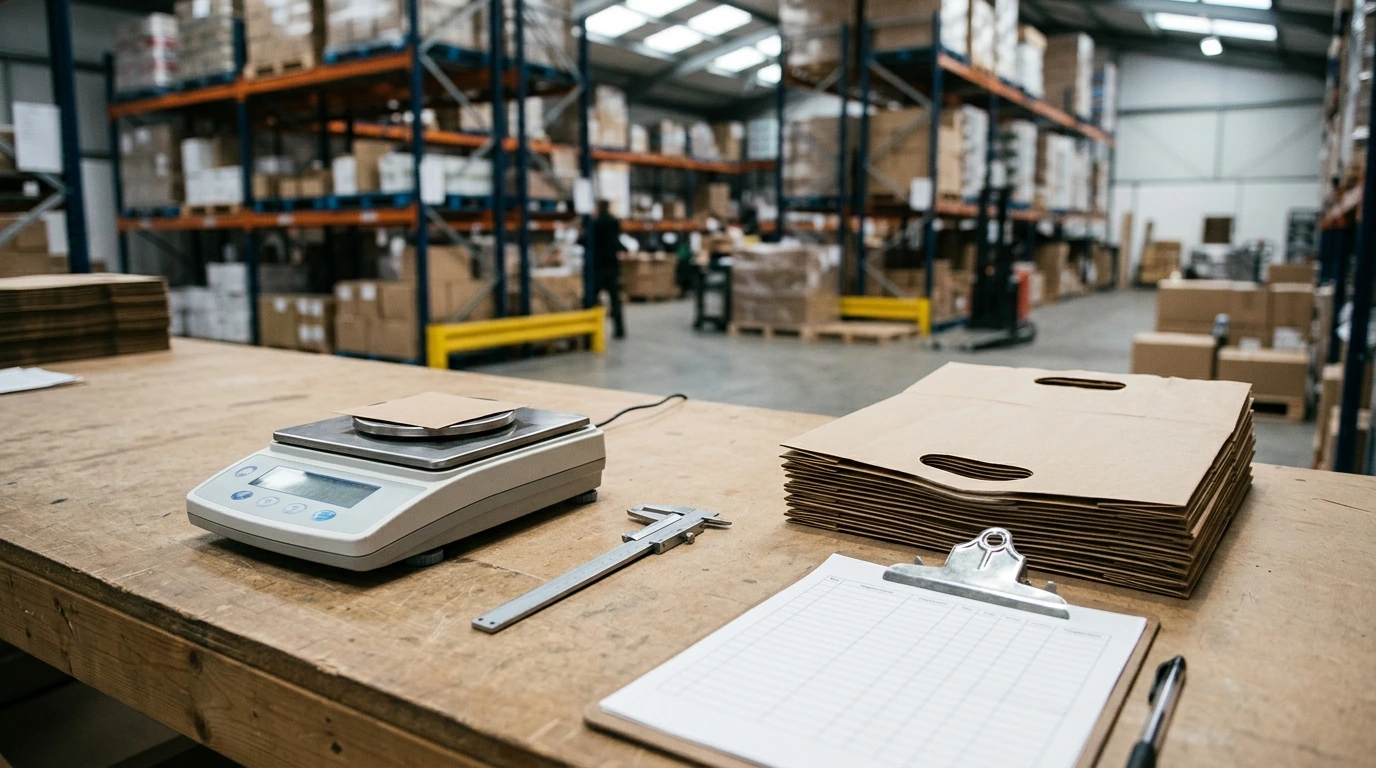
The standard measures grammage, it does not tolerate it: without an agreed tolerance there is nothing to reject at goods-in, and a quote without tolerances cannot be compared with any other. Which lines on grammage, dimensions, colour, sampling and pallet belong in a packaging specification, how many pieces you inspect and what happens when the scales show something other than the order.
How to read a packaging quote: unit price, plates, EXW, tolerance
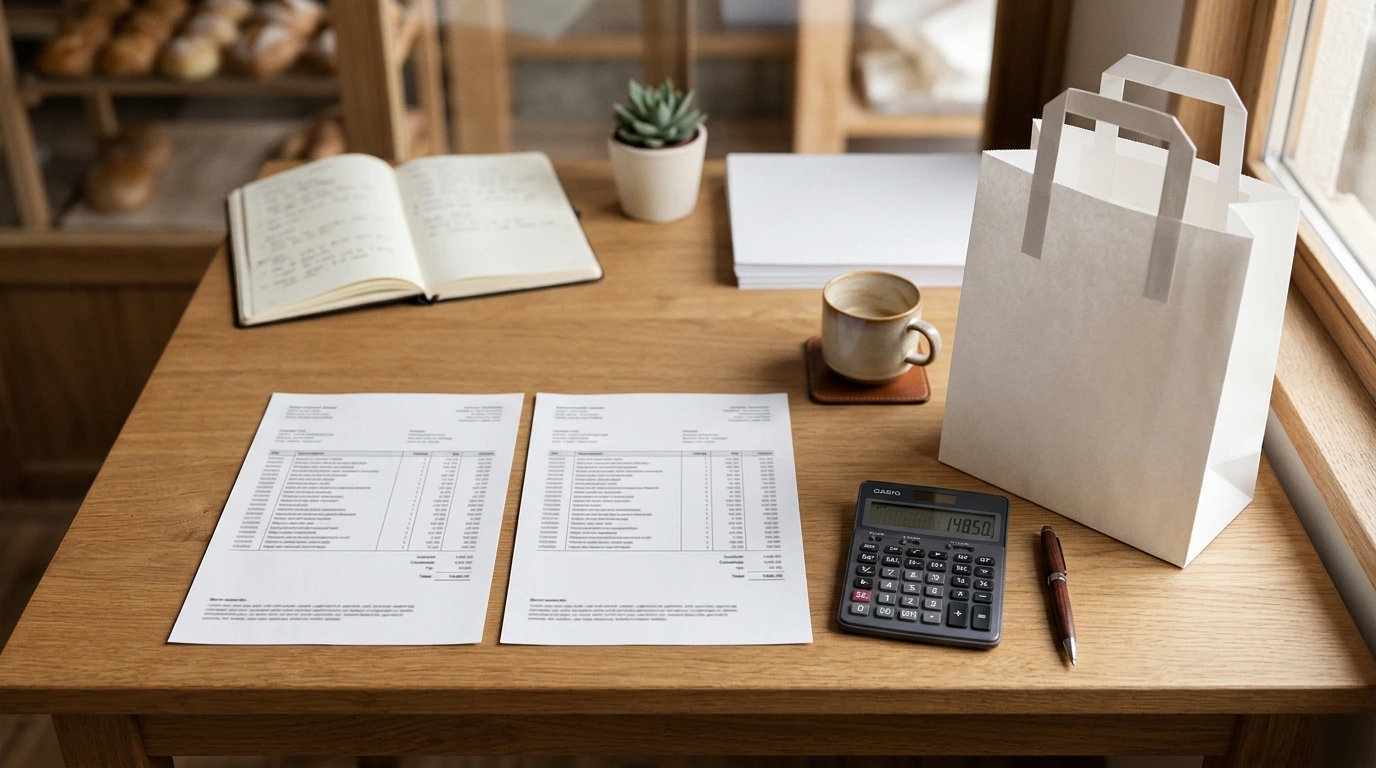
The cheapest unit price is often the dearest quote, because it leaves out the other five lines. What plates cost and who owns them after the run, why 10,000 bags ordered seldom means exactly 10,000 delivered, what an ex-works price leaves open at the border and how long a price actually holds. With a comparison table that makes two quotes readable side by side.

Supplier scorecard for packaging: which KPIs the plant reports
A scorecard without supplier data rates your own goods-in, not the supplier. OTIF, complaint rate and delivery reliability are measurable, but only when both sides use the same clock and the same specification. Which five figures a packaging manufacturer can report every month, which two it cannot, why delivery reliability counts from artwork approval and how the annual review gets by with three numbers.