Deutsch
 Français
 Türkçe
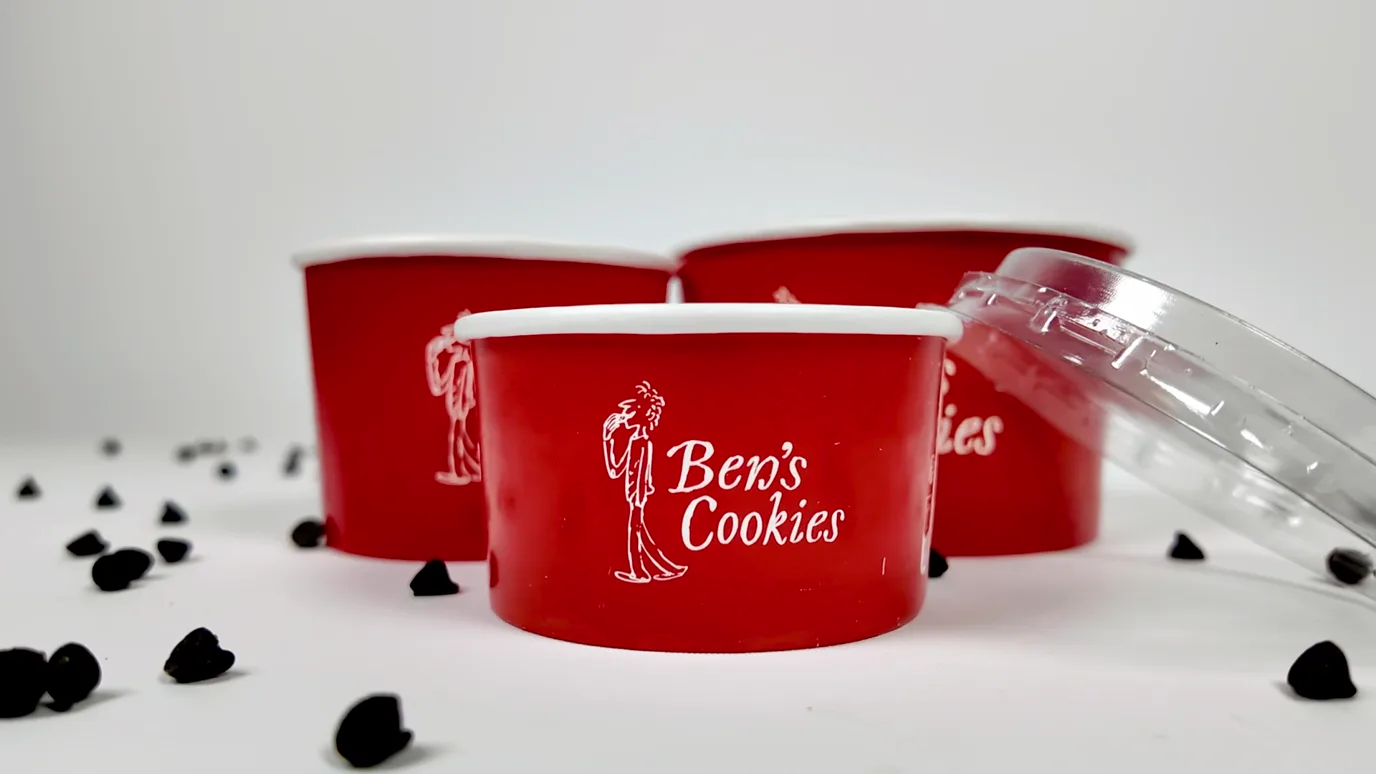
Take an ice cream maker in Devon selling through farm shops, its own website and its own parlour counter: twenty flavours, one 300 ml tub, one logo. The enquiry asks for tubs printed with the flavour name, priced per flavour. Our quote shows 10,000 tubs minimum per artwork. Twenty artworks are 200,000 tubs. The business sells 60,000 a year.
The enquiry is not wrong. It just starts from the wrong end: from the flavour that should appear on the tub, rather than from the surface it can appear on.
The flavour goes on the label; the tub carries the brand. Most ranges with many flavours end up at that sentence, and it comes with a rule: a flavour earns its own print when it sells more tubs a year than the minimum per artwork. Everything below that runs on the brand tub with a flavour label. There is a second point the labelling rules settle on their own: on prepacked food the ingredients, allergens and net quantity have to appear per flavour, so each flavour needs its own surface in any case. The only open question is which. This article takes the three routes, the rule, the food information requirements and the case of a flavour that only exists in summer.
Why do twenty flavours multiply the minimum by twenty?
Because ice cream tubs are offset printed and each artwork needs its own plate set, its own make-ready and its own run. The minimum therefore applies per artwork and per size, with us 10,000 tubs. A tub reading “Vanilla” and a tub reading “Pistachio” are two different products to the press, even if only one word and one colour panel differ. The fact that both tubs share the same board, size and logo saves no plate.
For the Devon maker that means twenty flavours in one size are twenty orders, each of 10,000, each with its own approval and its own shelf in the stockroom. At 60,000 tubs a year that is three years of stock per flavour on average, and for the small flavours that sell 800 tubs a year, twelve years. The useful question is how to manage with one to four artworks.
What are the three routes: label, sleeve or per-flavour print?
Brand tub with a flavour label, tub with a sleeve per flavour, or per-flavour print for a few large flavours. Most ranges combine the first and the third. On the first route the tub carries only the brand: logo, colour, perhaps a strapline, one artwork per size, one minimum per size. The flavour sits on a label, on the lid or the side, and the label also carries the mandatory particulars. Labels are printed by different methods and in different run lengths from tubs; a flavour selling 800 tubs a year is no problem there. Filling picks up an extra step, by hand or on a labeller, and the label has to be fit for the freezer. A standard adhesive is not made for −18 °C and can lift in the freezer; a deep-freeze adhesive does not.
The second route is the sleeve or band: a paper part wrapped around the tub that frees the whole surface for the flavour. It is printed and cut separately, carries its own minimum and its own fit per tub size, and it adds a second operation on the filling line. It earns its place when the flavour has to appear large across the surface, say in a premium line with few flavours. For twenty flavours it moves the problem rather than removing it: twenty sleeve runs instead of twenty tub runs, each with its own minimum. The third route is per-flavour print itself, and the rule decides which flavours can carry it.
What is the rule: annual volume per flavour against the minimum?
A flavour gets its own print when its annual volume in that tub size is above the minimum per artwork. Below that it runs on the brand tub with a label. For the sum you need two numbers per flavour: tubs sold in the last twelve months and the tub size they sold in. For the Devon maker the list reads: vanilla 14,000, chocolate 11,000, salted caramel 9,000, strawberry 6,500, then sixteen flavours between 300 and 2,500. Two flavours sit above 10,000, one just under, the rest well under.
The programme that follows: vanilla and chocolate printed, 10,000 tubs each, sold through in nine and eleven months respectively. Salted caramel is the borderline case: 10,000 tubs would sell through in about thirteen months if the volume holds; next year it may sell 12,000 or it may sell 7,000, and at 7,000 the run sits for seventeen months. It stays on the brand tub until two years show the same volume. Every other flavour runs on the brand tub with a label. Twenty artworks become three: two flavour prints and one brand tub. Three orders, three approvals, three shelves. The 10,000 line is ours; another manufacturer may draw it elsewhere, and then the list moves. The rule stays.
Two things belong in the sum. Size: a flavour sold in 100 ml and 300 ml has two annual volumes, not one, because 100 ml and 300 ml are two artworks. And time: a flavour print fixes the flavour for the life of the run. If the name, the recipe or the ingredients list might change within the next twelve months, the flavour belongs on a label even when the volume would justify print.
What has to go on the label when the tub is prepacked?
On prepacked food the mandatory particulars go on the pack, and most of them differ per flavour. They include the name, the ingredients list with allergens emphasised, net quantity, storage conditions, the name and address of the food business and, as a rule, the nutrition declaration, for which small-scale producers may have an exemption. The best-before date and the lot number change per batch and are coded at filling, not printed. That is the Food Information to Consumers Regulation (EU) No 1169/2011, retained in UK law. A tub in a farm shop freezer is prepacked. It needs those particulars, and they differ from vanilla to pistachio in almost every line. This is where the labelling rules have already made the decision: every flavour needs its own surface anyway. With per-flavour print that surface is the tub itself, ingredients list inside the artwork. With the brand tub it is the label, and the label does two jobs at once: flavour and mandatory particulars.
Counter sale is different. A tub filled in the parlour in front of the customer is not prepacked; the allergen information has to be available, on a board or in a folder, and need not be on the tub. Since October 2021 there is a third case in the UK: food prepacked for direct sale on the same premises, which has to carry the name and a full ingredients list with allergens emphasised. A business that does all three, counter, own-shop freezer and farm shop, needs the brand tub unlabelled for the counter and labelled for the freezers, and the two freezer labels carry different particulars. For the label, a look at the sizes helps: our 250 ml tub is 48 mm high at a top diameter of 97 mm, the 300 ml tub 82 mm high at 90 mm. On the flat 250 the lid is the natural place for the label; on the tall 300, the side. In the brand tub artwork, keep the label zone clear so the label never sits over the print. Which font size the particulars need and which national additions apply is a question for your food law adviser; this article is not legal advice.
What do we print for brands with many flavours?
Brand tubs in several sizes, polypropylene (PP) labels alongside and per-flavour print only where the volume carries it. Brand tubs and PP labels in one brand design are also how the Ben’s Cookies programme, whose packaging we make, is built: eight product types, among them ice cream cups from 100 to 400 ml and PP labels. We supply the labels; format and minimum go on the quote, depending on tub size and placement. How the eight product types are held together under one brand design is in the Ben’s Cookies case study.
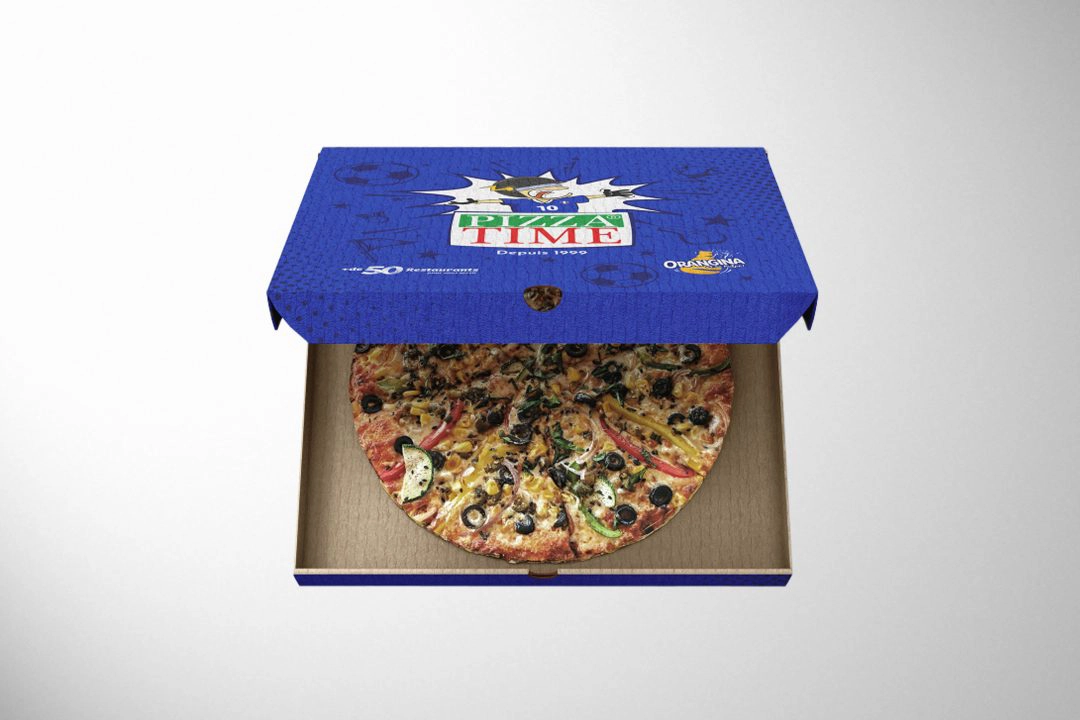
The counterpart is Pizza Time: three fixed box sizes instead of one-off dimensions, one brand design, few cutting tools. There the size changes instead of the flavour, and the answer is the same: what does not change is printed; what changes stays out of the artwork. For orientation, the key figures of our tubs: 100 to 400 ml in five sizes, offset printed in CMYK and Pantone, “Custom printed or unprinted production available”, minimum 10,000 per size and artwork, lead time around 15 to 20 working days after artwork approval; the dimensions are on our page for custom printed ice cream cups, which is where the 48 and 82 mm in this article come from. Why the number of scoops is not an order size and which capacity belongs to which portion is in our article Printed ice cream cups: a scoop is not an order size.
What happens when the flavour changes: season, limited edition, launch?
Then the label wins without a sum. A summer flavour that runs from May to September, a limited edition for Christmas, a launch nobody knows will stay: none of them earns an artwork, because none of them stays the same for twelve months. They run on the brand tub, and their label is printed in the run the season needs. A maker with twenty flavours rarely has twenty that run all year; usually it is something like a dozen core flavours and a handful that come and go, and that handful is the strongest argument for the brand tub.
Per-flavour print carries a change risk of its own. If the vanilla ingredients list changes because the vanilla pod supplier changes, the printed tub with the old list is no longer right. With per-flavour print there may be 6,000 tubs in stock that an over-label has to rescue. With the brand tub, one label artwork changes. The decision for per-flavour print therefore includes the volume and how settled the recipe is. Five questions to put to the manufacturer before you order:
- Does the minimum apply per artwork and per size, and what is it for a tub with the flavour printed on?
- Which label formats fit which tub size, lid or side, and what minimum applies per label artwork?
- Which adhesive is specified for the freezer, and is there a labelled sample for a test at −18 °C?
- Can a flavour’s mandatory particulars fit inside the tub artwork at the required font size, with space left for the brand?
- What would a per-flavour sleeve be as a separate line on the quote, with its minimum and its fit per tub size?
For the Devon maker twenty artworks would become three: vanilla and chocolate printed, eighteen flavours on the 300 ml brand tub with a side label, and the same brand tub unlabelled for the counter. The quote changes shape at one point: once we know the annual volume per flavour and size. So send us the flavour list with those volumes, the tub sizes you want, whether the tubs are sold prepacked or filled at the counter, and the logo as a vector file with its Pantone reference; you get, per flavour, print or label, per line the minimum and lead time, per size the label format.
In short
- The minimum for printed ice cream tubs at Bas Packaging applies per artwork and per size, 10,000 pieces; a tub with the flavour printed on is its own artwork.
- A flavour earns its own print when its annual volume in that tub size is above the minimum; all others run on the brand tub with a flavour label.
- On prepacked ice cream the food information rules require, among other particulars, name, ingredients with allergens, net quantity, storage and food business on the pack; at the counter the allergen information, not the full particulars, has to be available.
- A sleeve per flavour is printed and cut separately, carries its own minimum and adds a step on the filling line.
- A standard adhesive is not made for −18 °C and can lift in the freezer; specify a deep-freeze adhesive for labels on frozen goods.
- The tubs come in 100, 200, 250, 300 and 400 ml, offset printed in CMYK and Pantone, lead time around 15 to 20 working days after artwork approval; the 250 ml tub is 48 mm high, the 300 ml tub 82 mm.
Frequently Asked Questions
- Does the minimum for printed ice cream tubs apply per flavour?
- Per artwork and per size. With us that is 10,000 tubs, and a tub with the flavour printed on it is its own artwork. Twenty flavours in one size would be twenty orders of 10,000 each. If the tub carries only the brand and the flavour sits on a label, it is one order per size.
- Label or per-flavour print: how do I decide?
- By annual volume per flavour. If a flavour sells more tubs a year than the minimum per artwork, it earns its own print; with us the line is 10,000 per size. Every flavour below that runs on the brand tub with a flavour label. Depending on the volumes, that can leave a few flavours printed and the rest on labels.
- What has to go on a prepacked ice cream tub per flavour?
- Under the food information rules a prepacked food carries the mandatory particulars on the pack, which include the name, ingredients list with allergens emphasised, net quantity, storage conditions, the name and address of the food business and, as a rule, the nutrition declaration. Those differ from flavour to flavour, so each flavour needs its own surface anyway. A tub filled at the counter in front of the customer is not prepacked; there the allergen information has to be available, not printed on the tub. This is not legal advice.
- What about a sleeve or band per flavour?
- A sleeve or band is printed and cut separately, carries its own minimum and has to be fitted on the filling line. It earns its place when the flavour has to appear large across the surface and a label looks too small. Ask for it as a separate line on the quote, with minimum and fit per tub size.
- What do I send the manufacturer to get a flavour programme?
- The flavour list with annual volume per flavour and size, whether the tubs are sold prepacked or filled at the counter, the logo as a vector file with its Pantone reference and the tub sizes you want. From that comes a table: which flavour gets its own print, which goes on a label, minimum and lead time per line, label format per tub size.
Related Articles
Bagged in Advance: What Has to Go on the Label
Whether your bag needs a full ingredients list is not decided by what is inside it. It is decided by whether the item was bagged before the customer asked for it.

Framework agreement for packaging: call-offs, stock, leftovers
A framework agreement does not lower the minimum run; it spreads it over twelve months. Whoever does not call off still buys in the end, and whoever leaves the leftover unregulated pays for the next menu change with a pallet. What the agreement settles and what only the call-off does, why the supplier prints the annual volume in one run, who stores and bears the risk, how many call-offs a chain needs and which lead time the contract actually means.
Printed ice cream cups: a scoop is not an order size
Ice cream is sold in scoops, but cups are built in millilitres. Order “cups for two scoops” and you are ordering the number on your scoop without saying it. How to convert scoops into millilitres, why 250 and 300 ml are two completely different cups, what the lid does to the bin, and when the order has to leave so the cups are on the counter in March.