Deutsch
 Français
 Türkçe
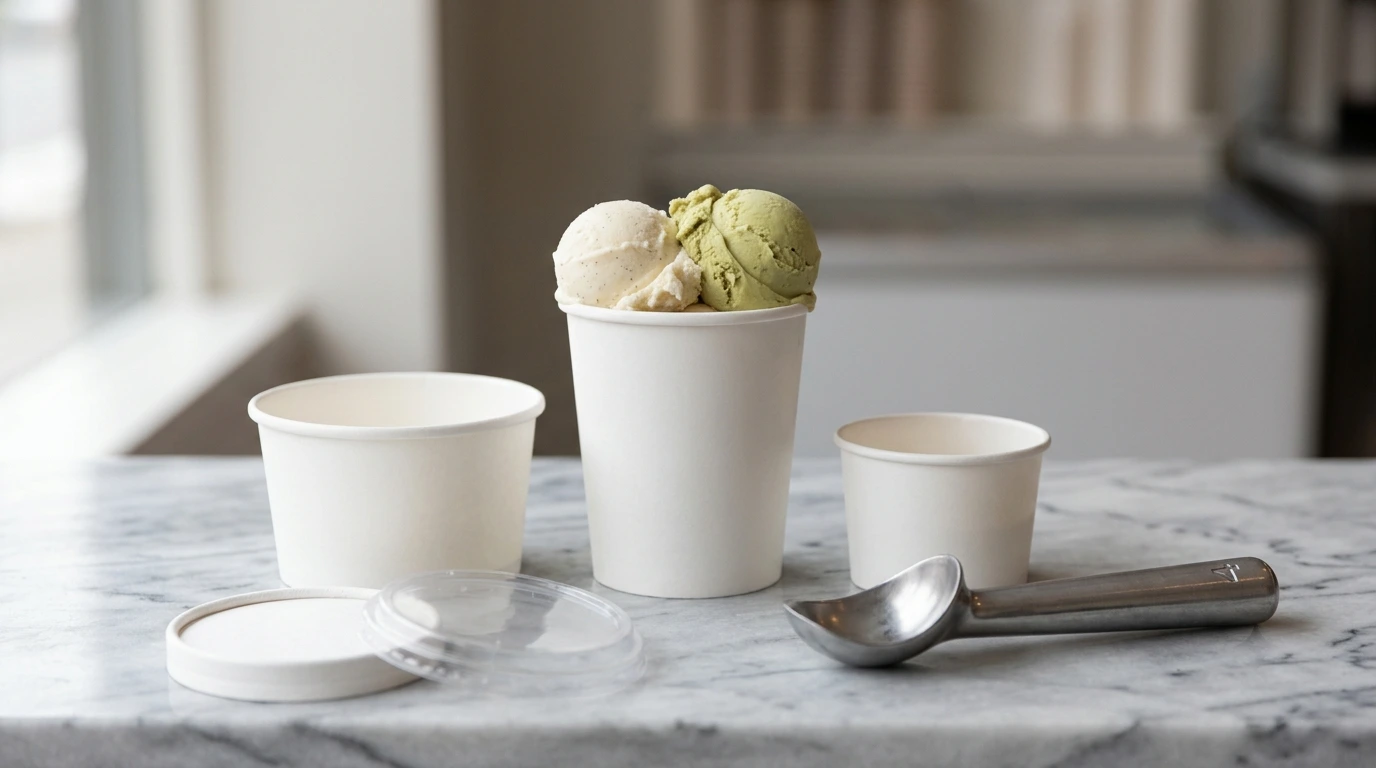
A Tuesday in January. The gelato bar in Brighton is closed until March, and last year’s order sheet is lying on the counter: “ice cream cups for two scoops, 20,000”. This time the logo goes on. The manufacturer’s first question is not about the logo. It is about the number on her scoop.
Anyone who has printed ice cream cups made orders in millilitres: 100, 200, 250, 300 or 400, offset printed, from 10,000 pieces per size and design. The scoop does not appear anywhere in that list, although every parlour thinks in scoops and sells in scoops. This guide explains how to get from scoop to millilitre, why 250 and 300 ml are two completely different cups, what the lid does to the bin, what a coated paper cup triggers once you sell into Germany, and when the order has to leave so the cups are there for the start of the season. Written from the production floor, for the owner behind the counter.
Why “for two scoops” is not an order specification
Because a scoop is not a unit: it depends on the scoop tool, the flavour and the hand that portions. Two scoops in Brighton are not two scoops in Belfast. The cup, on the other hand, has a volume that is fixed to the millimetre in production. To bring the two together, the scoop has to be translated into millilitres first.
Then there is the shape of ice cream in a cup. Scoops do not lie flat on the base; they stack, and they rise above the rim. A spoon needs room, cream needs more, a topping more still. Two scoops of 50 millilitres each are 100 millilitres of ice cream, but not a 100-millilitre cup. That is the sum that hardly ever appears in an order. It is missing.
In our enquiries roughly every second one says “for two scoops” or “for three scoops” and gives no millilitres at all. We ask for the scoop number, and about half have to go and look. No blame in that; the number is small, on the handle, and nobody checks it during service. But it is the only figure that pins down a cup size without guessing.
What number is on your scoop?
The number on a portioning scoop is the number of scoops per litre: a number 20 gives 50 millilitres per scoop. A number 16 gives around 62 millilitres, a number 24 around 42. The makers of these tools publish tables with bowl diameter, scoops per litre and scoop volume; the common bowls sit between roughly 38 and 49 millimetres.
With that number the order becomes arithmetic. A cup for two scoops from a number 20 has to take 100 millilitres of ice cream plus the height of the scoops above the rim plus the spoon: in practice that is the 200 ml cup, not the 100. Three scoops from a number 20 are 150 millilitres of ice cream and land in the 250 or the 300, depending on cream. The 100 ml cup is the tasting and children’s cup for one scoop. The 400 is for sundaes, sharing portions and anything built with fruit and cream.
Two caveats belong here. Sorbet and fruit ice pack denser than airy dairy ice cream, so the same scoop number does not give the same height in the cup. And in a July rush the scoop comes out larger than in January at a quiet counter. Which is why a sample settles it in the end: we send two sizes, you portion with your own tool, and the question is answered in five minutes.
250 or 300 millilitres: low or tall?
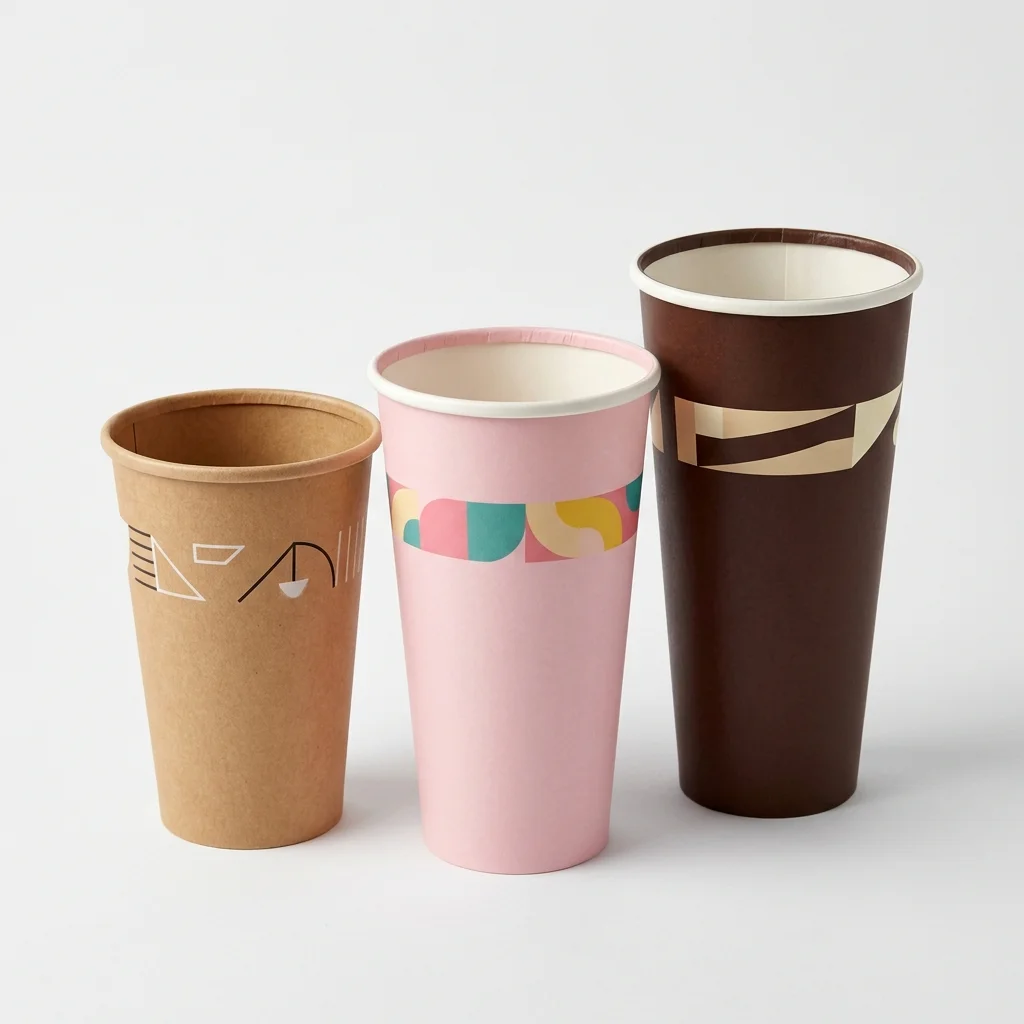
Near-identical capacity, two cups: 250 ml is low (97 mm top, 48 mm high), 300 ml is tall (90 mm top, 82 mm high). Look only at the number and you order a shape by accident. Look at the shape and you order a use.
The low cup carries the scoops side by side. That is the look of the classic sundae cup, cream on top, a spoon that does not vanish into the depths. It is the cup for the counter and the bench outside the shop. The tall cup carries the scoops one above the other. It takes a lid, does not tip over so easily in a bag, and leaves frozen yoghurt with fruit and sauce room to grow upwards. It is the cup for takeaway and for delivery.
The full range on our datasheet reads: 100 ml at 85 mm across the top, 73 mm at the base and 44 mm high; 200 ml at 90, 75 and 65 mm; 250 ml at 97, 80 and 48 mm; 300 ml at 90, 66 and 82 mm; 400 ml at 115, 100 and 70 mm. Two things follow. The 200 and the 300 share the same 90 mm top diameter, so they share a lid. And the 100 is wider than it is tall: a small, low tasting cup, not a miniature.
How many sizes a parlour needs is decided by the minimum, not by the menu. Each size starts at 10,000 pieces per design; three sizes are three pallets. Start with two, one for the single portion and one for two to three scoops, and you get through almost any season. The datasheet describes the cups as designed for efficient nesting, storage, counter service and takeaway, and nesting is why 10,000 cups take up far less room than 10,000 bags: they sit inside each other.
Paper lid or plastic lid: what the lid does to the bin
The lid decides part of the disposal, not only the cup. The datasheet for the printed cups carries two lines that belong together: “Compatible paper and plastic lid options available according to cup size and product requirements” and “Paper-based construction suitable for recycling; recyclability depends on barrier coating, food contamination, lid material and local recycling systems”. The second line says in one sentence what your customer will meet at the bin.
A paperboard ice cream cup has a barrier inside, or the base would soak through before the second scoop is in. The datasheet calls it a moisture-resistant inner barrier according to frozen dessert and food-contact requirements. Whether that barrier is a plastic layer or a water-based dispersion is the most important question in the whole order, and it rarely appears in the enquiry. In most UK councils and across the EU a coated cup counts as a composite and goes with mixed packaging rather than paper. The lid is disposed of separately; a paper lid can go with paper where the marking allows it, a plastic lid cannot.
For the order that means: if you need no lid because the ice cream is eaten on the bench outside, order none. If you deliver through Deliveroo or Uber Eats, you need one, and then the paper lid is the choice that does not make the cup heavier than it already is. What a plastic lid on a paper cup triggers in Germany we described in the guide on how the coating decides the reuse rule: the lid counts too.
What a coated paper cup triggers once you sell into Germany
Three things: the reuse offer obligation since 1 January 2023, the levy into the single-use plastic fund since 2024, and from 1 January 2030 a ban on in-house consumption. All three hang on the same property: a paper cup with a plastic coating counts as single-use plastic.
For a British or Irish brand with a site in Germany this is the part of the order that home rules do not prepare you for. The reuse obligation hits every parlour that hands out takeaway ice cream in a coated cup: it has to offer a reusable alternative at no worse price. Businesses with at most five staff and at most 80 square metres of sales area are exempt and must fill customers’ own containers instead. The wafer cone is not packaging and triggers nothing, which explains why many German parlours have pushed the cone even harder since 2023.
The single-use plastic fund files the ice cream cup as a food container, not a beverage cup. The levy is calculated on the weight of the whole cup, not the thin plastic layer inside it, and the rate for food containers is well below the one for drinks cups. Buy through a German wholesaler and the reporting is not yours; import directly and it is. And from 1 January 2030 the EU packaging regulation bans single-use plastic packaging for consumption on the premises in hospitality, on the terrace as much as indoors. For a parlour with tables that means a cup with more than 5 per cent plastic is no longer an option there, while for takeaway it remains one.
That is the honest side of this order. A printed paperboard cup is a good takeaway cup, and for eating at the table from 2030 only with a barrier below the plastic limit. If you need both, write it into the enquiry now rather than in 2029. In the UK none of the three rules applies, but packaging EPR does: with your logo on the cup you are the brand owner who reports it once your business passes the turnover and tonnage thresholds. This guide describes practice from the manufacturer’s side and is not legal advice for your business.
When does the order have to leave so the cups are there in March?
Count back from the season start: around 15 to 20 working days of production after artwork approval, the approval itself before that, shipping after it. If you open in March, approve the artwork in January. Every correction round on the file costs a week, and the file is the one part only you can speed up.
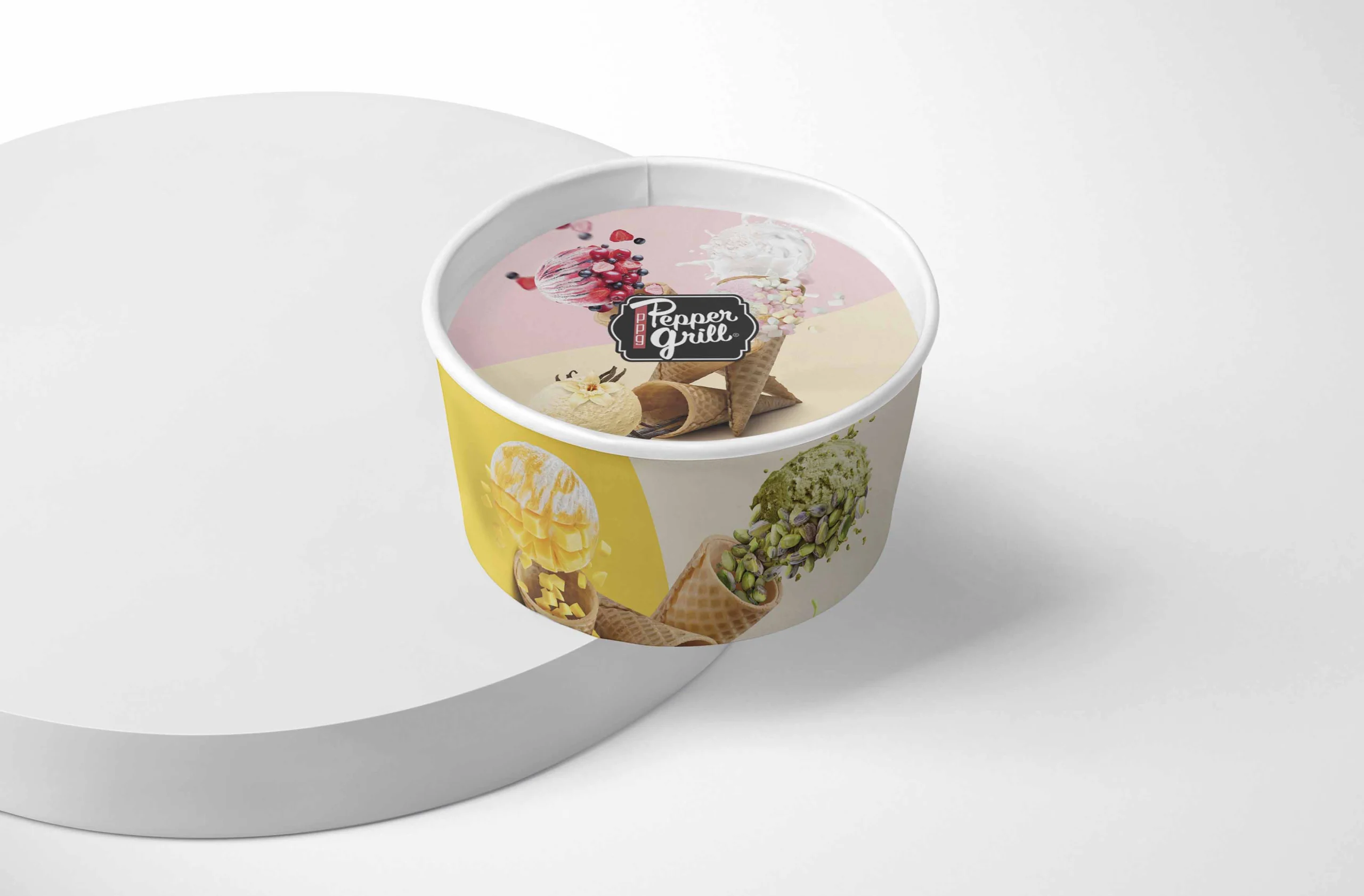
Ice cream cups are offset printed, in CMYK and Pantone. Unlike bakery bags in flexo, photographs, gradients and fine type are possible; the real question is whether the design sits on white board or on natural kraft board, because on kraft the light tones go darker. If you run both, submit the design once and have it proofed on both boards.
Quantity follows the season, not the catalogue. Seven months of season at 10,000 cups of one size is just under 50 a day; for a seafront parlour that is little, for a farmers’ market stall a lot. Two sizes are 20,000 cups, nested on a single pallet. How to plan a design with a date or a seasonal motif backwards is in the guide to planning seasonal packaging backwards; the ice cream cup follows the same sum with one difference: the season starts when the weather says so, not when the calendar does.
Seven details for the enquiry
These seven details turn “cups for two scoops” into an order that fits first time:
- The number on your scoop and the scoops per portion, split by flavour if you use more than one scoop.
- The capacities you want from the range of 100, 200, 250, 300 and 400 millilitres, or the portions you need the cup for.
- Low or tall: counter and bench outside, or takeaway and delivery.
- Lid or no lid, and if so: paper or plastic.
- White board or natural kraft board, and whether the design contains photographs or gradients.
- Whether the cup is also meant for frozen yoghurt or sorbet, so the inner barrier matches.
- Quantity per size and design, and the date the cups must be in the shop.
The gelato bar in Brighton ordered two sizes in the end: the 200 for two scoops from a number 20, and the 300 for frozen yoghurt to take away, with paper lids for delivery only. Last year’s sheet is still on the counter. Where it said “two scoops” there is now a number. The page for custom printed ice cream cups shows the five sizes with every dimension; the scoop you should read them with is in your counter.
In short
- Printed ice cream cups come in 100, 200, 250, 300 and 400 millilitres, offset printed, from 10,000 pieces per size and design, with around 15 to 20 working days of production after artwork approval.
- A scoop is not a unit; the number on a portioning scoop is the number of scoops per litre, and a number 20 gives 50 millilitres per scoop.
- 250 ml (97 mm top, 48 mm high) is a low cup for scoops side by side; 300 ml (90 mm top, 82 mm high) is a tall cup for stacked scoops and a lid.
- In Germany a plastic-coated paper cup counts as single-use plastic: reuse offer obligation since 1 January 2023, plastic fund levy since 2024, and from 1 January 2030 no longer allowed for consumption on the premises; in the UK packaging EPR applies to the brand owner instead.
- A coated cup goes with mixed packaging, the lid is disposed of separately; recyclability depends on barrier, food residue, lid material and the local collection.
Frequently Asked Questions
- Which cup size do I need for two scoops of ice cream?
- That depends on your scoop. Two scoops from a number 20 scoop are 100 millilitres of ice cream, and because the scoops sit on top of each other and rise above the rim you usually end up with the 200 ml cup. With a larger scoop or with cream it becomes the 250 ml cup. The only sure answer is a sample tried with your own scoop.
- How many cup sizes does an ice cream parlour really need?
- In practice two, occasionally three: one for the single portion, one for two to three scoops, and if needed a large one for sundaes. Every size has its own minimum of 10,000 pieces per design, so each extra size costs storage space as well as money.
- Does a paperboard ice cream cup go in the paper recycling?
- The coated cup generally does not; it is a paper and plastic composite and in most UK and EU collections belongs with mixed packaging, not paper. The lid is disposed of separately, and a paper lid can go with paper where the marking allows it. Our datasheet puts it plainly: recyclability depends on the barrier coating, food contamination, lid material and the local recycling system.
- Do I need a reusable alternative to the paper cup?
- In Germany, yes, if you serve takeaway ice cream in a plastic-coated paper cup, because that counts as single-use plastic; only businesses with at most five staff and 80 square metres are exempt and must fill customers’ own containers instead. In the UK there is no such rule, but packaging EPR treats you as the brand owner of a printed cup once you pass the thresholds.
- From what quantity does custom printing make sense, and how long does it take?
- Production starts at 10,000 pieces per size and design and takes around 15 to 20 working days after artwork approval; shipping and customs come on top. For a parlour with a seven-month season, 10,000 cups of one size is just under 50 a day, a realistic volume. If you open in March, approve the artwork in January.
- Can the same cup take ice cream and frozen yoghurt?
- Yes, if the inner barrier is specified for both and the height suits the toppings. Frozen yoghurt is usually served tall, with fruit and sauce; scooped ice cream sits better in a low, wide cup. Name both uses in the enquiry and the barrier and shape are chosen accordingly.
Related Articles

Are Compostable Cups Actually Compostable in the UK?
“Compostable” on a cup is a conditional promise: it needs an industrial facility and a local route that accepts it. Here is what EN 13432 actually certifies, why UK council bins differ, and a decision path for choosing a cup lining honestly.
Custom paper cups for a café chain: lids and MOQ per size
The minimum order quantity applies per size, not per programme: three sizes are three orders. Why a double-wall 12 oz cup takes a different lid from a single-wall one, which size should stay unprinted, how a logo is laid out across three sizes, what pEPR asks of the brand owner and what to send us so that a spreadsheet becomes a programme.
In Germany, Your Coating Decides the Reuse Rule
Whether you have to offer a reusable alternative in Germany is not settled by your menu or your floor area alone. It is settled by two lines in your packaging order: the barrier and the lid.
Sauce Cup Lids: Which Lid Fits Which Pot?
A lid has no idea how many millilitres your pot holds. All it sees is the rim. There are four standard capacities but only three rim diameters, and knowing that takes a line off your order.