Deutsch
 Français
 Türkçe
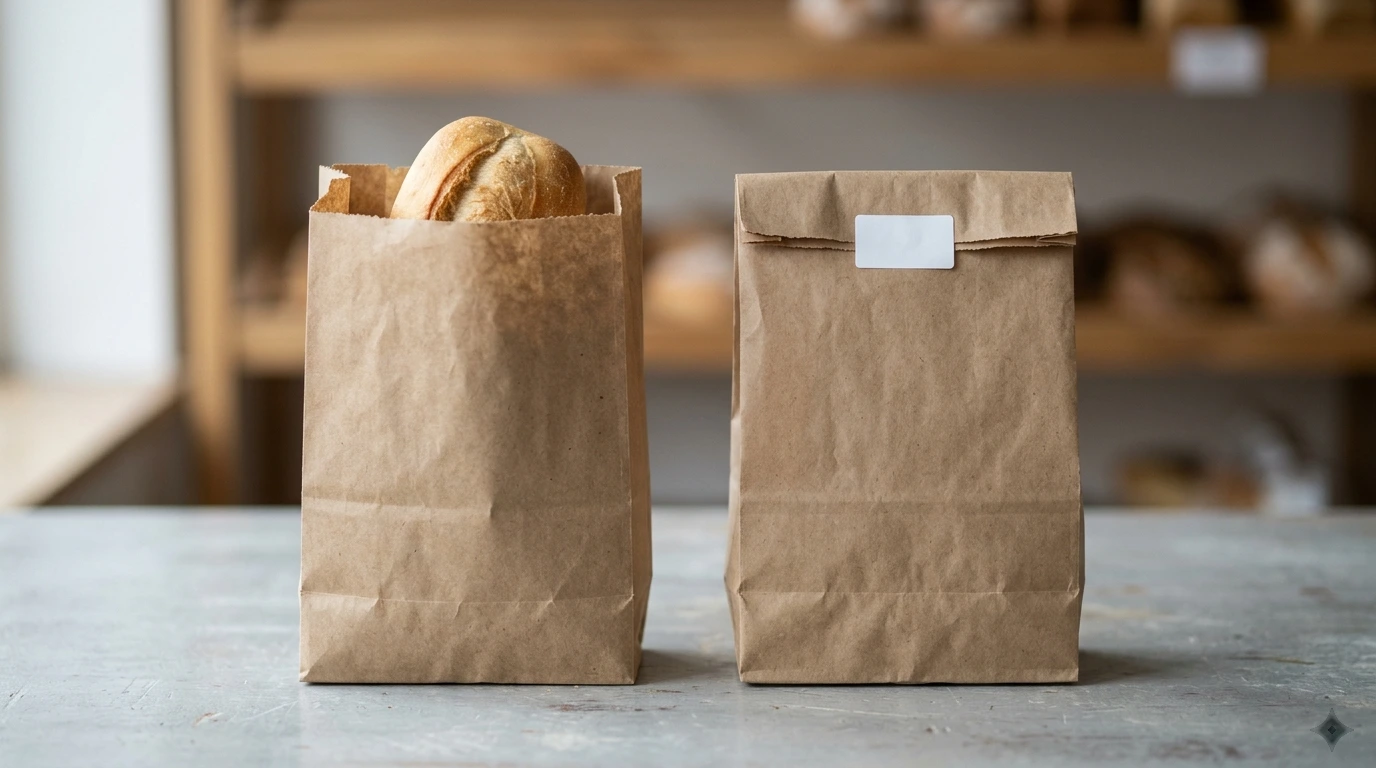
Short answer: whether your bag needs a full ingredients list is not decided by what is inside it. It is decided by when the item went into the bag. Bagged after the customer asked for it, the rules are light. Bagged before, and ready on a shelf, the rules are not.
Half past six on a Friday. The first trays are out, and rolls go into bags now so the queue moves later. Some go into a basket behind the counter, some onto the shelf by the door where customers help themselves. Same product, same bag, two different labelling regimes. Almost nobody spots it, because there is nothing about the bag that shows it.
Plenty has been written about allergen rules in general. What almost nobody writes down is that the answer sits in the construction of the packaging and therefore in the purchase order. That is what this piece is about, from a manufacturer's side of the table and without pretending to be legal advice.
What counts as prepacked for direct sale?
Food is prepacked for direct sale when it is packaged where it is sold and is ready for the customer before being ordered. The term is usually shortened to PPDS, and it also covers food ready for presentation to the consumer before it is selected.
That last clause carries the whole weight. Before it is ordered. A sandwich made and wrapped when the customer asks for it is not PPDS. The same sandwich made at eight, wrapped, and put on a chiller shelf at nine is.
Since 1 October 2021, under the rules commonly known as Natasha's Law, PPDS food has had to carry the name of the food and a full ingredients list, with the fourteen regulated allergens emphasised within that list. Not on a folder, not on a wall notice. On the pack.
Anyone comparing markets should note something counter-intuitive here. Several European regimes treat the pack-in-advance category more leniently and allow the information to sit elsewhere. Britain went the other way and tightened precisely that category, because it was the gap the law was written to close. If you sell in both places, the same bag can sit under two different expectations.
Where the line actually sits
Strip away the terminology and the test is mechanical. Was the food in the packaging before the customer chose it, or did it go in afterwards?
- Bagged on request, in front of the customer: not PPDS. Allergen information still has to be available, but it can be given another way.
- Bagged in advance, ready to pick up: PPDS. Name of the food and full ingredients on the pack, allergens emphasised.
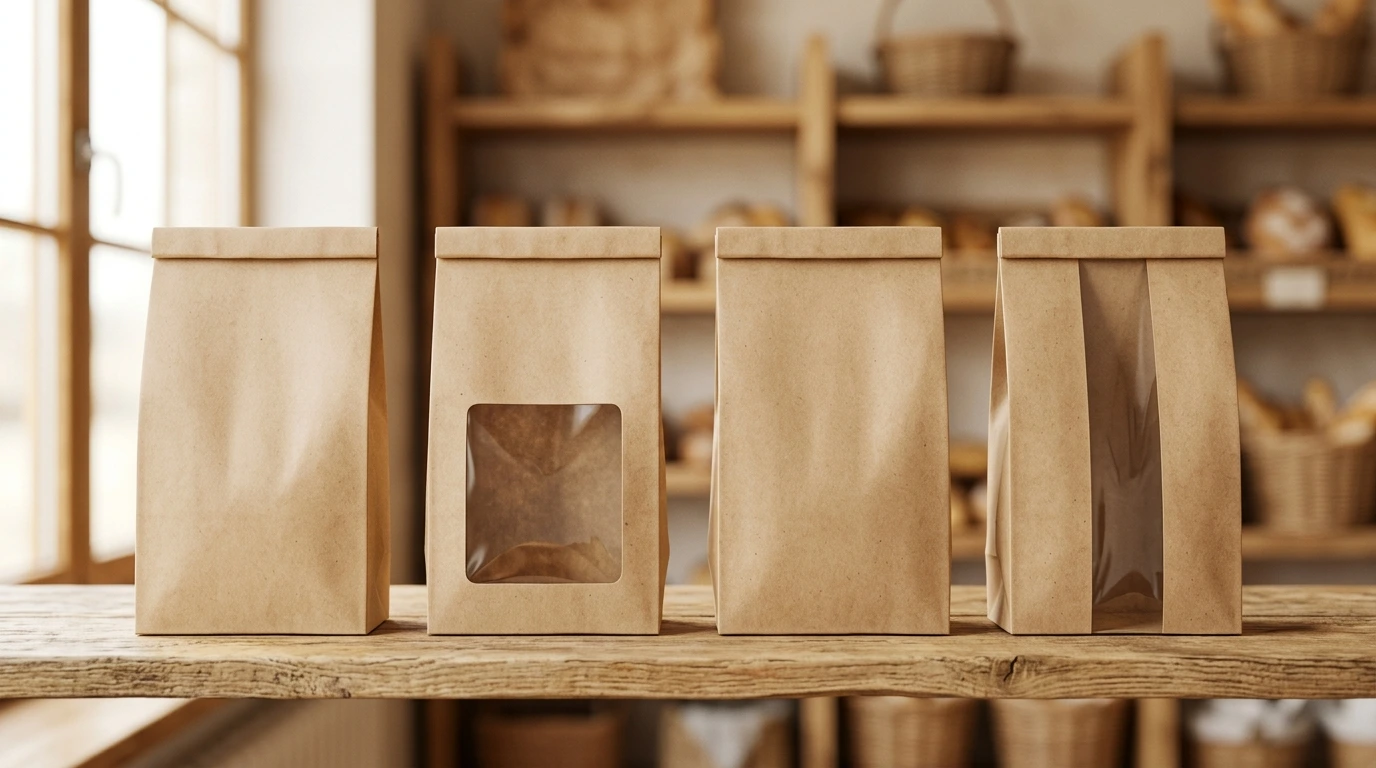
On natural kraft bakery bags the small standard sizes are described as open on both sides. That construction exists for counter service: the server picks the item up, drops it in and hands it over. It is the shape of a transaction, not just a shape of bag.
Which puts the classification in the hands of the person on the counter rather than the person who placed the order. Someone who bags ten rolls during a quiet spell so the rush runs faster has just created PPDS food, without a decision being made anywhere. That belongs in training as much as in purchasing, because the rule lives in a habit rather than in a specification.
What has to be on a PPDS label
Two things, and the second one is bigger than it sounds. The name of the food, and a full ingredients list with the fourteen regulated allergens emphasised within it.
Emphasis means visually distinct: bold, a different typeface, a background, something that separates the allergen from the words around it. Listing it and hoping the customer reads carefully does not meet the point of the rule.
Naming has to be specific in the same way. The allergen is named as what it is rather than by its family, so an ingredient list says the actual nut or the actual cereal rather than a broad category. It reads like a small thing and it is one of the more common corrections on a first artwork round.
There is a practical relief worth knowing for daily bakery lines. Bakers' and confectioners' wares that are normally consumed within twenty-four hours of being made are not required to carry a date mark. That removes one field from a label that is already crowded.
Why the self-service shelf is the trigger
A shelf by the door takes pressure off the counter, shortens the queue and sells on its own. It is a trading decision, made for trading reasons, and it quietly moves your product into the labelled category.
Businesses that want the shelf have three honest routes. Keep bagging to order and skip the shelf. Label properly. Or narrow what goes on the shelf to a handful of lines that run every day and are worth a printed or labelled bag.
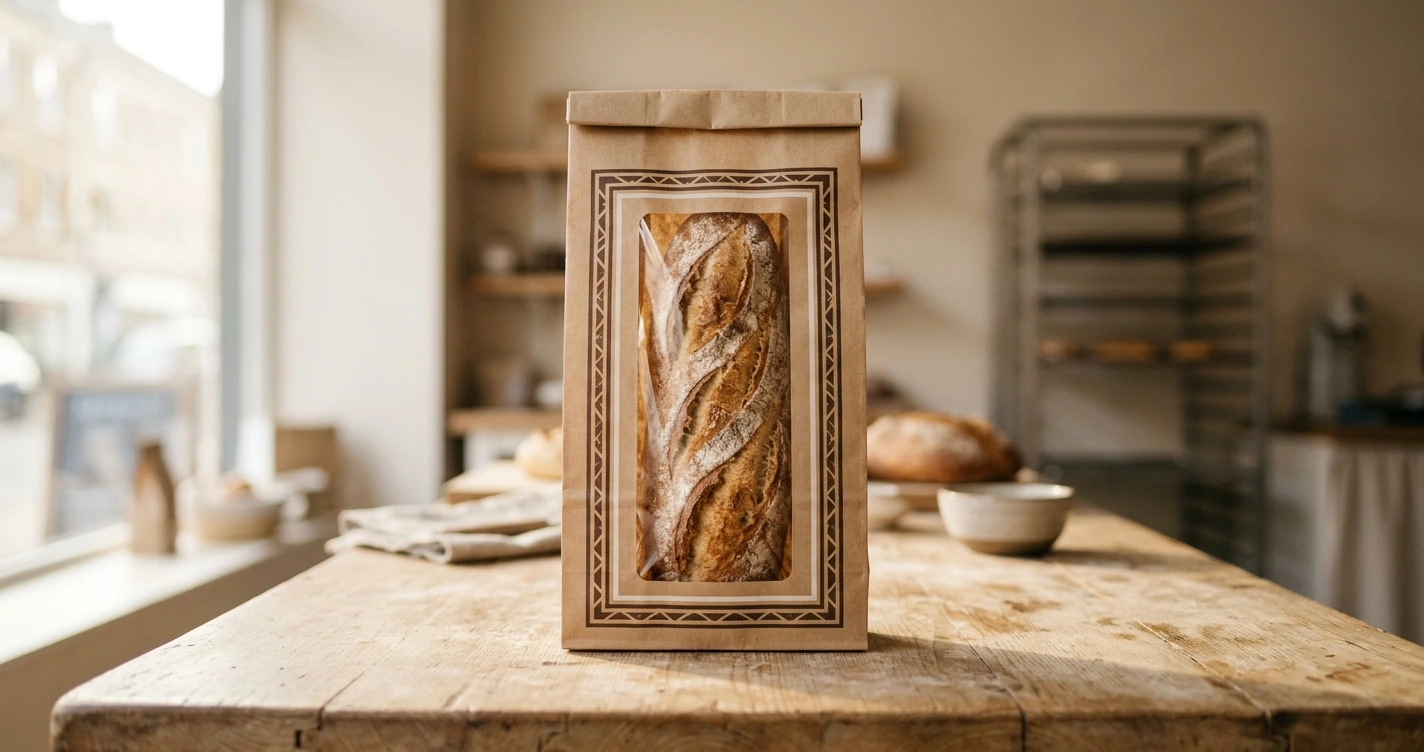
The third is what experienced operators choose. The shelf then holds four or five items rather than thirty. Flat window bakery bags are built for exactly that job: the customer sees the product through the window, and the printed panel beside it carries what has to be stated.
The common mistake here is trying to serve both situations with one bag. You end up either with a counter bag that carries too little on the shelf, or a fully printed bag that costs money at the counter where none of that print is needed. Two constructions side by side is almost always calmer than one compromise that fits neither place properly.
Print or label?
Both are allowed, and the choice is a cost question with a catch. Print what does not change. Label what does.
The catch sits in what actually changes. Your logo does not. Your address rarely does. Your ingredients list changes the moment a supplier switches or you adjust a recipe, and at that point a printed pallet is a problem you live with for a year.
The split that holds up in practice looks like this:
- Printed on the bag: logo, address, general wording, and if useful a clear area left for a label.
- On the label: name of the food, ingredients with allergens emphasised, dates, quantities.
There is a timing side to this that rarely gets counted. A printed pallet ties you to the recipe that was current on the day it went to press. A label can change next week. If a recipe is under review, or a supplier change is on the horizon, hold the variable information back from the print file even though the unit rate looks better with everything on it.
For lines that genuinely stay the same, the sum flips. A fixed-recipe classic selling in steady volume is the case where printing it all makes sense. On block bottom paper bags that is the typical use: standard sizes are stepped by fill weight from 100 g to 2,000 g, and anyone filling flour, granola or biscuits to a settled recipe prints the ingredients with the artwork.
The font size that breaks layouts
Mandatory information carries a minimum type size of 1.2 mm, measured on the x-height of the lower-case letters. It sounds like a formality and it is the most common reason a finished layout goes back for another round.
The reason is arithmetic. A full ingredients list for a filled roll needs more lines than most designs allow for, and at 1.2 mm you cannot buy space by shrinking the type. Either the panel grows or the artwork gives way.
So the text volume belongs at the start of the design rather than the end. Count the longest ingredients list in your range, not the shortest, and size the panel to that. Artwork that fits the plain item and bursts on the nut pastry gets made twice.
Window bags add a second constraint, because the window and the printed area share one front panel. The larger the window, the less room for text that has to be there. That trade is best settled before the tooling is ordered rather than after.
You can test it without a printer. Set your longest ingredients list at the intended size, print the page on an ordinary office printer and lay it against an empty bag in the format you want. If it does not fit there, it will not fit in production either, and you have found that out before ordering rather than after the pallet arrives.
What to ask your supplier
Four questions move this forward and fit in one message:
- Is this bag construction open at the top, or is it designed to be closed?
- How large is the genuinely printable area in my size, and how does a window change it?
- Will my longest ingredients list fit that area at 1.2 mm?
- Is the same size available with a clear area for labels, so I am not printing the parts that change?
With those four answers the labelling question gets solved in the layout instead of later with stickers. One note on framing, because the above reads more definitive than it is meant to: this describes practice from a manufacturer's perspective and does not replace legal advice for your business. What applies to your range depends on recipe, sales format and how you trade. The construction of the bag, by contrast, is fixed the moment you order it, and half of the labelling question with it.
In short
- Food is prepacked for direct sale when it is packaged at the place it is sold and is ready for the customer before being ordered or selected.
- Since 1 October 2021, PPDS food has had to carry the name of the food and a full ingredients list with the fourteen regulated allergens emphasised.
- Bagging on request keeps you outside that category; bagging in advance for a shelf puts you inside it, with no change to product or bag.
- Several European regimes treat the same pack-in-advance category more leniently, so a bag that satisfies one market may not satisfy the other.
- Mandatory information needs a minimum type size of 1.2 mm on the x-height, so the longest ingredients list decides the panel size.
- Bakers' wares normally consumed within twenty-four hours of production do not need a date mark.
Frequently Asked Questions
- What does PPDS mean?
- Prepacked for direct sale. It covers food that is packaged at the same place it is offered or sold and is ready for presentation to the consumer before it is ordered or selected. A sandwich wrapped when the customer asks for it is not PPDS; the same sandwich wrapped earlier and placed on a shelf is.
- What has to be on a PPDS label?
- The name of the food and a full ingredients list, with the fourteen regulated allergens emphasised within that list. Emphasis means visually distinct, through bold, a different typeface or a background. Allergens are named specifically rather than by their broad family.
- Does a self-service shelf change the rules?
- It changes which category the food falls into. Items bagged in advance and placed where customers help themselves are ready before being ordered, which is the PPDS test. The product and the bag are unchanged; only the position in the shop has moved.
- What is the minimum font size on food packaging?
- Mandatory information carries a minimum type size of 1.2 mm measured on the x-height of the lower-case letters. Because that cannot be reduced, the longest ingredients list in your range determines how much printed area you need, and window bags leave less of it.
- Is it better to print the information or use a label?
- Print what does not change and label what does. Logo and address belong on the bag; ingredients and dates usually belong on a label, because a recipe change would otherwise write off a whole pallet. For fixed-recipe lines in steady volume, printing everything is the cheaper route.
- Do bakery items need a date mark?
- Bakers’ and confectioners’ wares that are normally consumed within twenty-four hours of being made are not required to carry a date mark. That removes one field from a label that is otherwise crowded, which matters most on daily lines sold from a shelf.
Related Articles
Custom Printed Food Packaging: Getting the Artwork Right
Before a print run starts, a good supplier asks three questions most buyers cannot answer. What they mean, why brown board changes your colours, what stays off the food-contact side, and how finishes quietly add cost.
Food-Grade Packaging: What to Actually Check Before You Order
Food-grade is not a finish line — it is the floor. Here is what really decides whether printed cups, boxes and bags are safe for the food they hold, and the one document worth asking for every time.
Printed bakery bags: sponsored, co-branded or your own logo?
There are three routes to a printed bakery bag, and only one of them belongs to the bakery. What the free sponsored bag really costs, when your own logo pays off, what to write down before co-branding, what 38 to 70 g/m² paper does to a design, and who licenses the bag when you trade in Germany.
Window Bags and the Front Panel Decision
A window and your print compete for the same surface. Every millimetre you open up to show the product comes off the area that shows your brand. Which one wins depends on what actually sells the product on a shelf.