Deutsch
 Français
 Türkçe
Short answer: recycled fibre brings mineral oil from the printing ink of its earlier life, and that oil can migrate into the product. From 1 January 2027, binding maximum levels for those substances in food apply across the EU for the first time. The limits ignore where the contamination came from, and packaging counts as one of the routes.
Which is where a well-meant decision can reverse on you. Recycled paper is the environmentally stronger choice and it is asked for on exactly those grounds. That does not make it the automatic answer in direct contact with certain foods.
Search the subject and you find consumer journalism and product tests. Solid work, all of it, but written for the person holding one bag rather than the business ordering twenty thousand. Almost nobody writes about the ordering decision itself. This piece fills that gap, from a manufacturer's side of the table and without pretending to be legal advice.
Where the mineral oil comes from
The route is short and stops being surprising once you have seen it. Waste paper contains printed material, and newspaper ink contains mineral oil. When the fibre is reprocessed the ink is largely removed, but the mineral oil itself is not reliably removed with it. It stays in the pulp and passes into the new paper.
On the technical side, two groups get separated. MOSH covers the saturated hydrocarbons, MOAH the aromatic ones. The aromatic group is treated as the more critical of the two, and the new rules aim squarely at it.
One detail gets skipped constantly and it explains a lot of the confusion: migration does not only happen where paper touches food. Part of the substance evaporates and settles on the product. That is why the argument "it never touches the bag anyway" only carries so far.
The group most affected is dry goods with a large surface area and a long life. Flour, semolina, breadcrumbs, cereal. For a bakery that means something concrete. A bag holding a pastry for twenty minutes and a sack holding breadcrumbs for weeks are not the same case at all.
How strong the transfer gets depends on three quantities working together, which is why taking them one at a time misleads: how much mineral oil the paper carries, how long product and fibre stay in contact, and what the food itself is like, because fat makes uptake easier and a large surface multiplies it. Two of the three you settle when you place the order. The third is written on your menu.
What changes on 1 January 2027
Until now there has been no statutory limit for mineral oil hydrocarbons in food. The position taken by authorities amounted to "MOAH should not be detectable". Not a number you could hold on to.
That is changing. Member states have approved a regulation amending European contaminant law and setting binding maximum levels for MOAH in food for the first time. The new rules take effect on 1 January 2027, with fully harmonised values for all processed foods following by January 2030.
Two points matter on the operating side, and both are easy to miss.
- The limits apply regardless of source. Whether the contamination came from the raw material, from a processing aid or from the packaging does not change the number.
- The values belong to the food, not to the paper. There is no approval sticker you can tick off on the bag and move on.
If you sell into the EU from outside it, the practical translation is direct. Your buyer has to make this assessment in their own name, and they need written information from you to do it. Suppliers into retail chains usually get asked long before any regulation forces the question.
The decision rule: dry, moist, greasy
Here is the part that actually steers the order. The fibre question does not get answered for your whole range. It gets answered per contact situation.
- Dry and short-lived: a pastry, a loaf, a biscuit, out of the shop within minutes. Recycled content paper is a reasonable choice here, provided it is approved for that use.
- Dry but long-lived: a packed product sitting on a shelf for weeks. The risk rises noticeably, because time works in favour of migration.
- Moist or greasy: a buttery pastry, a filled sandwich, anything that intensifies the contact. The stricter rule applies: either a suitable coating, or a contact surface made entirely of virgin fibre.
Out of those three categories comes an unglamorous but effective practice. You do not need one blanket decision for the whole range. You need a mapping. Dry, fast-moving lines can carry the more economical fibre; greasy, slow-moving lines get the clean contact surface.
On the greasy side the route leads to greaseproof bakery bags, which get their effect from the structure of the paper rather than from a plastic layer, with PFAS-free options available depending on the material specification. Where a plain, unloaded contact surface is what matters, white sulphite paper bags are the natural answer.
That mapping takes one afternoon. Write your product groups down the page, note roughly how long each one sits in its packaging, and mark the ones that give off fat. What ends up at the top, dry and fast, tolerates the economical fibre. What ends up at the bottom gets the clean contact surface. Most operators find at this point that the critical group is smaller than they feared, and that it contains precisely the products the margin hangs on.
Why a paper inner bag is not a barrier
There is a widespread assumption to contradict here, because it can get expensive.
Plenty of businesses solve the problem mentally with a second layer: recycled board outside, paper bag inside, done. That does not work the way it looks. Inner packaging made of paper delays migration; it does not stop it. The reason is the evaporation route above. What evaporates travels through a paper layer as well.
The barriers regarded as tight enough are films made of certain plastics. Paper does not belong to that group, and a second sheet of it produces a slower route rather than a barrier.
The conclusion is uncomfortable and clear. Anyone wanting to solve this with an inner layer is solving it with plastic. Anyone wanting to solve it without plastic is solving it through the fibre choice at the contact surface. A third way gets offered often and rarely survives questioning.
The printing ink is the second source
Now the point where the simple story falls apart entirely. Mineral oil does not only come from waste paper. It can come from the ink printed on your own bag.
So a bag made from virgin fibre but heavily printed is not automatically unloaded. A business that switches the fibre and never questions the print side may have closed one of two sources.
For food packaging printed on the outside, the European ink industry maintains its own set of rules. It covers inks applied to the surface facing away from the food and excludes certain substances from the outset. That is exactly why paper bags get printed on the outside only. The useful question to a supplier is therefore not "is the ink food safe". It is whether the inks are formulated according to that guideline and whether a statement of composition exists.
An observation from the field: nearly every enquiry we receive says something about the paper and almost nothing about the ink. Yet the ink is the part you order, together with your artwork.
The conflict nobody tells together
Now to the place where two sensible rules pull in opposite directions. In Germany they get handled separately, although they concern the same piece of packaging.
The first rule says a moist or greasy product needs either a coating or virgin fibre at the contact surface. The second says that the moment there is a polymer in the structure, the packaging counts as a single-use plastic product and the obligations attached to that kick in. We covered that in detail in a separate article.
So the coating solves the migration question and opens the levy question. Anyone wanting to satisfy both arrives almost inevitably at the same answer: virgin fibre at the contact surface, without a plastic layer. Not the cheapest solution, but the only one that stays clean on both sides.
Seeing this conflict for the first time, people take it for a detail that concerns large corporates. It is not. In every business it decides which of the two rules you will end up explaining after the fact, and experience says that solving it once deliberately costs less than running into it twice by accident.
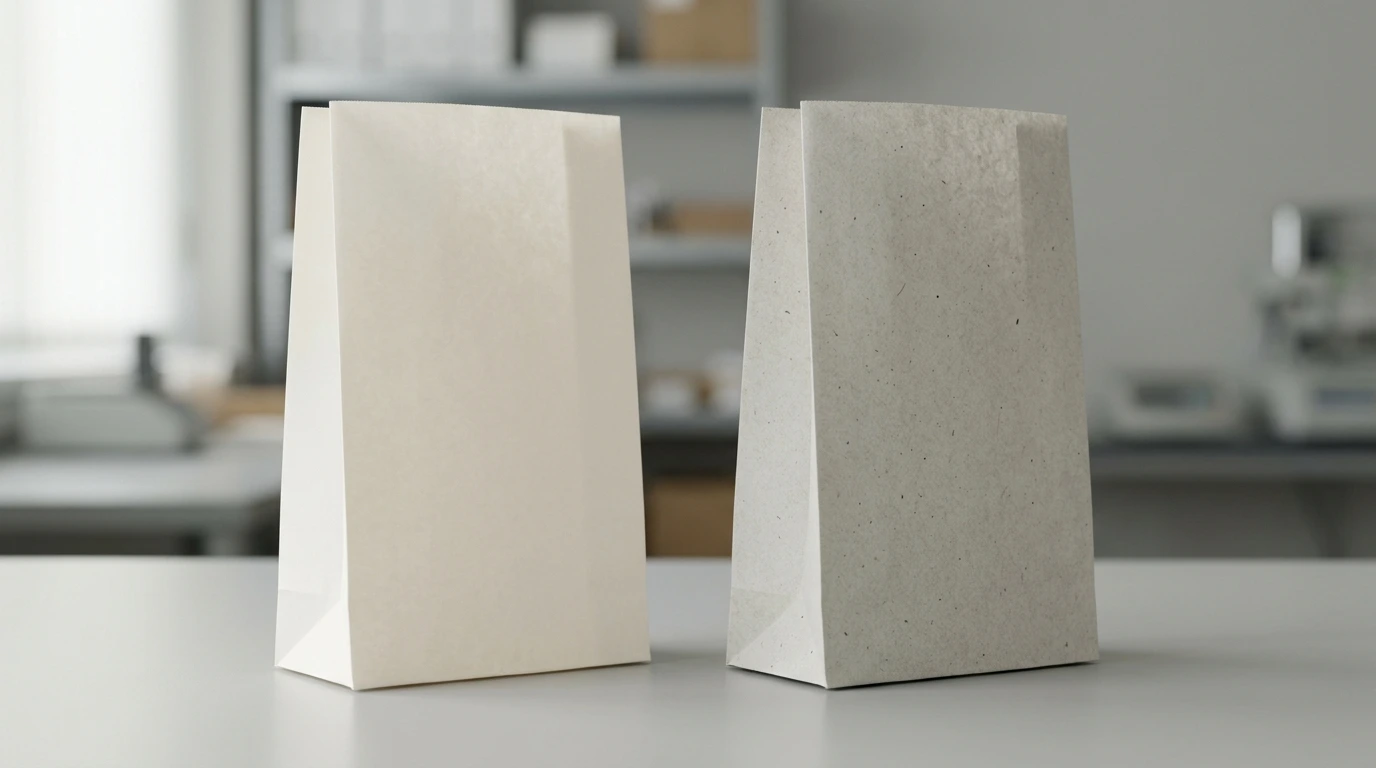
On block bottom paper bags the two paper options sit side by side in plain sight: brown kraft and recycled brown kraft. Which is precisely why writing down which of the two you mean beats leaving it to chance.
The case against dropping recycled fibre altogether
Without this section the picture would come out crooked. Recycled fibre is not the problem. It is an option with a clearly drawn field of use.
Environmentally it is the stronger choice. Paper made from waste paper needs noticeably less water and energy in production than paper from fresh cellulose, and it protects the raw material base on top of that. A business that drops it everywhere buys a disadvantage it will have to explain somewhere else.
A sense of proportion helps too. A broad review of paper bags on the market found no primary aromatic amines in any of the samples. That is a different substance group from MOAH, but it shows that market reality is more moderate than individual headlines. This is a decision, not an alarm.
The honest summary: recycled fibre where the contact situation allows it, virgin fibre where it does not, and in both cases a written record of what gets delivered.
What to ask your supplier
Five questions move this forward and they fit in a single message:
- Is the contact surface of this product made from virgin fibre, or does it contain recycled fibre?
- Which contact situation is the product approved for: dry, moist, greasy?
- Is there a version of the same product with a virgin fibre contact surface, and what changes if there is?
- Are the printing inks formulated to the guideline for the surface facing away from food, and is there a statement of composition?
- Is there a declaration of compliance for food contact, and does it name the actual manufacturer?
A supplier who answers those with "it is food safe" has not answered. Food safety is the entry ticket. It says nothing about the fibre.
One clarification on framing, because the above reads more definitive than it should. This text describes practice from a manufacturer's perspective and does not replace a legal assessment of your specific case. Which values apply to your product, and from when, depends on the product group. The fibre question, though, you can settle today, and until it is settled every other assessment is guesswork.
A last practical note. If you are planning new artwork anyway, that is the cheapest moment to change this. Fibre and print get decided in one round instead of touching the same line item twice.
Frequently Asked Questions
- Why does recycled paper contain mineral oil?
- Waste paper contains printed material and newspaper ink contains mineral oil. When the fibre is reprocessed the ink is largely removed, but the mineral oil itself is not reliably removed with it. It stays in the pulp, passes into the new paper and can migrate from there into the product.
- What changes on 1 January 2027?
- Binding maximum levels for MOAH in food take effect for the first time, with fully harmonised values for all processed foods following by January 2030. Two points are critical: the limits apply regardless of source, so contamination from packaging counts as well, and the values belong to the food rather than to the paper.
- Can recycled paper touch food?
- For dry foods, recycled content paper is a reasonable choice provided it is approved for that use. For moist or greasy products the stricter rule applies: either a suitable coating or a contact surface made entirely of virgin fibre. Storage time matters too, because a long shelf life makes migration easier.
- Does a paper inner bag protect the food?
- No. Inner packaging made of paper delays migration but does not stop it, because part of the substance evaporates and travels through a paper layer as well. The barriers regarded as tight enough are films made of certain plastics; a second sheet of paper produces a slower route rather than a barrier.
- Can printing ink be a source as well?
- Yes, and this gets skipped often. A bag made from virgin fibre but heavily printed is not automatically unloaded. The European ink industry maintains its own set of rules for food packaging printed on the outside, and it is worth asking whether the inks are formulated to it and whether a statement of composition exists.
- Should recycled fibre be dropped as a precaution?
- That would be an overreaction. Paper made from waste paper needs noticeably less water and energy in production and protects the raw material base. The better approach is a mapping rather than a blanket decision: recycled fibre where the contact situation allows it, virgin fibre where it does not, and a written record in both cases.
Related Articles
Food-Grade Packaging: What to Actually Check Before You Order
Food-grade is not a finish line — it is the floor. Here is what really decides whether printed cups, boxes and bags are safe for the food they hold, and the one document worth asking for every time.
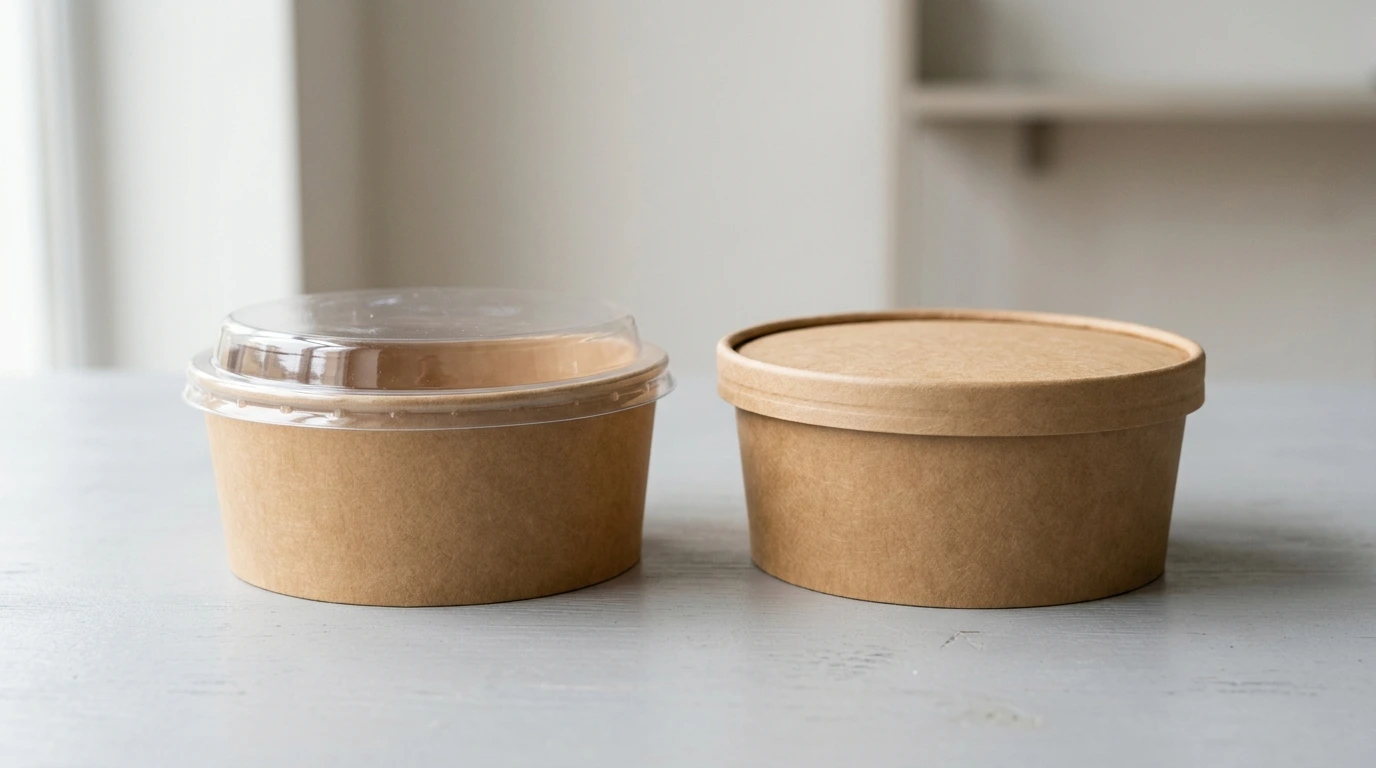
In Germany, Your Coating Decides the Reuse Rule
Whether you have to offer a reusable alternative in Germany is not settled by your menu or your floor area alone. It is settled by two lines in your packaging order: the barrier and the lid.
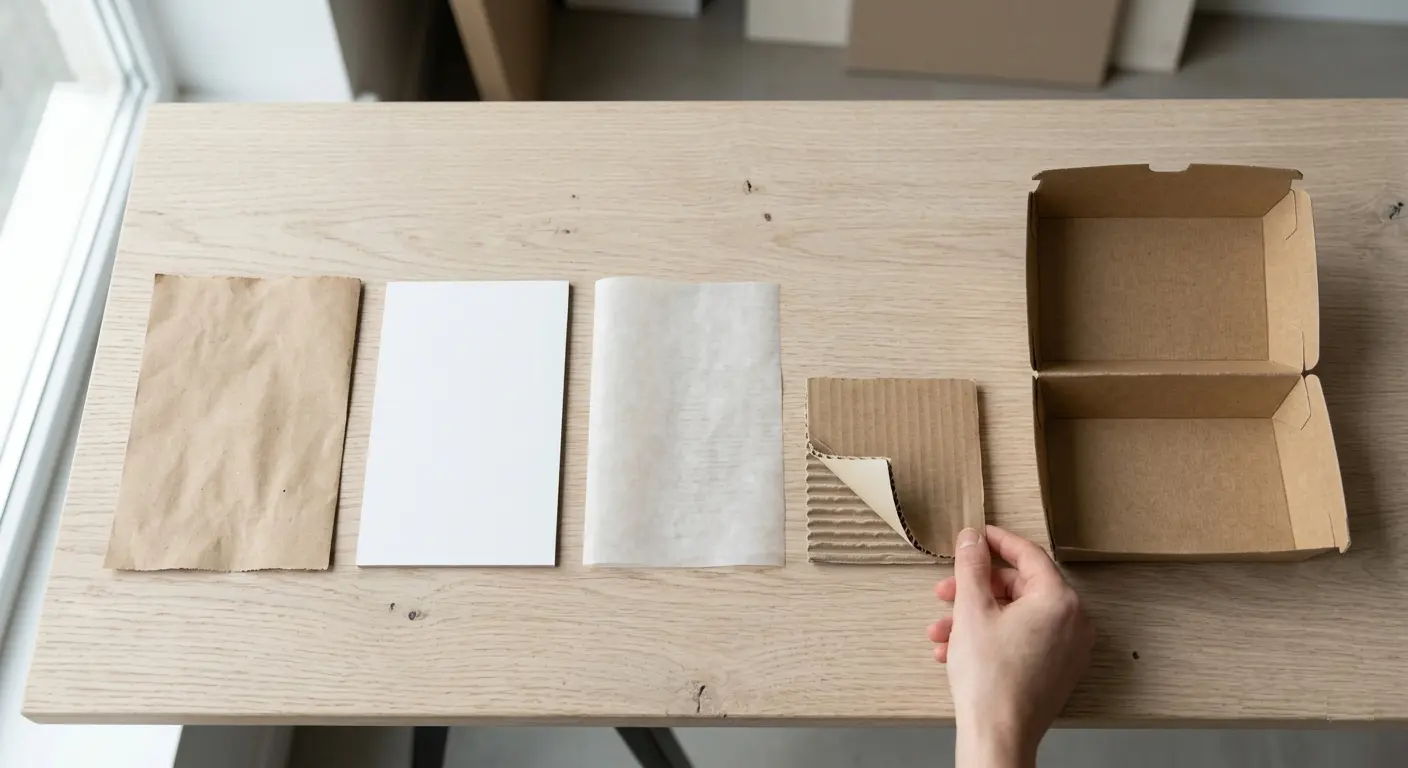
Paper, Grammage and Barriers: Which Material for Which Food
The same box holds a burger perfectly and fails under a curry. The difference is not the board, it is the layer on it. What grammage actually changes, which barrier suits which dish, and how to test material with your own food before you commit.
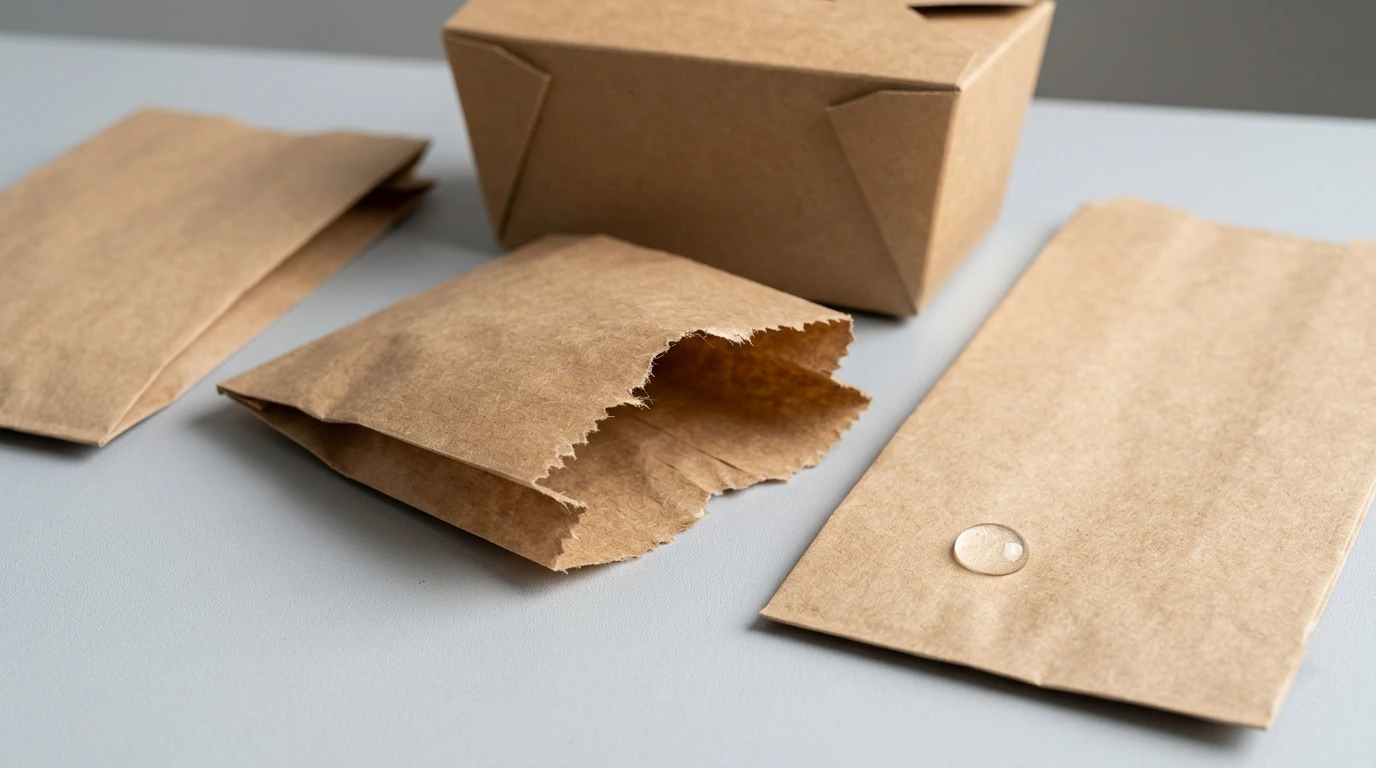
Does Your Paper Packaging Contain Plastic?
A coating you cannot see can move paper packaging out of the paper category altogether. For anyone shipping into Germany it has become the first technical question a buyer asks, and the answer belongs in the specification.