Deutsch
 Français
 Türkçe
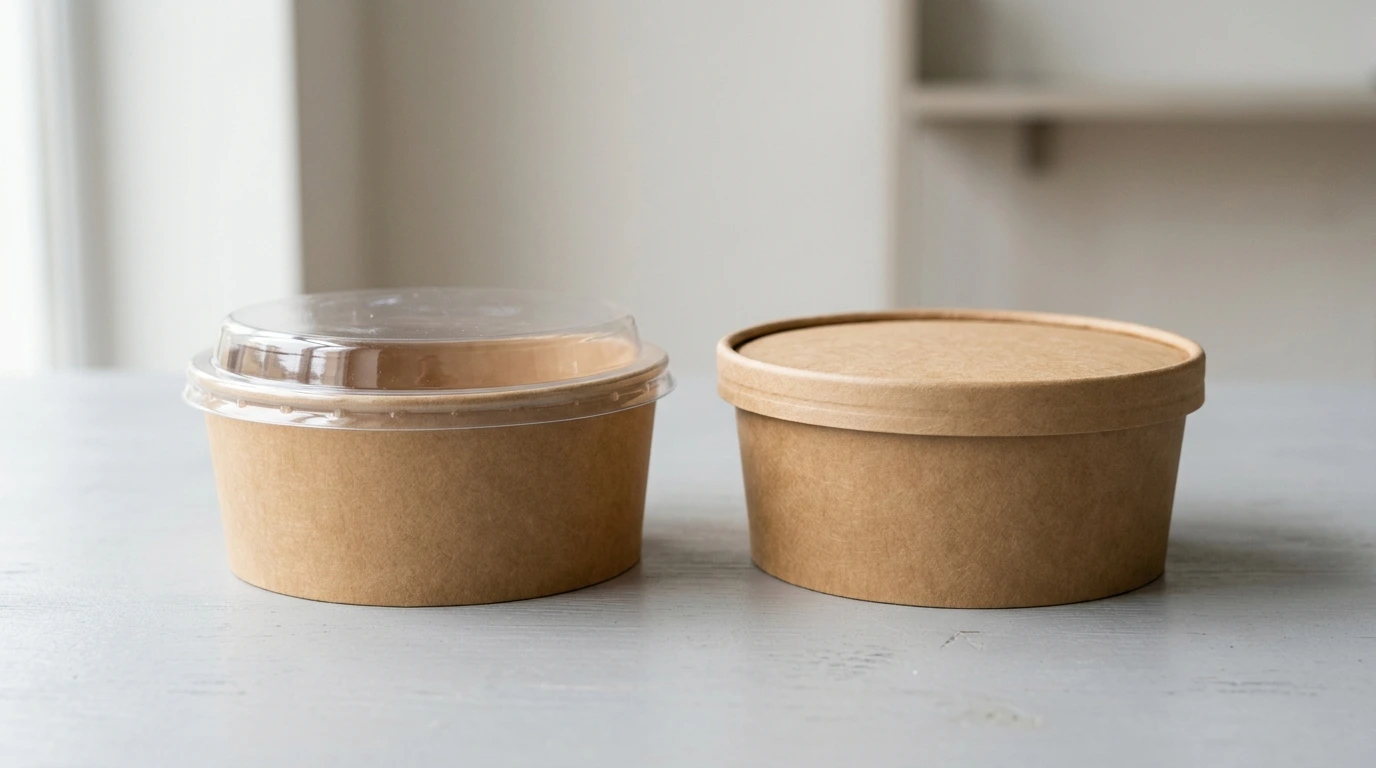
Short answer: whether Germany's reuse obligation catches you is not decided by your menu. It is decided by two lines in your packaging order. For food containers the obligation bites only where plastic is involved. For beverage cups it bites always, whatever the material.
That sounds like a technicality and it is the whole difference. A board bowl with no plastic lamination and a paper lid falls outside the reuse obligation. The same bowl with a thin coating, or with a clear plastic lid, falls inside it.
Plenty has been written about the obligation itself. Authorities, chambers of commerce and trade bodies explain clearly who has to offer what. What almost nobody writes down is that the answer sits in the order form rather than in how you run the shop. That is what this piece is about, from a manufacturer's side of the table and without pretending to be legal advice.
Who the rule is actually aimed at
The rule addresses whoever hands the food or drink to the customer. A takeaway, a bakery, a café, a delivery kitchen, a canteen, a market stall. Not the packaging manufacturer and not the wholesaler.
The obligation has applied since 1 January 2023. Where it applies, the reusable option has to be offered at the same place, at no higher price and on no worse terms than the single-use version. Those two conditions get skimmed over constantly, and they are exactly why a reuse scheme set up for show tends not to hold.
For purchasing this has an uncomfortable consequence. You cannot discharge the obligation by parking some reuse system in a corner. You can avoid it, though, if your single-use packaging never falls under it in the first place. That is not a loophole. It is the logic of the rule, which is aimed at plastic.
If you sell into Germany rather than operate there, the practical translation is just as direct. Your customer is the one the rule addresses, but whether they stay outside it depends on the structure you build for them. So the question reaches you sooner or later, and it usually reaches you at the quotation stage.
The distinction most people read straight past
Food and drink are treated differently, and most businesses read past it because both sit in the same sentence.
- Single-use beverage cups: always in scope. The material is irrelevant. A paper cup counts exactly as a plastic one does.
- Single-use food containers: in scope only where they consist wholly or partly of plastic.
So packaging made of paper, board, corrugated, aluminium, wood or moulded fibre sits outside the rule on the food side. With one condition that carries everything: no plastic lamination, and not closed with a plastic lid.
Put those two lines side by side and it becomes obvious why bakeries and takeaways stand in different places. A business selling mostly pastries and filled rolls over the counter can stay entirely outside the obligation on the food side. The moment coffee joins the menu, it is inside on the cup. One business, two product groups, two completely different starting positions.
There is no de minimis threshold
Now the point where most misjudgements are born. For plastic content there is no threshold below which it stops counting.
No percentage exists under which a coating would be disregarded. A film of plastic on the inside face, thin enough to be invisible, turns a board bowl into a single-use plastic food container. Nothing about it shows to the eye, it occupies one line on the material sheet, and legally it is the difference between in scope and out.
What makes this awkward is that it catches the businesses coating for good reasons. Anyone serving greasy or moist food wants a barrier, and the obvious barrier is a polymer. The decision gets made in the kitchen, on practical grounds, and nobody is thinking about a legal clause at that moment.
Which is why a plain stocktake pays off, and it requires you to order nothing. Lay your food packaging out on a table and sort it into two piles: anything with a visible inner coating to the left, anything that is pure fibre to the right. The left pile is your workload. In most businesses it comes out smaller than feared and contains two or three lines that carry real volume.
The information itself is not printed on the packaging. It sits in the specification, and not where most people look for it: a note saying food safe tells you nothing about the coating, because it answers a different question. What you want is the line on barrier, lamination or inner layer. If it is missing altogether, that absence is itself an answer.
The lid counts too
Here is the part that stays vague even in good summaries. The lid belongs in the assessment.
An uncoated board bowl closed with a clear plastic lid is no longer the plastic-free packaging you take it for. The bowl on its own would sit outside. With the lid, the combination sits inside.
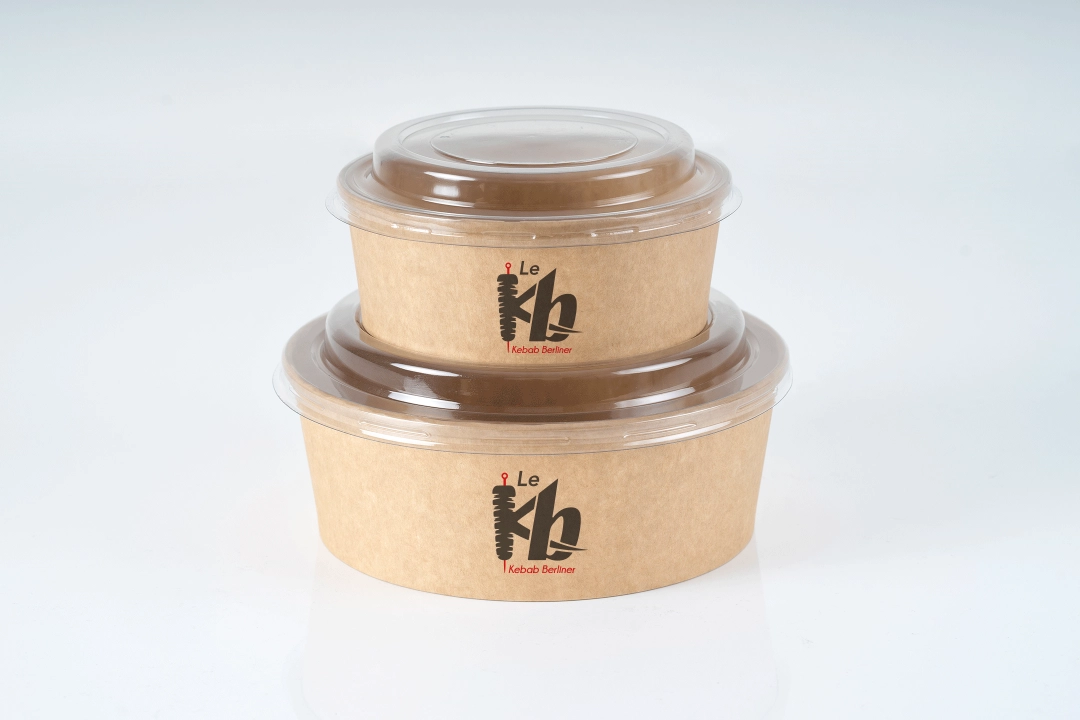
That matters in practice, because almost the entire bowl market is sold this way: board bowl underneath, transparent lid on top. The lid usually is not ordered separately at all. It arrives with the delivery, and nobody asks about it at goods-in.
On kraft bowls the lid options sit openly side by side: PET for cold applications, PP for hot, and paper lids depending on bowl size. So the same bowl is inside or outside the obligation according to which line gets ticked. A business that knows this makes the decision deliberately. One that does not still makes it.
On chicken buckets the paper lid is a regular option, alongside plastic-free board constructions depending on barrier and lid requirements. That pairing, fibre on fibre, is the route by which a hot dish gets packed without triggering the obligation.
Moving to a fibre lid is not purely a paper question, though, and it would be dishonest to leave that out. The lid seats differently, it stacks differently, and the customer can no longer see inside. On delivery that barely registers, because the bowl disappears into a bag anyway. At a counter, where the display does part of the selling, it can feel different.
The small-business exemption and what it does not cover
Small businesses are exempt. The conditions are narrow and they apply together rather than as alternatives: no more than five employees and no more than 80 square metres of sales area. Both have to be true.
Break the headcount limit while staying inside the floor area and you are not exempt. The reverse holds equally. Both figures also move: one extra summer hire, or a refit adding a few square metres, shifts the classification without anything changing in the range you sell.
The second half gets overlooked even more often. Exempt does not mean free of duties. Small businesses have to make it possible for customers to have their own containers filled under the applicable hygiene conditions. That is not a recommendation, it is the price of the exemption.
Filling those containers has a practical side worth settling in advance. The customer's container does not belong behind the counter or on the work surface; the usual approach is a handover across a tray or a defined drop zone, so your own area stays clean. Set that once and explain it to the team, and the argument at the till is behind you.
For purchasing planning the conclusion is this. If you sit just under both thresholds today and expect to grow, do not rest the packaging decision on the exemption. Packaging that stays outside the obligation regardless of headcount and square metres survives your next hire. The exemption may not.
Where the exemption is simply not available
This section belongs here, otherwise the picture turns too comfortable. There are cases where the way out does not exist, and it is better to know that before ordering.
The clearest is the cup. For a drink to take away no material helps, because the rule does not ask about material there. A café can move its entire food packaging to fibre and still carries the obligation on coffee.
The second is visibility. On sushi boxes transparent lid options exist for product visibility, and for a good reason: with sushi the look is part of the product. Switching to a closed fibre lid here saves you an obligation and costs you a selling point. That can be the wrong trade.
The third is sealed trays. Where a lid is heat-sealed by machine, the seal layer is part of the function and without it there is no seal at all. Here the route does not go around the obligation but through it. The question stops being how you get out and becomes what the reuse offer beside it looks like, since you will be setting one up regardless.
So the honest formulation is not that fibre is always the answer. It is this: go through the range line by line and ask whether the coating or the plastic lid serves the product or only serves habit. For part of the range it serves the product. For another part it is simply what the previous supplier put in the box.
What changed on 12 August 2026 and what did not
Since 12 August 2026 the European packaging regulation has applied directly, and in Germany the packaging act has been replaced by an implementing act. That has understandably caused some uncertainty.
For the question in this piece the answer is unspectacular. The reuse obligation for takeaway business continues. The established structures stay in place in substance, and the European regulation now carries the reuse principle Germany adopted early across the whole EU.
In practice that means a range you set up outside the obligation today is not built on a transitional rule about to expire. The direction of European requirements runs toward less single-use plastic, not more. A fibre solution ages better in that environment than a coated one.
To be clear about the framing: this text describes practice from a manufacturer's perspective and does not replace a legal assessment of your own case. Whether and how the obligation applies to your business depends on size, range and sales format. What needs no lawyer is the material line in your order; everything else is built on it.
What belongs in the enquiry
Four details take a conversation further than any range overview, because they describe your business rather than our catalogue:
- Which of your food packaging lines have an inner coating and which are pure fibre. If you do not know, that is precisely the first question for your current supplier.
- Which lines arrive with a plastic lid, even where the lid was never ordered separately.
- Which of those go out hot or greasy. That decides which barrier is genuinely needed and whether it stays achievable without a polymer.
- Whether you serve drinks to take away. That side follows different rules and otherwise gets counted in when it does not belong.
The useful question to a supplier after that is not whether the packaging is sustainable. It is whether the same line exists as a plastic-free construction with a fibre lid, and what changes in barrier and handling if it does. There is either an answer to that or there is not, and both tell you something.
One note on timing, because it decides more often than price does. A change that comes out of your own planning attaches to the normal ordering rhythm and costs little attention. A change that comes out of an inspection lands in a week where nothing has time anyway. The work is the same, the circumstances are not.
A sample helps more than any description at this point. Take two constructions, put your own dish inside, and leave it standing for as long as a delivery run actually takes at your place. What a datasheet cannot show you, half an hour in the box will.
Frequently Asked Questions
- Does the German reuse obligation cover board packaging?
- On the food side it generally does not. Packaging made of paper, board, corrugated, aluminium, wood or moulded fibre is out of scope, as long as it has no plastic lamination and is not closed with a plastic lid. For beverage cups the obligation applies regardless of material.
- From what level of plastic content does the obligation apply?
- There is no de minimis threshold. Even a very thin coating or lining is enough for packaging to count as a single-use plastic food container. No percentage exists below which a coating would be disregarded, so a layer you cannot see still changes the classification.
- Does the lid count?
- Yes. An uncoated board bowl closed with a plastic lid falls under the obligation even though the bowl alone would be exempt. This matters especially in the bowl segment, where the transparent lid usually arrives with the delivery rather than being ordered deliberately.
- Which businesses are exempt?
- Businesses with no more than five employees and no more than 80 square metres of sales area. Both conditions have to be met together. Exempt businesses still have to make it possible for customers to have their own containers filled under the applicable hygiene conditions.
- What applies to takeaway coffee cups?
- For single-use beverage cups there is no material exemption, so paper cups are covered too. A business can move its food packaging entirely to fibre and still carries the obligation on drinks. Food and drink are assessed separately here.
- Did anything change with the new rules since August 2026?
- The reuse obligation for takeaway business continues. Since 12 August 2026 the European packaging regulation has applied directly and the German packaging act has been replaced by an implementing act, with the established structures staying in place in substance.
Related Articles

Germany's LUCID Packaging Register, Explained for Food Businesses
Selling food or running a site in Germany? Even businesses buying pre-licensed cups and boxes must register in LUCID, and since 12 August 2026 anyone ordering service packaging with their own logo is the producer. Who is affected, which checkbox counts, and which supplier paperwork you need.
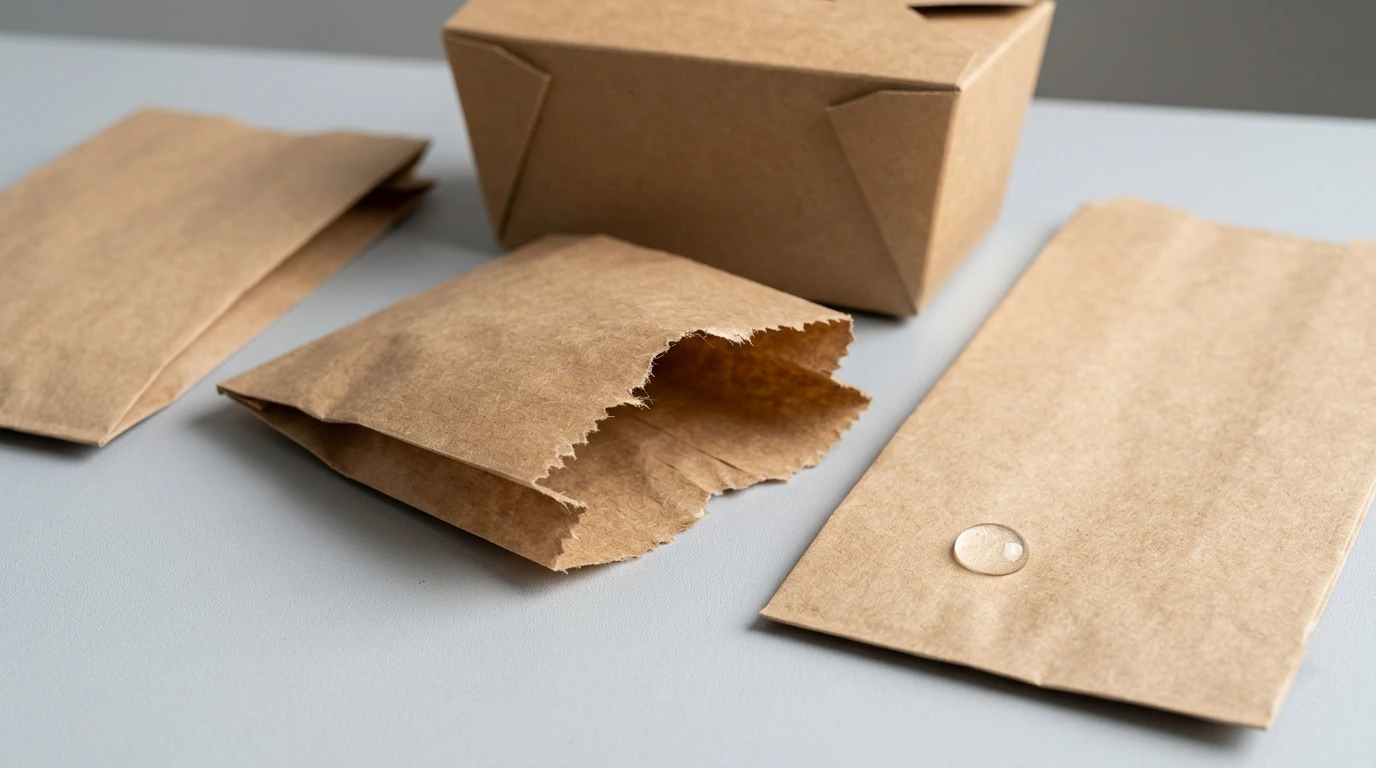
Does Your Paper Packaging Contain Plastic?
A coating you cannot see can move paper packaging out of the paper category altogether. For anyone shipping into Germany it has become the first technical question a buyer asks, and the answer belongs in the specification.
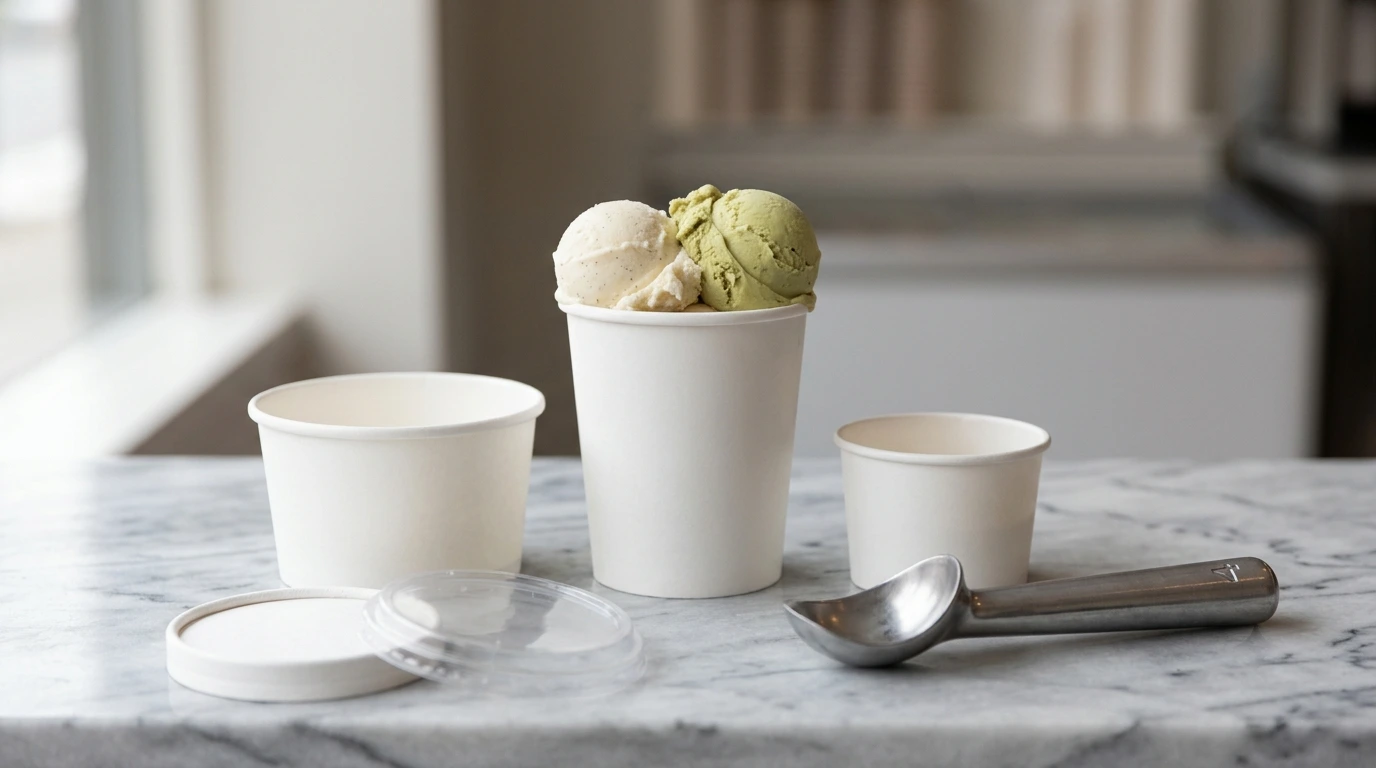
Printed ice cream cups: a scoop is not an order size
Ice cream is sold in scoops, but cups are built in millilitres. Order “cups for two scoops” and you are ordering the number on your scoop without saying it. How to convert scoops into millilitres, why 250 and 300 ml are two completely different cups, what the lid does to the bin, and when the order has to leave so the cups are on the counter in March.
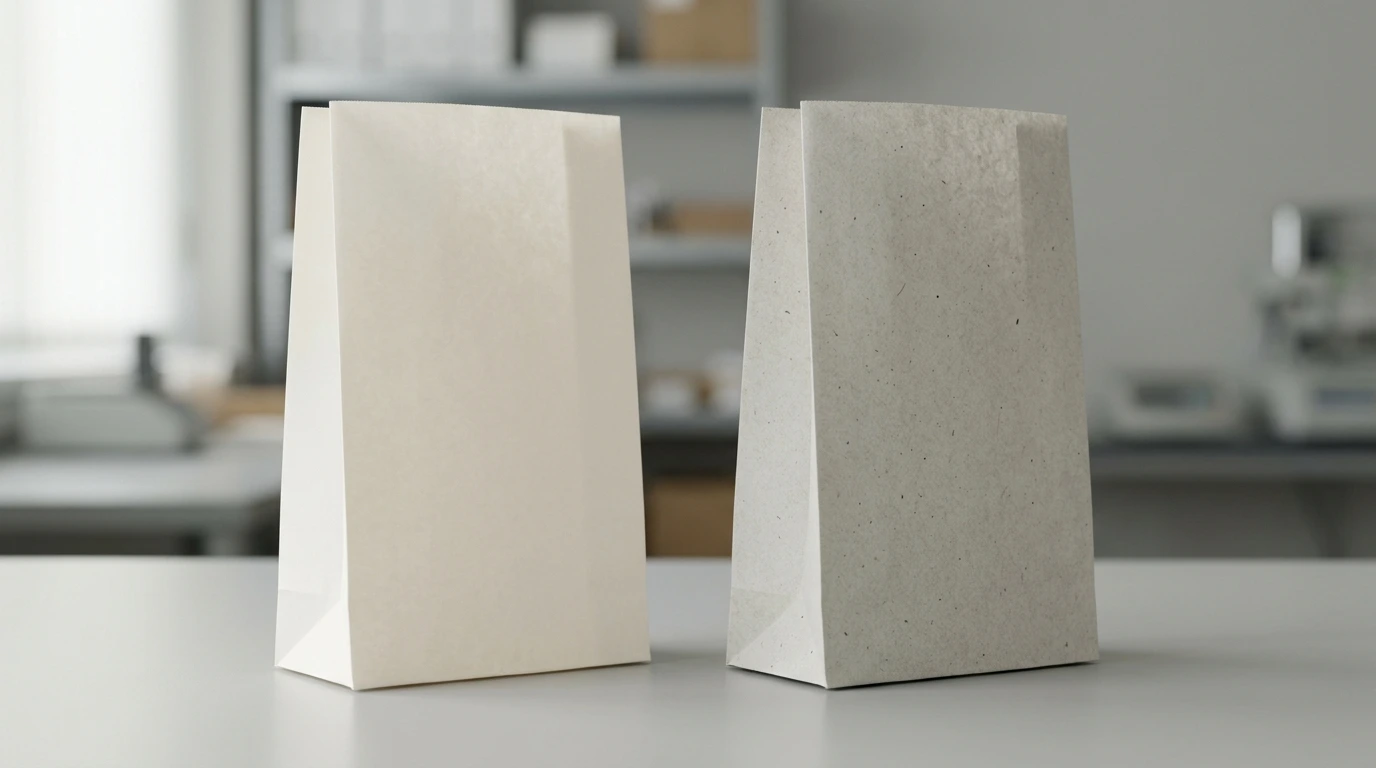
Which Fibre Touches Your Food
Recycled paper carries mineral oil from the printing ink of its former life. From January 2027 there are binding limits for those substances in food for the first time, and the limits do not care where the contamination came from.