Deutsch
 Français
 Türkçe
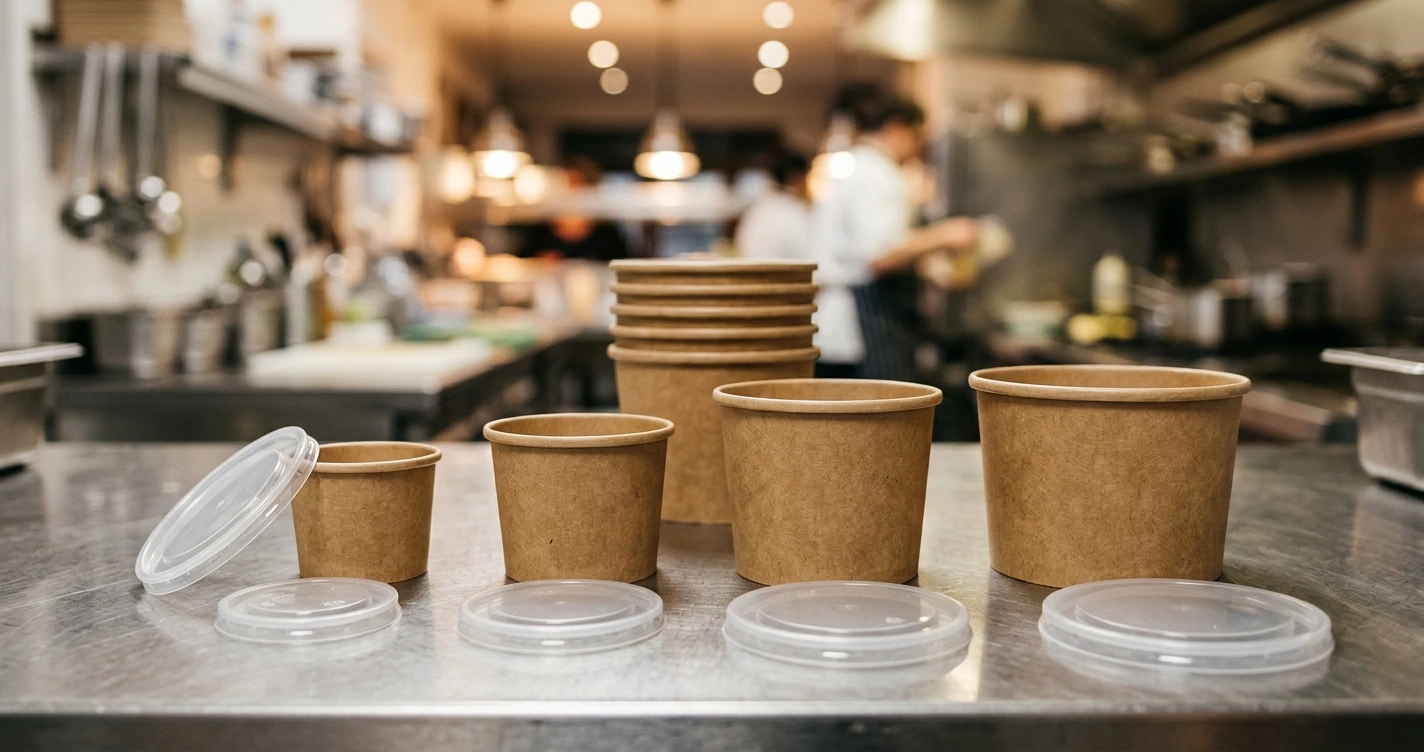
The voice on the phone is tense. "The lids don't fit," says the buyer for a delivery chain. The pots arrived, the lids arrived, and on the counter the two refuse to meet. A few questions in, the picture clears. Pots were ordered against one capacity, lids against another. Both were made perfectly. The only mistake was assuming they came off the same list.
Search for sauce cups and almost everything that comes back is a listing. Capacities stacked up, the words "compatible lids available" underneath, and that's where it stops. Nobody writes down which lid sits on which pot, or how full the pot can be before it lets go in a delivery bag. Yet that is exactly where orders go wrong, not at the point of picking a capacity.
A lid fits the rim, not the capacity
It packs into one sentence. A lid has no idea how many millilitres are underneath it. The only thing it reads is the diameter of the rim. There is no such thing as a 90 ml lid. There is a Ø74 lid.
Our standard ladder has four rungs:
- 30 ml: top Ø44 mm, bottom Ø36 mm, height 37 mm
- 60 ml: top Ø63 mm, bottom Ø53 mm, height 36 mm
- 90 ml: top Ø74 mm, bottom Ø60 mm, height 44 mm
- 120 ml: top Ø74 mm, bottom Ø60 mm, height 52 mm
Read those last two rows again. The 90 ml and the 120 ml share a rim, and they share a base. Eight millimetres of height is the whole difference between them. The pot grows taller; the mouth stays exactly where it was.
Four capacities, three lids
Here is what that table looks like from the buying side. Run all four capacities on your menu and you still only need three lid diameters: Ø44, Ø63 and Ø74. The two largest pots share one lid between them.
That matters more than it sounds. The minimum order on sauce cups is 50,000 units, and the minimum applies to the lid as much as to the pot. A chain planning around four separate lids is carrying a line it doesn't need. The same menu built on three lids asks for one less drawer in the store cupboard and one less thing to get wrong at the counter.
It works in your favour going up, too. Moving from 90 ml to 120 ml costs you nothing in tooling on the lid side, because the Ø74 you already hold drops straight onto it. Going from 30 ml to 60 ml is a different story: the rim jumps from Ø44 to Ø63, so doubling the capacity means opening a new lid.
Fill level, or why one branch leaks and the next one doesn't
This is the pattern we see most often in the field. Same pot, same lid, same sauce. Complaints from one site, silence from another. Everyone goes looking at the packaging when the difference is in the hand holding the ladle.
When a lid seats on a rim, a shallow band of air has to stay between the sauce and the underside of the lid. Fill into that band and closing the lid pushes the sauce sideways, so the first spill happens on the counter rather than on the road. Once the pot tips over in a courier bag, the surface of sauce touching the lid gets much bigger, and the trapped air is the only thing keeping that surface from finding a way out.
The rule shifts between sizes as well. In a narrow 30 ml pot one ladle reaches the rim; in a 120 ml pot the same ladle barely covers the base. Kitchens that portion with a measure stop having this conversation altogether. Kitchens that fill by eye have it again every shift. We went through where a lid actually seals in our piece on coffee cup lids that leak, and the mechanics behind a sauce pot are no different.
How many capacities does your menu really need
You don't have to carry all four, and most kitchens shouldn't. The answer comes off your menu, not off a supplier catalogue:
- Ketchup, mayonnaise, mustard, one dip and done: 30 ml covers it. One pot per portion, and the customer rarely gets through more.
- Barbecue, ranch, garlic, anything shared: 60 ml. This is the size that doesn't run out halfway through a single order.
- Dressings and the big dip beside a chicken platter: 90 ml.
- Soup sides, yoghurt, sauce sold in its own right: 120 ml. This rung earns its place the moment the pot stops being a freebie and starts being a line on the menu.
Build a three-capacity menu from 30, 90 and 120 ml and your lid count drops to two. When you put the combination together, look at rim diameters rather than capacities and the answer arrives on its own.
The shelf maths that runs backwards
One detail here goes against instinct. The 30 ml pot stands 37 mm tall. The 60 ml pot stands 36 mm. The pot holding half as much is a millimetre taller on the shelf. The reason is straightforward enough: 30 ml is narrow and deep, 60 ml is wide and shallow.
In practice that means a nested column of 30 ml pots and a nested column of 60 ml pots take up the same height on your counter. Going up a capacity costs you nothing in headroom. What does eat space is the 90 and the 120, because both sit on a Ø74 footprint and their columns climb quickly.
In a busy kitchen this decides how the pack-down station gets laid out. The pots are built to nest tightly, and the straighter the column stands, the less handling and the fewer knocked-over stacks you get across a service.
Where a brand fits on a 44 mm lid
On the small capacities the print area really is tight, and there's no point pretending otherwise. The body of a 30 ml pot is short and tapered. A mark reads there. A sentence doesn't. Decide accordingly.
Printing is offset, with CMYK and Pantone matching available. What we usually suggest: the mark alone on the small pot, the mark plus a short line on the larger ones. Getting your sauce cups and the food boxes they travel beside onto the same colour family does more work than squeezing copy onto every surface.
Unprinted production is on the table as well. Plenty of operators brand three capacities and take the low-turnover fourth one plain.
Three things to send before you order
The list that shortens a quote round is short itself:
- Which capacities you want, with a monthly quantity against each. Your lid requirement is calculated from this.
- Whether the sauce goes in hot or cold. That decides the inner barrier.
- Whether you're running lidded or open. An open dip pot and a lidded portion pot are separate lines.
Production runs roughly 15 to 20 working days after artwork approval. That clock covers pot and lid together rather than one after the other, which is why leaving the lid decision until later is the one thing guaranteed to stretch it.
When you ask for samples, ask for the pot with its lid rather than on its own. Give a head chef a pot they can actually close and they'll tell you in five seconds what no specification table ever gets across.
Frequently Asked Questions
- Which lid fits which sauce cup?
- Lids are chosen by the rim diameter of the pot, not by its capacity. On the standard ladder, 30 ml has a Ø44 rim, 60 ml a Ø63 rim, and both 90 ml and 120 ml share a Ø74 rim. Four capacities therefore need only three lid diameters, with the two largest pots sharing one lid.
- Do hot sauces need a different pot?
- The construction stays the same; what changes is the inner barrier. Moisture-resistant barrier options come into play for hot or oily sauces. Say in your first message whether the sauce is filled hot or cold and the specification gets built correctly from the start.
- Which capacity is used most?
- It depends on the menu rather than on a general answer. Single-dip condiments tend towards 30 ml and shared dips towards 60 ml, while 90 and 120 ml suit dressings, soup sides and sauce sold separately. The useful question is not which size is popular but how many millilitres your own portion runs to.
- Is buying pots without lids cheaper?
- An open dip pot and a lidded portion pot are separate lines, and the lid carries its own minimum. If the sauce is served across a counter, the open build does the job. If it goes into a courier bag, treat the lid as a requirement rather than an option.
- What is the minimum order on sauce cups?
- The minimum order is 50,000 units, and it applies separately to pots and to lids. That is why the number of distinct lid diameters you run can matter more to your planning than the number of capacities you choose.
- Are pots and lids produced together?
- Yes, they are planned as one set. Production takes roughly 15 to 20 working days after artwork approval. Holding the lid decision back is the main reason that timeline slips, because the schedule treats pot and lid as a single job rather than two.
Related Articles
Why Coffee Cup Lids Leak and What Actually Fixes It
The lid clicked on, the customer got ten steps away, and coffee ran down the sleeve. What causes it nearly every time, the counter habit that fixes it for free, and what to settle with your supplier before the next pallet arrives.
Ghost Kitchen Packaging: Three Brands, How Many Boxes?
Ghost kitchen packaging usually gets discussed as a question of which box. The harder question is how many separate lines one kitchen can actually carry, and that is settled by minimums and shelf space rather than by the menu.
Packaging specification: agree tolerances before the pallet lands
The standard measures grammage, it does not tolerate it: without an agreed tolerance there is nothing to reject at goods-in, and a quote without tolerances cannot be compared with any other. Which lines on grammage, dimensions, colour, sampling and pallet belong in a packaging specification, how many pieces you inspect and what happens when the scales show something other than the order.

Paper sauce cups and the 2030 ban: the five per cent question
From 1 January 2030 single-use plastic portion packs leave the restaurant table across the EU, but not the delivery bag. Whether your paper cup is caught is decided by a number printed on no cup: its plastic share. Why the same coating counts for Germany’s plastic fund but only above five per cent for the ban, and what belongs in an order for 2027 to 2029.
Opening a Takeaway: The Packaging Checklist That Saves You Money
New operators buy packaging from a catalogue, end up with too many sizes and a year of the wrong box. This checklist works from your menu instead, covers how much to order, and ends with the seven lines that get you a real quote.