Deutsch
 Français
 Türkçe

A burger restaurant in Dublin, forty seats, a terrace, delivery through two apps, orders its sauce cups twice a year by the pallet. With the quote for 2027, a question comes up for the first time that nobody asked before: which of these can we still put on a table in 2030?
The question is fair, and the answer is more precise than the headlines suggest. From 1 January 2030 the EU Packaging and Packaging Waste Regulation, the PPWR, bans certain single-use packaging in hospitality, among it portion packs for sauces, ketchup, sugar and coffee creamer. Whether a paper cup is caught is decided by no headline but by a number printed on no cup: its plastic share. What leaves the table in 2030, what stays in the delivery bag, and why the same cup can count as plastic in Berlin and remain paper in Brussels, is set out here from the practice of a manufacturer of sauce cups that sells into the EU.
What leaves the restaurant table on 1 January 2030, and what does not
From 1 January 2030 two groups of single-use plastic packaging may no longer be placed on the market in hospitality: packaging for food and drink filled and consumed on the premises, and portion packs for condiments, sauces, preserves, coffee creamer, sugar and seasoning. That is Annex V of the regulation, which has applied across the EU since 12 August 2026. The first group expressly covers all dining areas inside and outside a site, terraces included. The second group has two exceptions: portions handed over together with food to take away, and settings where hygiene or medical reasons require the single portion.
Three words in that text carry the whole weight: single-use, plastic and on the premises. The ban does not hit portion packs as such but single-use plastic packaging; not ketchup but the sachet; not the delivery driver but the table. The ketchup sachets and creamer pots in the headlines are plastic or composite and fall clearly under it. The paper cup of sauce on the table is the case this guide is about, and it is less clear.
One more date, so the sequence is right. On 12 February 2028, two years earlier, an EU-wide duty arrives to offer takeaway in reusable packaging as well; Germany has had its own version since 2023. The 2030 ban is a different rule with a different object.
Does the ban cover paper cups? The five per cent rule
A paper cup falls under the 2030 ban only if its plastic share is above five per cent of total mass. The regulation itself does not define single-use plastic packaging; it does define composite packaging, and the answer hangs on that. A composite is packaging made of two or more materials that cannot be separated by hand, unless one of them makes up no more than five per cent of total mass. Labels, varnishes, paints, inks, adhesives and lacquers stay out of that calculation. In its guidelines of March 2026 the European Commission drew the conclusion: paper-based packaging with more than five per cent plastic falls under the Annex V bans, packaging with no more than five per cent does not.
For the sauce cup that means: paperboard with an applied plastic layer, the kind that keeps sauces and dips from soaking through, is a composite, and the layer counts towards the five per cent because it is neither a label, nor an ink, nor a lacquer. Whether the cup sits above or below the line depends on the ratio of board weight to layer weight, and only the manufacturer can say. A cup with a thin dispersion coating can sit below it; a cup with a film layer usually sits above it. Plastics industry associations attacked this reading in the summer of 2026 and the Commission confirmed it in July. It is the basis businesses have to plan with today. The question is finally settled only when nobody is litigating any more.
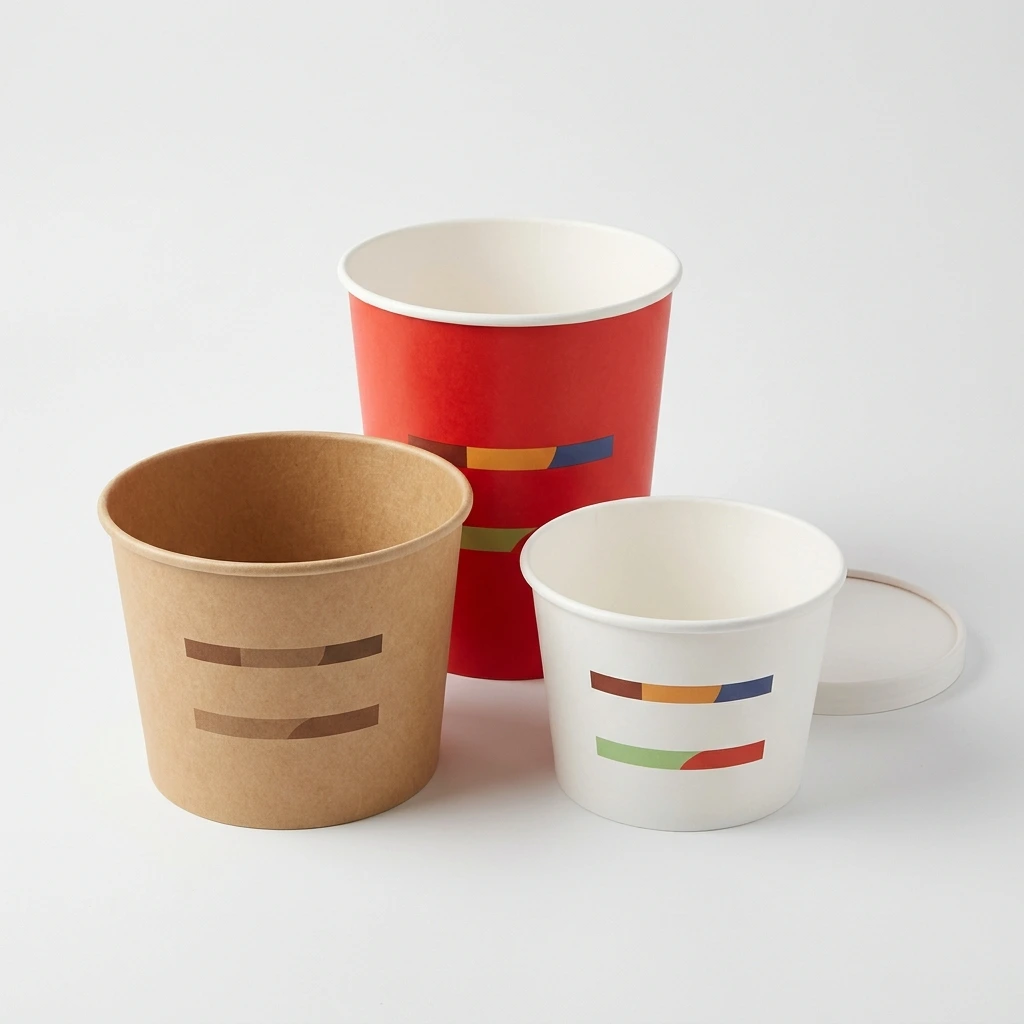
On our sauce cups page two lines therefore carry two different meanings in 2030: “Moisture-resistant inner barrier options available for sauces, dips and other liquid or semi-liquid products” and “Plastic-free paperboard cup constructions available depending on barrier and lid requirements”. The first line describes the cup that raises the five per cent question. The second describes the cup that answers it, but only for sauces that stay put without a plastic layer.
Why the same coating counts for Germany’s plastic fund but not for the ban
For Germany’s single-use plastic fund and its reusable-offer duty there is no five per cent line; there, every plastic layer turns a paper cup into a plastic product. Both German rules derive from the Single-Use Plastics Directive of 2019, and the PPWR expressly leaves that directive untouched. The Commission says so in the same guidelines: the composite definition with its five per cent threshold applies to the Annex V bans, not to the directive on single-use plastic items.
The same sauce cup can therefore play three roles in three rulebooks. For the German fund it is, with any coating at all, a single-use plastic product, and the levy weighs the whole cup. For Germany’s reusable-offer duty it is, with any coating, a single-use plastic food container for which a reusable alternative has to be offered, unless the business falls under the small-business exemption; we described that in our guide to Germany’s reuse rule and the coating. For the 2030 ban, by contrast, it counts as plastic only if the layer weighs more than five per cent. Anyone who thinks those three roles through in one order buys differently from someone who knows only the headline. For a UK business the first two rules matter only at German sites; the third matters at every EU site and in every EU order.
Since the summer, businesses have asked us whether they should “switch to paper”. The question cannot be answered in that form. Paper with a plastic layer stays plastic for the German fund and reuse duty, and for the 2030 ban it becomes paper or plastic only through the number on the scales. The word on the quote decides nothing.
On the premises or to take away: the exemption that matters to delivery
Portion packs handed over together with food to take away remain allowed in 2030, even in plastic. That is the exemption that describes everyday life for the takeaway, the delivery kitchen and the dark kitchen: the sauce cup in the delivery bag is not affected, whatever it is made of. What is affected is the cup on the tray in the dining room, on the terrace and in the seating area outside the door.
It gets difficult for businesses that do both, and that is most of them. The Dublin burger restaurant hands out the same sauce on the tray and in the bag, from the same board. From 2030 that needs either two cups, one for the table below five per cent or with no layer at all and one for delivery, or one cup that satisfies both rules. Two items mean two minimum runs, two shelf positions and the question whether the kitchen grabs the right one in the rush. One item means choosing the cup for the table and putting it in the bag as well. From the production side the second route is the simpler one. From the kitchen’s side too.
For businesses without seating the 2030 ban changes nothing about sauce cups. For them the German fund and reuse duty remain the rules on which the coating is decided, at German sites, and those apply today.
Dispenser or portion cup: what stays on the table in 2030
Three options stay on the table in 2030: the dispenser, the reusable cup and the single-use cup with no more than five per cent plastic. The dispenser is the solution from the headlines: ketchup, mustard and mayonnaise in refillable bottles that stand on the table or are handed out at the counter. It works for three sauces everybody knows and fails with the house aioli, the dip for the chicken box and anything that has to be chilled or portioned because the guest is not meant to dose it.
The reusable cup is the second solution and long routine in restaurants with a dishwasher: the porcelain ramekin that comes back with the plate. For a takeaway with trays and self-clearing it is the solution that ends up in the bin. That leaves the single-use cup below the line: a paperboard cup whose barrier is thin enough to stay under five per cent, or a cup with no plastic layer at all for sauces that need none. Ketchup, mustard and thick dips survive the time from the counter to the last chip in an uncoated cup; thin dressings and oily sauces do not. That is the honest limit, and anyone who knows it knows which sauces belong in which cup in 2030.
Nothing changes for the portion sizes. The four fill volumes of 30, 60, 90 and 120 ml cover everything from a dip to a side sauce, and the question of which of them the menu needs is the same in 2030 as today. What is new is only that behind every fill volume sits the question of the layer.
How do you find out the plastic share of your cup?
Only from the manufacturer, as a figure in per cent by weight, in writing. The share is not printed on the cup, usually not on the quote either, and the description “paper cup” says nothing about it. What you need is a data sheet that names the weight of the board, the weight of the barrier and the resulting share, per fill volume, because the ratio changes with the size of the cup. The same figure is needed anyway for the German fund and for volume reporting; anyone who has it once, clean, uses it three times.
As a manufacturer we see two kinds of enquiry. One asks for “plastic-free sauce cups” and means a cup that may stay on the table in 2030; the other asks for the plastic share in per cent and gets an answer to plan with. The first enquiry leads to a cup that is not tight enough for some sauces. The second leads to a table stating, per sauce, which cup fits. And it leads to a question back to the business: which sauces go on the table, which go in the bag, and which do both?
What belongs in the order so that 2029 stock is not worthless
An order that survives 2030 names, for every sauce, the route, the fill volume and the barrier. That sounds like more work than it is, because most menus have three to five sauces. For each of them: table, bag or both. For each: 30, 60, 90 or 120 ml. For each: does it need a barrier, and if so, what per cent does it weigh? Those three columns show whether one cup item is enough or two are needed, and whether the stock lying on the pallet at the end of 2029 may still go on the table on 1 January 2030.
The minimum run belongs in that sum. Printed sauce cups start at 50,000 pieces per version, and a pallet arriving in autumn 2029 is not used up by January 2030. What was placed on the market before the cut-off may, by the logic of the regulation, continue to be used; the safer course is to place the last order before 2030 so that it does not have to be separated afterwards. Anyone ordering printed sauce cups for 2027 should have the five per cent figure on the data sheet already; anyone ordering them for 2029 must. The same applies to bowls in which sauce travels with the meal; with kraft bowls the lid and the barrier together decide the role in the rulebook.
Five questions to the supplier sum it up. What is the plastic share of the cup in per cent by weight, per fill volume? Which sauces stay tight in the uncoated version, and for how long? Is there a version that stays below five per cent and still holds oily sauces? Is the share on the data sheet that travels with the delivery? And: how many versions do I need for my menu if the same sauce goes on the table and in the bag? Anyone with those answers in writing orders a cup in 2027 that is still right in 2030. This guide describes practice from a manufacturer’s side and is not legal advice; the reading of the five per cent line comes from the Commission’s guidelines and may still move before 2030.
In short
- From 1 January 2030 hospitality across the EU may no longer use single-use plastic packaging for consumption on the premises, nor plastic portion packs for sauces, sugar and creamer; takeaway portions remain allowed.
- Under the European Commission’s guidelines, paper-based packaging falls under the ban only with more than five per cent plastic; labels, inks, adhesives and varnishes do not count towards the share.
- Germany’s single-use plastic fund and reusable-offer duty have no five per cent line; there every plastic layer counts.
- Only the manufacturer can state the plastic share in per cent by weight, per fill volume; sauce cups come in 30, 60, 90 and 120 ml.
- Printed sauce cups start at 50,000 pieces per version; an order for 2027 to 2029 should fix route, fill volume and barrier per sauce.
Frequently Asked Questions
- Are paper sauce cups banned in the EU from 2030?
- Only if their plastic share is above five per cent of total mass and they are handed out for consumption on the premises. Under the European Commission’s guidelines, paper-based packaging with no more than five per cent plastic does not fall under the Annex V bans. Whether a coated cup sits above or below that line can only be stated by the manufacturer from the weights.
- Does the ban apply to delivery and takeaway?
- No. Portion packs handed over together with food to take away are expressly exempt. The ban targets consumption on the premises, including terraces and seating outside the door. For a business without seating the 2030 ban changes nothing about its sauce cups.
- Does the 2030 ban apply in the UK?
- No. The PPWR is EU law and applies in Ireland, the Netherlands and every other member state, not in the UK, where a consultation on banning sauce sachets in 2021 and 2022 did not lead to a ban. It does matter to a UK business with sites in the EU or selling packaging into the EU, because the five per cent question then lands with its customers.
- What does the five per cent limit mean in practice?
- It comes from the definition of composite packaging: a material making up no more than five per cent of total mass does not turn packaging into a composite. Labels, inks, adhesives and varnishes are not counted; a plastic barrier layer is. A paperboard cup with a thin coating can sit below the line, one with a film layer usually sits above it.
- What must the enquiry contain so that the supplier states the plastic share?
- The fill volume, because the ratio of board to coating changes with cup size, and the sauce, because that decides whether a barrier is needed at all. Ask for a data sheet with board weight, coating weight and the resulting share per version, and for that data sheet to travel with the delivery. The same figure is needed for Germany’s single-use plastic fund.
Related Articles
EU Packaging Rules Since 12 August: What Goes On the Pack
The EU packaging regulation started applying on 12 August 2026. If you sell into the EU, the first part that reaches you is not a filing task. It lands in the artwork of your next print run.
Selling Cups into Germany: Who Pays the Single-Use Plastic Levy
A German café buying cups from a domestic wholesaler never meets Germany’s single-use plastic fund. Once cups travel straight from a supplier abroad to a German business, someone becomes the producer, and the levy is charged on the weight of the whole cup.
Sauce Cup Lids: Which Lid Fits Which Pot?
A lid has no idea how many millilitres your pot holds. All it sees is the rim. There are four standard capacities but only three rim diameters, and knowing that takes a line off your order.