Deutsch
 Français
 Türkçe
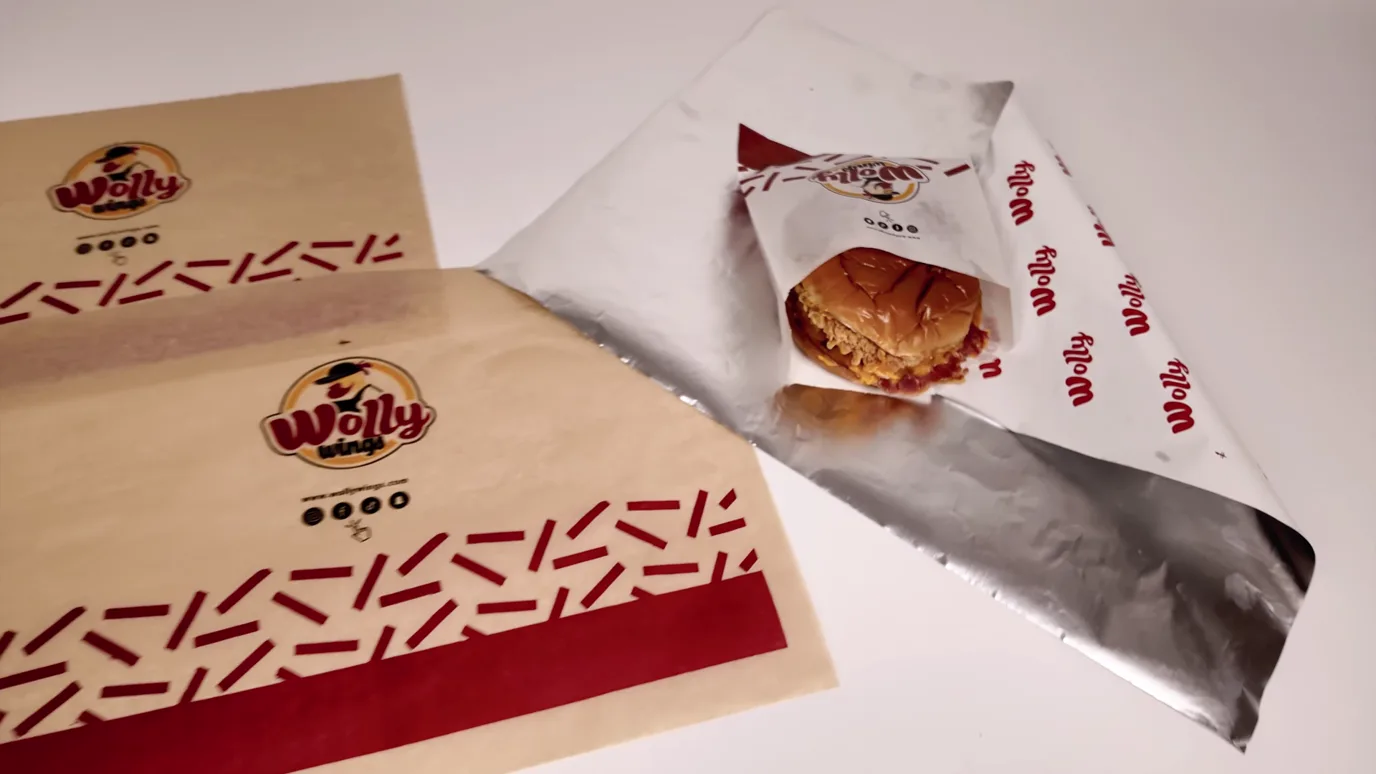
A distributor writes: 115,000 printed tray liners, one colour, FOB price please. No grammage, no sheet size, no grade, no delivery country. The enquiry is written in the language of a price list, where a tray liner is a code and a price per thousand. On our side that line opens into five decisions before a price exists.
Wholesale is not a bigger order of the same sheet; it is a different specification sheet. A restaurant buys a tray liner that fits its tray and its burger. A distributor buys a sheet that has to fit a hundred customers’ trays, sit on a pallet in a known count, carry a price per thousand that leaves room for resale, and come with the two documents its own customers will ask for. This article answers the distributor’s enquiry from the manufacturer’s side: which grade belongs on a tray and which around a burger, how grammage and format drive the price per thousand, how the quantity is really counted, what print at this volume looks like, why we quote EXW rather than FOB and which documents belong in the product file.
What does a distributor’s enquiry look like, and what is missing from it?
It names a quantity, a colour count and an Incoterm, and it leaves out grade, grammage, sheet size, print layout and delivery country. All five are needed before a price per thousand exists, and three of them (grade, grammage and size) move the price as much as the quantity does. The 115,000 sheets in the enquiry sound like a large order, and in sheets they are; in weight they are not. A sheet of 300 × 400 mm at 35 g/m² weighs about 4 g, so 115,000 of them weigh roughly 480 kg. In weight that is about one pallet, and that matters for the freight line more than anything else does: a tray liner order is counted in pallets.
What we send back is a short list rather than a price: which grade, which grammage, which sheet size, diagonal repeat or centred print, how many colours, delivery country and Incoterm, and whether the artwork exists. With those answers the price per thousand follows quickly. Without them a quote would be a guess dressed as a number, and a distributor who resells it would be guessing twice.
Dry wax, greaseproof or coated kraft: which grade for a liner, which for a wrap?
A tray liner takes a light greaseproof or sulphite paper; a wrap around a hot burger needs more grease resistance, for longer. Silicone baking parchment is an oven paper and a different product. Our wrapping and tray papers come in natural and white kraft, sulphite, greaseproof, waxed paper, and PE- or PP-coated kraft, from 27 to 110 g/m². On a tray the paper sits under a box and a drink, catches a few drops and is thrown away with the tray; a light greaseproof or a sulphite paper at the lower end of the range is the usual choice, and a printed kraft works where the look matters more than grease. Around a hot burger a heavier greaseproof or a coated kraft holds; waxed paper, dry wax in the trade, suits cold, moist food. Which grade suits which food is covered in our article on wrapping paper grades; here the point is commercial. Grade comes first. It is the first line of the price list, and a distributor usually needs two, a liner grade and a wrap grade, under one design.
How do grammage and sheet size drive the price per thousand?
Paper is bought by weight and sold by the sheet. So the price per thousand sheets is, to a first approximation, the paper in the sheet plus the converting and the print. A 300 × 400 mm sheet at 35 g/m² carries about 4 g of paper; the same sheet at 50 g/m² carries 6 g. The heavier sheet is not a better tray liner, it is a heavier one, and it costs more per thousand for the paper alone. The same applies to the format: 250 × 350 mm is 0.0875 m², 300 × 400 mm is 0.12 m², and the larger sheet carries about a third more paper at the same grammage. A distributor who lists one liner at 250 × 350 and one at 300 × 400 is listing two prices, not one.
The standard sizes on our product page come in two layouts with two different lists. Diagonal print, where the design repeats across the sheet, runs from 200 × 300 to 350 × 500 mm and carries 320 × 400 mm; centred print, where the design sits in the middle, goes up to 400 × 500 mm and carries 300 × 400 mm. For tray liners 250 × 350 mm and, depending on the layout, 300 × 400 or 320 × 400 mm are the formats we are asked for most, because they cover the common fast-food tray; a size outside the lists is evaluated against production specifications and needs its own cutting size. At wholesale volume that is worth a question: a distributor that can align its customers on one standard size buys the same sheet for all of them, and the price per thousand reflects it.
How is the quantity actually counted: sheets, cartons, pallets?
In sheets at the quote, in cartons at dispatch and in pallets on the lorry. The three counts have to match on the order confirmation. Our minimum is 10,000 sheets per design and size; a distributor’s order is a multiple of the carton count, and the carton count depends on grammage and format, because a carton of 27 g/m² sheets holds more than a carton of 50 g/m². We state sheets per carton and cartons per pallet on the quote once grade, grammage and format are fixed, and a distributor should ask for both, because its own price list is per thousand and its warehouse counts cartons. Pallet type and dimensions go on the quote as well. The 115,000 sheets from the enquiry, at 300 × 400 mm and 35 g/m², are roughly one pallet; the same quantity at 400 × 500 mm and 50 g/m² is two or more.
A note from our warehouse that applies at any volume: paper is sensitive to humidity and to pallet handling, and a cockled liner looks wrong on the tray however good the print is. Cartons are stretch-wrapped on the pallet, and a distributor who breaks pallets into cartons for resale keeps the cartons closed until they reach the customer.
Print: one or two colours, repeat pattern, plate once
Tray liners are printed flexographically, up to four colours with Pantone matching, and at wholesale volume one or two colours in a diagonal repeat is the common choice. One colour, one plate. One make-ready, one ink; a logo in a single Pantone brown or red on white greaseproof is the classic tray liner, and it prints in one pass. Two colours double the plates and the registration work; four colours make sense for a brand design, rarely for a distributor’s own-label liner. The diagonal repeat has a practical reason beyond the look: the artwork is one repeating motif rather than a drawing positioned for each format, so a second size is a small artwork step. The plates themselves are made per design and size in both layouts.
The plates are made once for a design and size and reused on every repeat order with unchanged artwork, which also removes the artwork approval step from the repeat; a distributor that standardises on one design and two sizes pays for two sets of plates and then prints from them for years. New artwork, new plates. Ask for the plate cost as its own line on the quote; a distributor reselling the liner has to know what a second design costs its own customer.
FOB, EXW or DAP: what the distributor’s price list needs
We quote EXW Istanbul, and FOB is the wrong term for a lorry. FOB, free on board, belongs to sea freight: the seller loads the goods on a named vessel at a named port, and the price includes export clearance and loading. The enquiry named no delivery country; for an overseas distributor shipping by container, FOB at a Turkish port is a legitimate ask, and we answer it with EXW or FCA Istanbul. Deliveries to European distributors go by road, and a road shipment has no vessel and no port of loading. What a landed-cost price list wants is a price that already contains the export side, and on a lorry the term for that is FCA: the goods are handed to the buyer’s carrier at a named place, export-cleared, and from there the cost sits with the buyer. A distributor that wants the manufacturer to carry transport to its warehouse asks for DAP, and then the price contains transport but not import VAT or duty.
For a distributor’s price list the difference matters twice. Once because its landed cost per thousand is EXW price plus transport, customs and handling, and only a delivered term makes that visible on the quote. And once because the forwarder is the distributor’s under EXW and FCA, and the manufacturer’s under DAP; whoever books the lorry gives the delivery date. What each term contains and leaves out is in our article on EXW, FCA or DAP; for the price list the short version is: ask for FCA if your forwarder collects, DAP if ours delivers, and never for FOB on a road shipment.
Which documents do distributors ask for: food contact, PFAS, origin?
Three: a declaration of compliance for food contact, a PFAS declaration for the paper and the fibre origin for due diligence. All three belong in the product file before the first pallet moves. The base document is the declaration of compliance, which confirms per grade that paper and inks are suitable for food contact. Grease-resistant papers are the product group most often asked about PFAS, because fluorochemical treatment was for years the easy way to make paper repel fat, and since the EU ban on PFAS in food contact packaging came into force in August 2026 the question comes with almost every tray liner enquiry. The declaration sets out for the specific grade what the paper does and does not contain; what the ban covers and how to read the declaration is in our PFAS article. The third is the origin: the EU deforestation regulation requires due diligence on the fibre origin of paper products from 30 December 2026, and the due-diligence statement is filed by the EU importer, the distributor itself, which needs the fibre origin from the manufacturer to do it. Ask for these documents per grade; file them per grade rather than per supplier, because a change of grade is a change of document.
From a distributor’s enquiry to a price list, then, the path runs through grade, grammage, format, layout, colour count, Incoterm and the documents. Send us the grade or the food it is for, the grammage if you know it, the sheet size or the tray size, the number of colours and whether the artwork exists, the annual volume, the delivery country and the Incoterm you need; we come back with the price per thousand by grade and size, at the quantity breaks you name, sheets per carton and cartons per pallet, the lead time of around 10 to 15 working days after artwork approval, and the documents for the file; ask for unprinted sample sheets of the grades too. The full list of papers, grammages and standard sizes is on our page for wrapping and tray papers.
In short
- The minimum for printed tray liners at Bas Packaging is 10,000 sheets per design and size; at wholesale volume the price is quoted per thousand sheets by grade, grammage and format.
- A tray liner takes a light greaseproof or sulphite paper at the lower end of the 27 to 110 g/m² range; a burger wrap needs more grease resistance, and baking parchment is a different product.
- Grammage and format drive the price per thousand: a 300 × 400 mm sheet at 35 g/m² carries about 4 g of paper, and 115,000 of them are roughly one pallet.
- Standard sizes run to 350 × 500 mm in diagonal repeat and to 400 × 500 mm in centred print; 250 × 350 mm and, by layout, 300 × 400 or 320 × 400 mm are the usual tray liner sizes.
- Printing is flexographic, up to four colours with Pantone matching; plates are made once per design and size and reused on unchanged repeat orders.
- Bas Packaging quotes EXW Istanbul; FOB belongs to sea freight, FCA covers export-cleared handover to the buyer’s carrier, DAP a delivered price without import VAT; ask for food contact, PFAS and fibre-origin documents per grade.
Frequently Asked Questions
- What is the minimum order for printed tray liners?
- With us 10,000 sheets per design and size, and the figure is the same whether a restaurant or a distributor orders. What changes at wholesale volume is the unit of the price: a distributor needs the price per thousand sheets by grade, grammage and format, plus sheets per carton and cartons per pallet, because its own list is per thousand and its warehouse counts cartons.
- Which paper grade is right for a tray liner?
- A tray liner carries food for minutes and gets a little grease on it, so a light greaseproof or sulphite paper in the lower part of our 27 to 110 g/m² range does the job. A wrap around a hot burger needs more grease resistance and often a coating; a waxed paper suits cold, moist food. The grade decides the price per thousand more than the print does.
- Which sheet sizes are standard?
- Our standard list runs to 350 × 500 mm in diagonal repeat and to 400 × 500 mm in centred print. For tray liners 250 × 350 mm and, depending on the layout, 300 × 400 or 320 × 400 mm are asked for most; other sizes are evaluated against production specifications at a separate cutting size. At wholesale volume it is worth asking whether one standard size covers all your customers.
- Can you quote FOB?
- We quote EXW Istanbul; FOB belongs to sea freight and names a port of loading, which our European deliveries by road do not have. A distributor who wants a price including loading and export clearance asks for FCA Istanbul, and one that wants a delivered price asks for DAP to the warehouse; FCA runs with your forwarder, DAP with ours. The difference is explained in our article on EXW, FCA and DAP.
- Which documents do distributors ask for on tray liners?
- Three: the declaration of compliance for food contact as the base document, a PFAS declaration for the paper, because grease-resistant papers are the group most often asked about those chemicals, and the fibre origin the EU importer needs for its due-diligence statement under the deforestation regulation from 30 December 2026. Ask for all three per grade.
Related Articles

EUDR from 30 December 2026: your paper packaging needs an origin
From 30 December 2026 the EU Deforestation Regulation covers pizza boxes, bakery bags and paper cups the moment they enter the EU as goods. Buy them from outside the EU, and since Brexit that includes a supplier in Leeds, and you are the operator who has to prove where the fibre grew. Which datasheet line decides whether a bag is in scope, what your supplier has to hand over, and where the EUDR stops and LUCID starts.

The EU PFAS Ban on Food Packaging: What to Check Now
Since 12 August 2026 the EU has banned PFAS above strict limits in food-contact packaging. What it means if you sell into the EU, which packaging is actually at risk, and the five questions to put to your supplier.
Wrapping Paper: Which Grade for What You Are Wrapping
The only question anyone asks about wrapping paper is whether it is greaseproof. There is a second test though, and it is moisture. Paper that holds grease back holds steam back too, and then you get a soggy bun instead of a stain.