Deutsch
 Français
 Türkçe
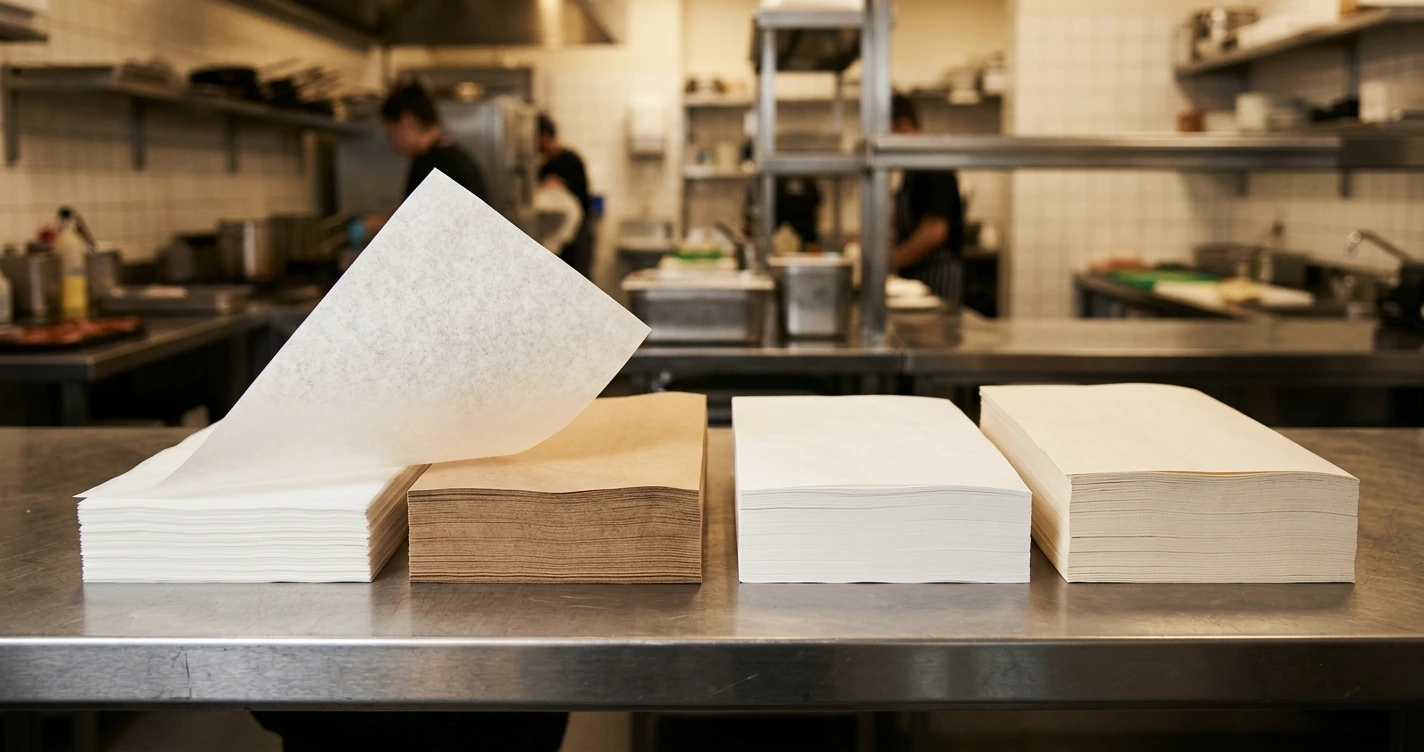
Same paper, two opposite complaints. One burger site says the grease is coming through and customers are picking up a stained wrap. Another says the opposite: open the wrap and the top of the bun has gone damp. Both bought the same grade from the same supplier.
Ask anyone choosing wrapping paper what they need and the answer comes back as one question: is it greaseproof? There is a second test the paper has to pass, and almost nobody asks about it. The listings do not help either. They give you the name of the paper and its dimensions, and nothing at all about what it was meant to go around.
Grease is one axis. Moisture is the other
The paper is managing two things trying to get out of the food at once: fat and steam. They travel the same direction, and the fixes point opposite ways.
To stop grease you tighten the paper or put a coating on it. That coating stops steam as well. Wrap a hot burger in a fully barriered sheet and the grease stays put, quite true, but the steam has nowhere to go either. It condenses under the paper and lands on the bun. One shop's complaint is a stain, the other's is a soggy top. Both come from the same decision.
So the useful question is not whether a paper is greaseproof. It is this: how hot is this product, how fatty, and how long does it sit in the paper? Line those three answers up and the grade picks itself.
Four situations, four different grades
Matched to what you actually sell, it usually falls out like this:
- Hot and fatty, eaten straight away: burgers, toasties, wraps. Grease resistance matters, a fully closed structure does not, because the thing gets eaten within minutes. Greaseproof paper handles it.
- Dry and ambient: biscuits, pastries, anything from the dry side of the counter. Low fat, next to no steam. Natural or white kraft is enough and more is wasted.
- Hot with a journey ahead: tray liners, catering volume, longer deliveries. Steam is the main enemy here and the sheet needs to let it move.
- Cold and moist: cheese, charcuterie, the butcher's counter. That one earns its own section, because the logic runs backwards compared with the other three.
We put the paper grades and coatings side by side once already in our material and barrier guide. What matters here is not the material in the abstract but which job the sheet is being sent to do.
The deli counter: breathing against barrier
With cheese and cured meat the aim is not to trap moisture at all. This is the part of the subject that gets misunderstood most often.
A mature cheese gives off moisture slowly. If that moisture cannot leave, it sits under the paper, wets the surface and the product looks like it is sweating in the cabinet. The opposite happens too: in a sheet with no barrier whatsoever, the product dries faster than it should, the cut face hardens, and colour drains out of salami and ham. The paper's job is not to stop moisture. It is to set the speed at which moisture leaves.
In practice that means one grade rarely covers a deli counter. A fatty product at risk of leaking and a mature cheese simply do not behave alike. When you see two grades sitting side by side behind a supermarket counter, that is a considered choice rather than an oversight.
Print layout quietly shortens your size list
Here is the detail that costs the most time at ordering and is the least known. Wrapping paper comes in two print layouts. On a diagonal print the design repeats across the sheet at an angle; on a centre print it sits once, in the middle. It looks like a purely visual choice. It is not.
The two layouts do not carry identical size lists. Seven of the ten sizes are common to both. Three exist only in one layout:
- In both: 200×300 · 250×250 · 250×300 · 250×350 · 300×300 · 350×400 · 350×500
- Diagonal only: 300×350 · 320×400 · 350×350
- Centre only: 300×400 · 400×400 · 400×500
Two things follow. If you need the largest sheet, your route runs through centre print, because 400×500 exists nowhere else. If you want a square sheet, 350×350 is diagonal only. In other words the layout belongs ahead of the size. Leave it until afterwards and you learn that your format does not exist in that layout, and the whole thing starts again.
What a 27 to 110 g/m² range is telling you
Wrapping paper runs from 27 to 110 g/m². That is a wide band, and the width itself says something: a product sold under one name is doing completely different work at its two ends.
The thin end is for wrapping, separating and moving quickly on a counter. As you climb, the sheet stops behaving like a wrap and starts behaving like a base: it lies flat in a tray, carries the grease underneath it, and comes away without tearing.
The most common mistake we see is a thin sheet pressed into service as a tray liner. It wets through, sticks down, tears when someone lifts it, and service slows. Nothing wrong with the paper. It was sent to the wrong job.
A tray liner and a wrap are not the same product
Most catalogues file them under one heading, and that merge is the single most common cause of a wrong order.
A wrap goes around the product, so it needs to give: fold it and it must not crack. A liner lies flat with the product on top of it, so it needs to hold: wet it and it must keep its shape. No single sheet does both well, and choosing for one means giving something up on the other.
Most kitchens use both and order one line. Treating the two uses as two specifications on wrapping and tray papers gets both jobs done properly on the same budget. You can see which grades sit alongside the rest in the wrapping and tray papers range.
What to send before you order
The list that shortens a quote round stays short:
- What is being wrapped, and whether it is hot when it meets the paper. The grade comes out of those two answers.
- How long it stays in the paper: minutes, a shift on the counter, or days under refrigeration.
- Wrap, tray liner, or both. They are separate lines.
- Print layout, diagonal or centre. Your size list narrows accordingly.
Printing runs up to four colours flexographic with Pantone matching available. Minimum order is 10,000 units and production takes roughly 10 to 15 working days after artwork approval. Unprinted production is available too, and operators running several grades usually brand the one that turns over most and take the rest plain.
When you ask for samples, do not ask for one sheet. Ask for two grades side by side and test both against your own product. What no specification table can show you, a burger left sitting for ten minutes will.
Frequently Asked Questions
- Which wrapping paper should I use for burgers?
- For hot, fatty products eaten straight away, a grease-resistant paper is enough. A fully closed barrier is not wanted, because it traps steam and that lands on the bun. The decision comes down to how fatty the product is and how long it sits in the paper before someone eats it.
- Does heavier paper resist grease better?
- No, those are two separate properties. Grammage adds stiffness and tear resistance, while whether fat travels through the sheet depends on how the paper is built or treated. Going heavier for a greasy product gives you a thicker sheet with the same mark on it.
- What paper suits cheese and charcuterie?
- The aim is not to trap moisture but to set the rate at which it leaves. Block it completely and the surface wets and the product looks like it is sweating; hold nothing back and it dries too fast, with a hardened cut face. Because a fatty product and a mature cheese do not want the same sheet, deli counters usually run two grades together.
- What is the difference between diagonal and centre print?
- On a diagonal print the design repeats across the sheet at an angle; on a centre print it sits once in the middle. Beyond the look, there is a practical consequence: the two layouts do not carry identical size lists. 400×500 exists only in centre print and 350×350 only in diagonal, which is why the layout is chosen before the size.
- Are wrapping paper and tray liner the same thing?
- They sit in the same category but do different work. A wrap goes around the product, so it has to fold without cracking. A liner lies flat under the product, so it has to keep its shape when wet. Ordering the two as a single line is the most common mistake we see.
- What is the minimum order on wrapping paper?
- The minimum order is 10,000 units, and production takes roughly 10 to 15 working days after artwork approval. Printing runs up to four colours flexographic with Pantone matching available. Unprinted production is also possible, so operators running several grades often brand only the highest-turnover one.
Related Articles
Food-Grade Packaging: What to Actually Check Before You Order
Food-grade is not a finish line — it is the floor. Here is what really decides whether printed cups, boxes and bags are safe for the food they hold, and the one document worth asking for every time.
Paper, Grammage and Barriers: Which Material for Which Food
The same box holds a burger perfectly and fails under a curry. The difference is not the board, it is the layer on it. What grammage actually changes, which barrier suits which dish, and how to test material with your own food before you commit.

What Your Packaging Supplier Needs Before They Can Quote
Three suppliers, three prices, three different bags. Most packaging quotes are unusable because the enquiry described a logo instead of a product. Here is the brief that gets you comparable numbers.