
 Deutsch
 Français
 Türkçe
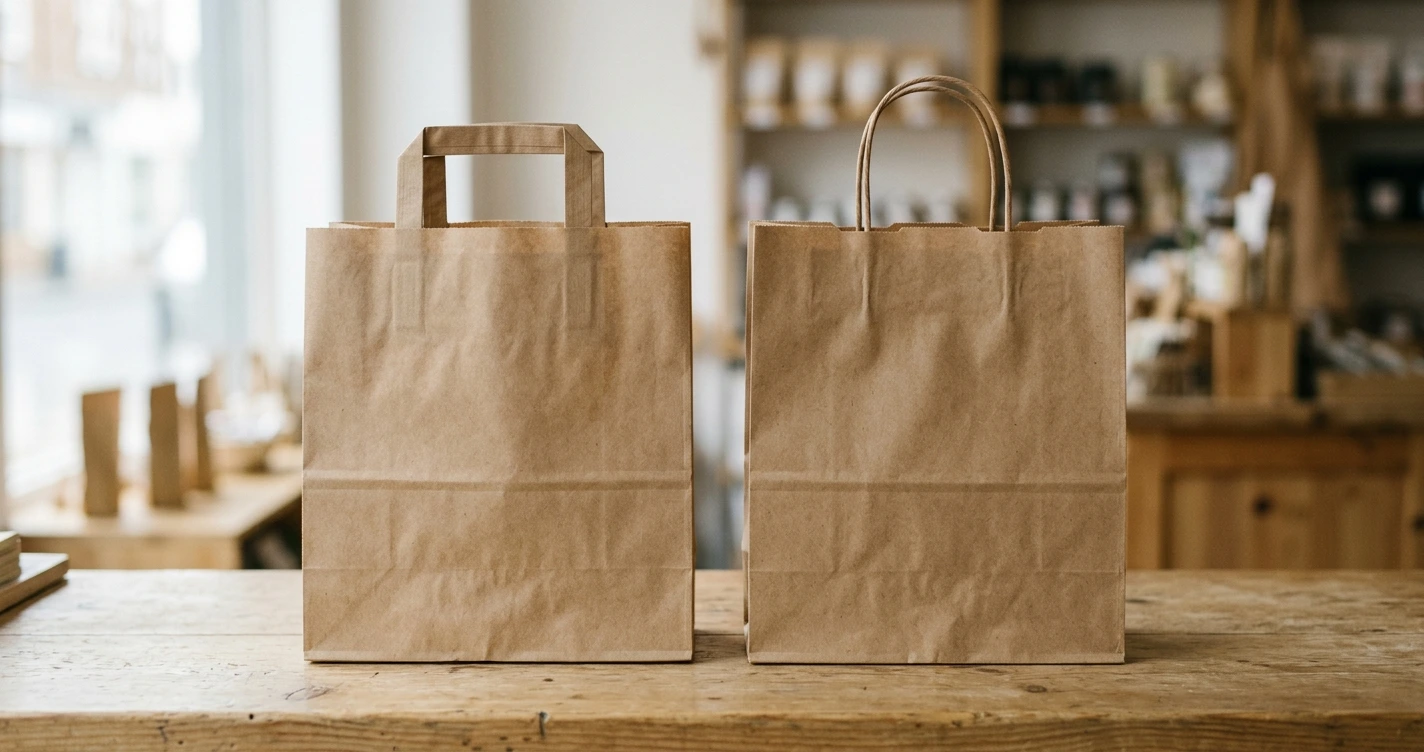
Flat vs Twisted Handle Paper Bags: Which to Choose
Last reviewed:
The short answer first: for bakeries, takeaways and fast counter retail, the flat handle is almost always the economical and entirely sufficient choice. The twisted handle earns its price where the bag is part of the presentation: gifting, boutiques, longer carries. If you take away only those two sentences, you are already deciding better than the catalogue photos suggest. The rest of this page explains why, and where the exceptions sit.
What actually separates the two handles
A flat handle is a paper strip folded several times and glued to the bag wall across a broad patch. A twisted handle is paper turned into a cord and anchored as a loop at smaller points. From the production side this is a genuine difference: the cord demands an extra manufacturing stage, since the paper must first be twisted, then cut and inserted, while a flat handle forms in one continuous process with the bag. That additional work is the real reason for the price gap, not any difference in quality.
The same construction explains the feel. A cord sits round in the hand and digs in less on longer walks; a flat handle spreads its load across a larger glued area on the wall. Which is why turning the strength question into a handle duel misses the point: in practice, whether a bag holds is decided by the attachment, not the handle shape. We took apart why bags almost always tear at the glue patch, and what that means for buying, in our piece on why paper bag handles tear.
The everyday test: two shops, two right answers
Picture two businesses on the same street. The bakery hands over rolls and cake boxes at one-minute intervals on a Saturday morning. What matters there is that bags lie flat within reach, open with one hand and cost little per unit, because they are consumables in the best sense. A twisted handle would improve nothing at that counter; it would only raise the purchase price. Two doors down, a gift shop sells candles, wine and boxed sets. The bag leaves as part of the present, gets carried further and often stands in the customer's hallway for weeks. There the cord pays into exactly what it was built for: grip, presence, perceived value.
Between the two sits the most common grey zone: cafés and delis that are both everyday counter and gift business. The workable answer there is rarely a compromise handle but two bags: an economical flat handle bag for daily trade and a smaller run with twisted handles for presents and promotions. Two clear roles beat one unclear middle way, in the costing too.
Cost, storage and speed: the invisible arithmetic
The unit price is the visible part of the difference, but not the whole of it. Flat handle bags lie completely flat in the case and take noticeably less shelf space per thousand; at a busy counter it also counts that they open and fill in a single movement. Cord bags carry more material at the anchor points, stack slightly bulkier and want two hands to open. Taken singly these are small things; across a year of daily volumes they add up to real differences in storage and handling. There is, however, a limit to this arithmetic: for small gift runs, efficiency hardly matters, and there the look may decide without anyone doing sums.
The stubborn myth: the cord carries more
Because the cord looks sturdier, many buyers assume it is the stronger choice. In practice that does not hold as a rule. The flat handle spreads load across a broader glue area; the cord concentrates it on smaller points. Which bag survives depends on the quality of the attachment, the grammage and the base, not on the handle shape. We see it regularly in sample checks: a cleanly attached flat handle passes the jerk test while a poorly glued cord bag fails on the first lift, and the other way round. If you sell heavy goods, do not ask about the handle; ask about the reinforcement behind the attachment, and ask for a sample to run your own rough test.
Print and presence: where the cord genuinely wins
On print, both take ink the same way; kraft stays kraft. The difference is the effect of the whole object. A cord bag signals gift and value before anyone reads the logo, which is exactly why fashion and gifting standardised on it. For the everyday bag the reverse holds: a calm logo on a clean flat handle bag reads more professional than a cord that is visibly too much for a sandwich run. The bag should match the occasion; overdressing reads like a priced-in surcharge.
Ordering in practice: volumes, designs, samples
The role split carries into ordering strategy. The everyday flat handle bag runs in larger, plannable volumes, where a single calm permanent design pays off, since every design change costs set-up. The gift bag runs smaller and is reordered less often, so it rewards deciding format and design thoroughly once rather than changing yearly. Ordering both from the same manufacturer saves twice: the print stays consistent and deliveries can be bundled. And for both, the first step before any run is the same: one sample each, filled with your own goods, carried once dry and once after brief rain. Only then is a quantity a decision rather than a hope.
Colour and material: the combinations behind the handle question
The handle rarely ends the decision, because both types come in several finishes, and the combination changes the effect more than the handle type alone. Brown kraft with a brown flat handle is the quiet classic of the counter: understated, natural, at ease with almost any logo. White paper with a white cord plays a league up and is the gifting standard, though it demands artwork that can carry the bright surface. Coloured cords, finally, are the cheapest route to bringing a bag onto brand colour without printing the whole surface: a plain brown bag with a cord in the company shade often looks more considered than a flooded print, at a fraction of the cost.
A practical note from the production side: solving colour through the cord rather than the printed surface keeps reorders flexible, because the bag itself stays a standard item and only the handle material changes. For seasonal looks, say a red cord on the same brown bag for Christmas trade, that is the fastest and cheapest route to a fresh appearance without a new printing plate.
Staying honest: what neither handle solves
Both handles sit on paper, and paper has limits. Very heavy single items, wet goods and rain shift the question from the handle to the construction: grammage, base fold, sometimes a second bag. The volume question remains too: printed bags make sense from realistic quantities, and one design instead of three cuts set-up costs noticeably. If in doubt, order samples of both handle types and test them with your own goods, your own walk and your own weather; twenty minutes of practice replaces any catalogue debate. And if your goods sit badly in either bag, that is not a defeat but a signal that a different format is the better answer.
| Criterion | Flat handle | Twisted handle | Winner |
|---|---|---|---|
| Cost per unit | Lower, one continuous production process | Higher, extra cord-forming stage | Flat handle |
| Carrying strength | Broad glue patch spreads the load | Strong cord, smaller anchor points | = |
| Grip comfort | Flat, less comfortable on long carries | Round and pleasant, digs in less | Twisted handle |
| Storage and counter speed | Lies flat, little space, opens one-handed | Slightly bulkier, needs two hands | Flat handle |
| Perceived value and gifting | Practical and professional | Clearly more premium feel | Twisted handle |
| Fit for high volumes | The standard for bakeries, takeaways, retail | Better for smaller, representative runs | Flat handle |
Which to Choose?
Choose flat handles for bakeries, takeaways and fast retail, wherever many bags cross the counter daily. Choose twisted handles for boutique, gift and promotional use, where grip and perceived value make the difference. Businesses living in both worlds do best with two bags in two roles.
Verdict
For counters, takeaways and high volumes, the flat handle is the economical and entirely sufficient choice. The twisted handle wins where the bag is part of the presentation: gifting, boutiques, longer carries. On strength, the attachment quality decides, not the handle shape.
