Deutsch
 Français
 Türkçe
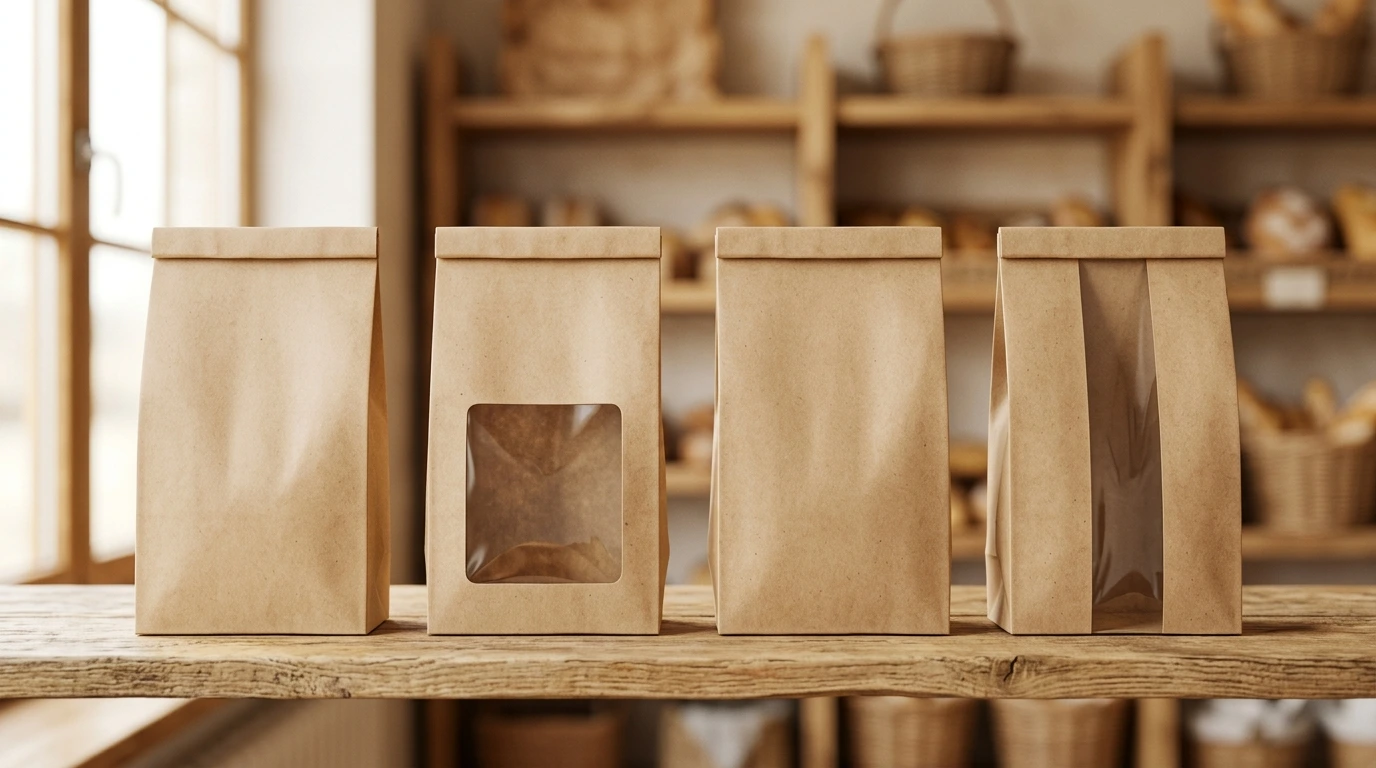
Short answer: the window and the print are competing for one surface. The front panel of a bag is fixed, so whatever you open up to show the product comes straight off the area that shows your brand. Which way to go depends on the product, because some things sell themselves on a shelf and some are sold by the name on the bag.
Operators who order without settling that question go wrong in both directions. Some cover the bag in branding and make the contents invisible. Others cut a window so large there is nowhere left for a mark; the product shows, and nobody can tell whose product it is.
The pages that come back in a search never frame this. Window bags are listed, dimensions are given, and not one line explains what the window is taking the place of.
What a window fixes, and what it does not
A window has exactly one job: showing the product at the moment of purchase. Instead of asking a customer to read a label to work out what is inside, you show them.
Where that pays is fairly clear. If the look of the product creates appetite, if varieties are told apart by eye, or if a shopper picks between two things on the same shelf by shape, a window earns its place. Biscuits, chocolate, nuts, confectionery and fresh bakery all sit in that group.
What it does not do is equally clear: a window does not create freshness. The longer the product sits, the longer its visible face sits too, and a pastry that has dried out looks worse behind a clear panel than it did hidden in a closed bag. Visibility cuts both ways.
The window and the print share one face
This is the point that takes up most of the conversation at ordering. The front of a bag is a single area, and two requests arrive at once: show the product, and make the logo big.
Three layouts do the job in practice:
- Window centred, brand above it: the logo runs as a band across the top. The most common answer, because the eye lands on the band first and the product second.
- Window lengthwise, brand to the side: a narrow, tall window with the mark set vertically. This works on long products and baguette-style bakery.
- No window, full print: the product stays hidden but the whole face belongs to the brand. Closed bag, strong name.
On flat window bakery bags both centred and lengthwise window shapes are available, and the size and position are customised to the product and the bag specification. The window goes where your product needs it rather than where a template puts it.
The size ladder does not change
Here is the fact that shortens the decision and that most buyers do not know: the window version runs in exactly the same standard sizes as the plain one. Put the two tables next to each other and the ladders match line for line.
On the flat side the sizes start at 120×155, pass through the middle range around 150×200 and 160×175, and run out to 200×80×205. On the block bottom side the fill weights sit beside the dimensions: 100×57×180 for 250 g, 125×70×250 for 500 g, 125×70×300 for 1,000 g.
What that means in practice: a patisserie running 150×200 today measures nothing again when it moves to a window bag. Same line, different face. When you ask for samples, "the window version of the size we run now" is a complete brief, and that one sentence takes a round off the quote.
Flat or block bottom: the window does not decide, the shelf does
The window does not pick the format. How the product has to stand on a shelf picks the format.
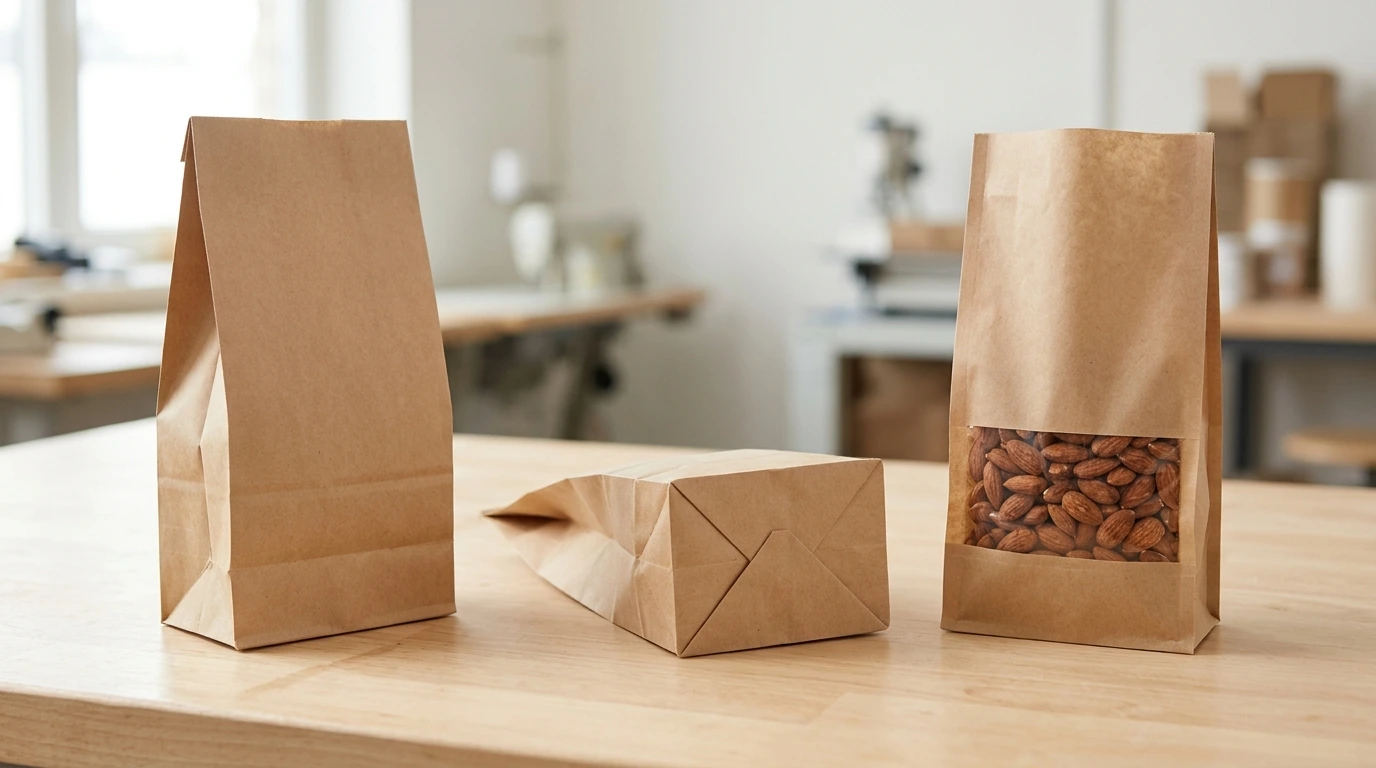
A flat bag lies down. It suits horizontal display and counter service, takes up little room, and fills and folds quickly. A block bottom bag, in its window block bottom version, stands up instead. It lines up in a row, takes a label, and holds the window at eye level.
For anyone selling weighed goods that distinction gets sharper. Fill weights appear beside the sizes on the block bottom range precisely because those bags were built for weighed product. With nuts, coffee and dried fruit you tend to need standing and a window at the same time.
If you skip the window, look at white
Visibility comes in more than one form. Showing the brand strongly instead of showing the product is a strategy too, and for that the way the surface takes print starts to matter.
On white kraft block bottom bags the surface is clean and bright, so brand colours come out truer and more vivid than they do on brown kraft. For products that have to catch the eye without showing what is inside, that option competes directly with a window.
The decision comes down to one question: does the customer buy this by looking at the contents, or by trusting the name? With nuts it is usually the first. With roasted coffee it is usually the second.
The honest limits: recycling and hot food
This subject is not finished without the cost of a window.
Take recycling. A paper-based bag on its own is suitable for recycling; adding a window complicates the picture. Recyclability then depends on the paper, the window material, the adhesives and any added coatings together. Compostable window material options can be evaluated according to product and production requirements, but writing an unconditional "window bags recycle" would not be honest. Which collection system it reaches changes the outcome as well.
Then there is heat and grease. A window is a clear material, and hot, oily product is harder on it than on paper. Put a freshly baked, buttery pastry into a window bag and leave it on a shelf and you may well see misting and marks on the panel. On those products, either a smaller window or a closed bag gives a better result.
Three lines before ordering, and one calendar warning
The list that shortens a quote round is short:
- The size you run today. Since the window version sits on the same ladder, this one line usually covers it.
- How long the product sits on a shelf and whether it goes in hot. The window decision and the material choice come out of that.
- Where the logo sits relative to the window: above, or to the side. Artwork should be finalised after that decision, not before.
There is a calendar detail that slips past people. Minimum order is 10,000 units on all three, but the production times differ. Flat bags take roughly 10 to 15 working days after artwork approval; block bottom bags take 15 to 20. An operator running both formats gets two different delivery dates even when both are ordered on the same day. If you need them together, say so in the first message and the planning gets built around it.
When samples arrive, do not judge them empty. Put your own product in, line them up on a shelf and step back two paces. Whether the window is in the right place shows itself from two paces, never from the desk.
Frequently Asked Questions
- Are window bag sizes different from plain ones?
- No, the window version is produced in exactly the same standard sizes. On the flat side the ladder from 120×155 through to 200×80×205 applies unchanged, and on the block bottom side the fill-weight sizes carry over as well. Moving from the size you run today to a window version needs no re-measuring.
- Where does the window go on the bag?
- Window size and position are customised to the product and the bag specification, with centred and lengthwise shapes available. Three layouts cover most cases: window centred with the brand above, window lengthwise with the brand to the side, or full print with no window. The logo position is settled after the window decision.
- Can window bags be recycled?
- The answer has to be conditional. A paper-based construction is suitable for recycling on its own, but on a window bag the outcome depends on the paper, the window material, the adhesives and any added coatings together. Compostable window material options can be evaluated, and the local collection system affects the result too.
- Can hot or greasy products go in a window bag?
- They can, as long as the limit is understood. A clear window material is more sensitive to hot, oily product than paper is, so a fresh buttery pastry sitting on a shelf can leave misting or marks on the panel. For those products a smaller window, or a closed bag, gives a better result.
- What is the alternative to a window?
- Showing the brand strongly rather than the product is a genuine alternative. White kraft block bottom bags give a clean, bright surface, so brand colours print truer and more vividly than on brown kraft. The decision turns on one question: does the customer buy this by looking at the contents, or by trusting the name?
- What are the minimum order and lead times?
- Minimum order is 10,000 units on all three products. Lead times differ: flat bags take roughly 10 to 15 working days after artwork approval, block bottom bags 15 to 20. Operators running both formats should say in their first message if they need a single delivery date.
Related Articles
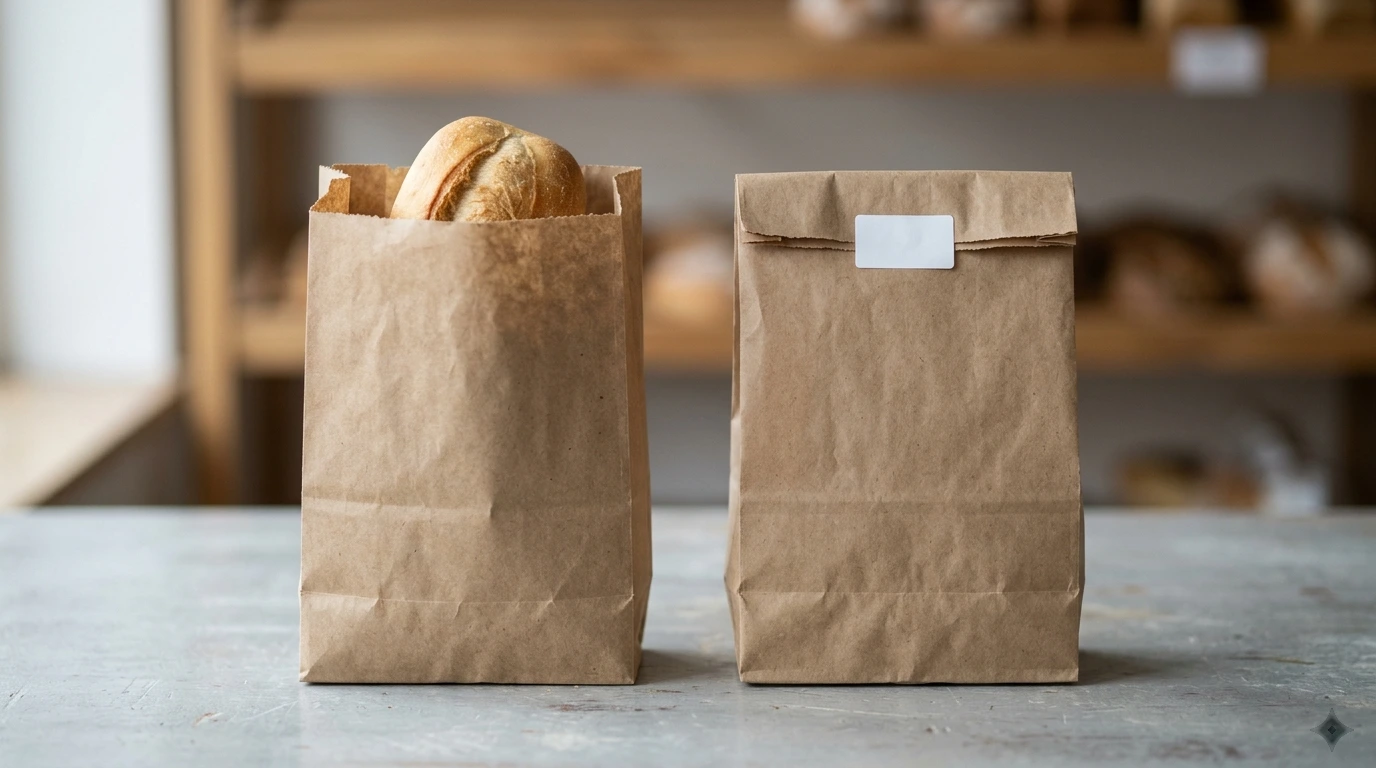
Bagged in Advance: What Has to Go on the Label
Whether your bag needs a full ingredients list is not decided by what is inside it. It is decided by whether the item was bagged before the customer asked for it.
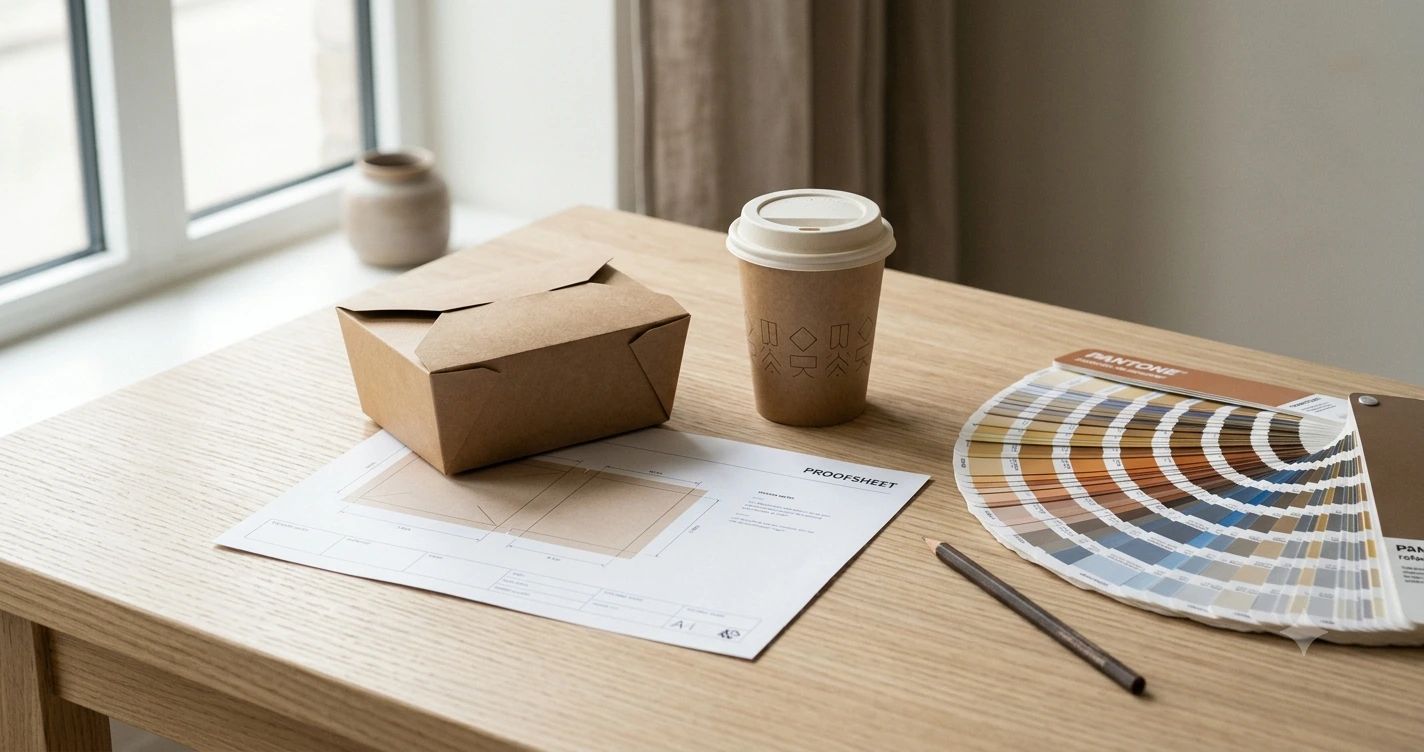
Custom Printed Food Packaging: Getting the Artwork Right
Before a print run starts, a good supplier asks three questions most buyers cannot answer. What they mean, why brown board changes your colours, what stays off the food-contact side, and how finishes quietly add cost.
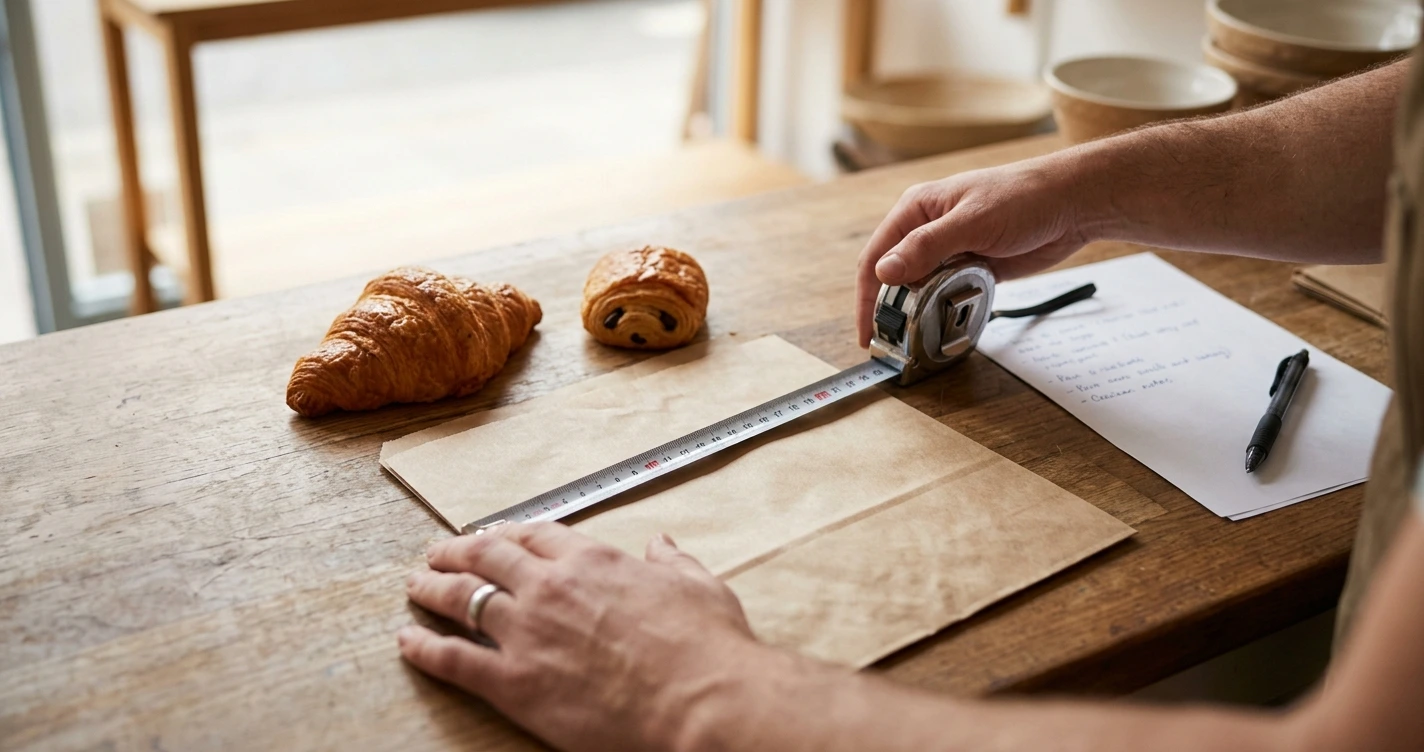
What Your Packaging Supplier Needs Before They Can Quote
Three suppliers, three prices, three different bags. Most packaging quotes are unusable because the enquiry described a logo instead of a product. Here is the brief that gets you comparable numbers.
Paper Bag Sizes: Which Size for Which Bakery Product
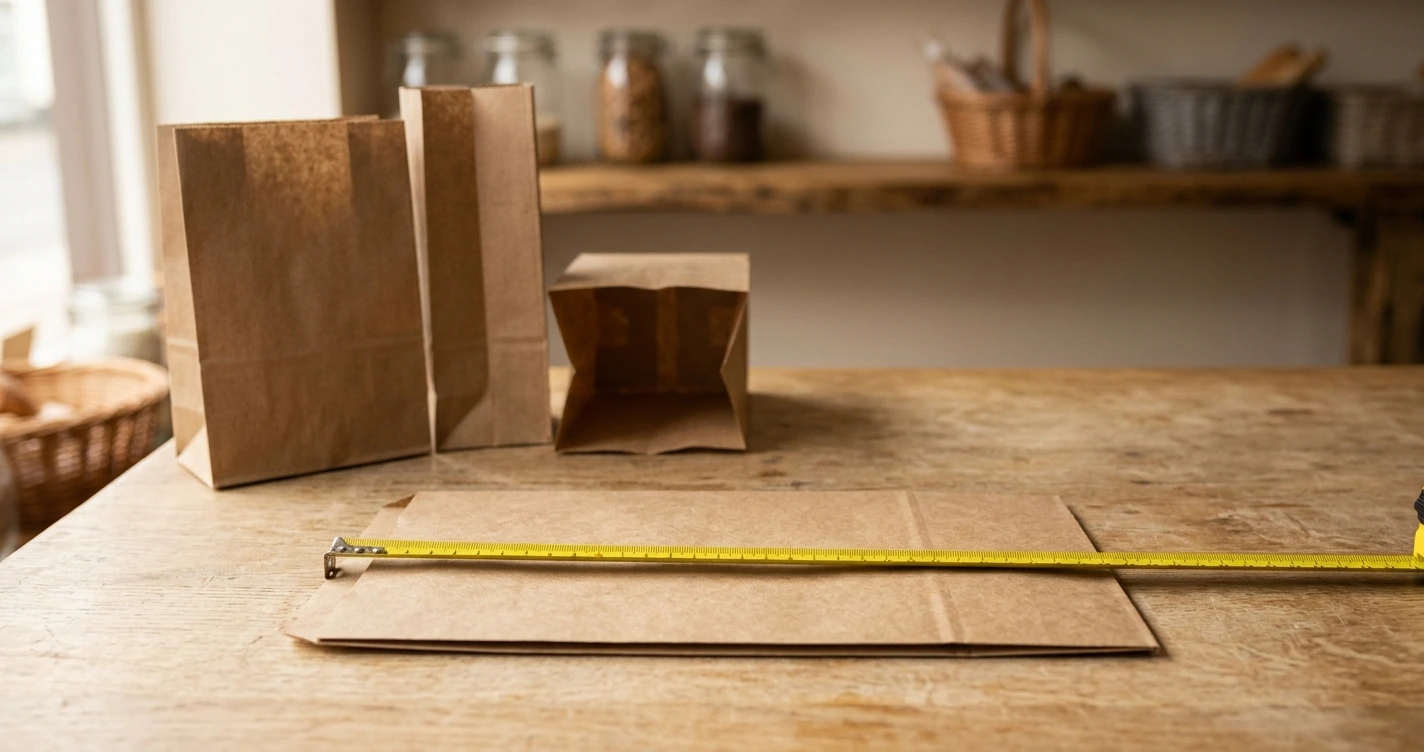
Size lists are everywhere. What is missing is the line telling you which one fits your product. How to work the size out from what goes in, what separates two numbers from three, and how to measure a bag you already use.
Printed block bottom bags: which base for which product?
Search for printed bottom bags and you are offered three different bags. Which of them stands empty and speeds up the counter, why a coffee roaster is at the wrong address with paper, how fill weights from 100 g to 2,000 g choose the size, what belongs on the side gusset and when the bag needs a second layer.