Deutsch
 Français
 Türkçe

The email comes from the head office of a bakery chain with sites across the Midlands and Ireland, two weeks before supplier approval: “We need a supplier audit for approval. Will a video session do, or do we have to travel?” The question is well meant and badly put. It assumes both options check the same thing.
They do not. A supplier audit at a packaging plant has parts that run better from a screen than from the factory floor, and parts that simply do not exist on a screen. Whoever knows which is which beforehand saves either the trip or the second appointment.
We are the plant being audited, so this is written from the unusual side: what a buyer or quality manager is right to demand of us, where a certificate saves them work, which exercise they should never accept pre-prepared, and what we learn from a good audit ourselves. It replaces neither your own audit standard nor your legal team; it describes what gets checked in practice and why.
When is the certificate enough, and when do you have to travel?
The certificate is enough for everything it expressly covers; you travel for what concerns only your products and your contact conditions. A BRCGS Packaging Materials certificate or an ISO 9001 certificate says that a site and its management system were audited against a standard, with scope, date and auditor. You need not repeat that audit. What no standard checks for you is the rest: whether the coating on your meal box is proven for your contact case, whether your print is hanging as a limit sample at the supplier’s own goods-out, whether a change of paper mill reaches you before the pallet leaves.
Then there is the obligation side. Most UK retailer codes build BRCGS or another GFSI-benchmarked certificate into their supplier approval criteria for food-contact packaging, and the schemes that your own site is certified to expect you to satisfy yourself that packaging suppliers are suitable; how you satisfy yourself is left to you. ISO 9001 asks for supplier evaluation without prescribing the tool. Both mean the same in practice: you may take a certificate as the basis, but you must be able to say why it is sufficient for your case. That reasoning is your audit, whether it takes two hours on a screen or two days in the plant. From our experience with chains and caterers a simple rule holds: read the certificate, mark the gaps, audit only the gaps. Whoever runs the full audit again checks cleaning schedules twice and the glass register not at all.
What does a remote audit really show, and what does it not?
It shows documents, records and the supplier’s ability to find both on request; it shows no factory floor. The BRCGS standard for packaging materials describes, in its seventh issue, a blended audit in which the remote part examines documented systems and records and the on-site part covers manufacturing and storage. The remote part may take at most half of the audit duration, and the option is open only at re-certification, not at an initial audit and not where certification has lapsed for more than two years. The certification body decides after a risk assessment whether the technology at the site allows a robust audit. That rule is not your yardstick, but it is an honest sign of how far the industry trusts the screen: up to half, and only when it already knows the site.
For your own supplier audit a division of labour follows. Remote works for: certificates with scope, declarations of compliance and migration test reports per item, specifications with tolerances, training records, cleaning and pest-control schedules as documents, complaint statistics, change management, contingency plans, the traceability exercise from records. Remote does not work for: the smell in the warehouse, the state of sieves and magnets, whether the glass register is complete, whether pallets stand on the floor, whether the hygiene lobby is used or bypassed. A camera shows what the supplier films. Which documents must sit in your file anyway for packaging sold into the EU since 12 August 2026 is set out in our guide to PPWR conformity and the supplier file; the remote audit is the appointment at which you hold that file against reality.
The traceability exercise: one batch, thirty minutes
The exercise runs like this: you name a batch number from one of your delivery notes, and within the agreed time the supplier shows the path to the paper lot, the ink batch, the production date and every other customer supplied from the same paper reel. Then the other direction: you pick a raw-material lot, and the supplier shows which items and customers it became. Regulation 1935/2004, retained in UK law after Brexit, requires traceability at all stages in Article 17; it names no time. The time is your agreement, and half an hour is no problem for a plant with a working system. Longer than a working day is a finding.
What matters is that the batch is yours. We have seen audits where the auditor took the batch the supplier had “prepared as an example” and left satisfied. That tests the presentation, not the system. Take a delivery from the last quarter, ideally one that raised a query. And check two side issues while you are at it: is the batch number on the carton, not just on the delivery note? And does it change with the paper lot, not just with the production day? Two pallets from one week can be two batches; whoever cannot see that in the system cannot block two pallets in a recall, only everything.
Foreign bodies, hygiene zones, glass: what does only the floor show?
Foreign-body sources, the separation of zones and the state of things that are always in order on paper; these three decide whether you travel. Foreign bodies first. In a packaging plant that means glass and hard plastic at lamps, windows, inspection panels and instruments; metal from cutting rules and tools; wood from pallets; paper dust and fibres. A plant keeps a register listing every glass and hard-plastic source and checks it on a schedule. Remotely you see the register. On site you see whether the lamp above the die-cutter is in it. Hygiene zones second: where does the area end in which pallets with road dust stand, and where does the area begin in which open packaging lies? Is there a lobby, and is it used? The rest is eyesight: magnets and sieves, pest monitors with dates, stock kept off the wall, no food in production, cleaning chemicals stored away from material.
With individually wrapped items the hygiene boundary moves to a place an audit easily overlooks. Our product page for wet wipes says, in the line on individual packaging, that each wipe is individually wrapped for hygiene, portability and brand visibility. For audit planning that sentence means: the seal of the sachet is the boundary beyond which no foreign body gets in and none is found. So at a supplier of custom printed wet wipes you check not only the wipe but the process before sealing: how seal integrity is tested, how often, who records it, what happens to an open seal in the sample. The same applies to cutlery sets in paper sleeves, whose product page also justifies the individual wrap with hygiene: the sleeve protects only while it is closed, and whether it is closed is decided at a machine that does not appear in a remote audit.
This is where the counter-argument we owe you as a supplier belongs. An on-site audit in Turkey costs you two days of travel and us a production day at half attention. We offer remote audits because they are convenient for both sides. But convenient is not complete: a plant’s foreign-body risk can only be seen in the plant, and whoever approves printed packaging for eighty sites should have seen the site at least once before the first pallet rolls. After that, certificate, remote sessions and performance figures carry you well; the first look does not replace them, and they do not replace the first look.
Which self-assessment answers should you verify?
Verify the answers that are easiest to claim and most expensive to believe; the rest may remain self-assessment. The self-assessment questionnaire is the form your buying team sends before every audit: company data, management system, certificates, product groups, capacity, insurance, subcontractors. It is the document you build the audit plan from, and it has one weakness: every line is a box the supplier ticks itself. Five lines therefore deserve a “show me”. The certificate with scope and expiry, for the site that makes your goods, not for group headquarters. The glass and hard-plastic register with its last check date. The process for material changes: who tells you about a change of paper or coating, in what notice period, with which new data sheet? The question about subcontractors and second plants, because a certificate for the main plant says nothing about the plant that helps out in summer. And product liability insurance with cover and territory for the UK or Ireland.
A hint from production about sequence: do not send the questionnaire together with the audit date, send it six weeks earlier. A supplier who returns it complete within a week has the documents; one who needs six weeks is building them. Both are information you want before the audit rather than during it.
What comes after the audit: action plan and follow-up
After the audit comes a list of findings, and for each finding an action, a name, a date and the evidence; without those four columns the audit was a visit. Findings are graded: critical where product safety or legal compliance is affected, say a missing migration report for the actual contact case or an unregistered glass source above open product; major where a system exists but has gaps; minor where it is a matter of form and paperwork. Critical points block approval until the evidence arrives, as a document or a photograph, not as a promise. Major points get a deadline, minor ones go into the next review.
The follow-up depends on the type of finding. Documentary gaps you close remotely when the paperwork arrives; structural or hygiene gaps you go and look at. And once a year, usually at the annual review, comes the question whether the picture still holds: has the site changed, are there new machines, new subcontractors, a new certificate or an expired one? A supplier who reports those changes unprompted has done half your follow-up for you.
Audit checklist for a packaging supplier
Twelve points, split into remote and on site, so that the plan exists before the trip and not after it.
- Remote: certificates of the manufacturing site with scope, expiry and certification body.
- Remote: declaration of compliance and migration test report per item, matching your contact case.
- Remote: specifications with tolerances and the limit sample the supplier itself inspects against.
- Remote: change management, meaning notification route and notice period for changes of material, coating or ink.
- Remote: complaint statistics for the last twelve months and two closed cases in detail.
- Remote or on site: traceability exercise with a batch you chose, in both directions, timed.
- On site: glass and hard-plastic register checked against the floor, especially above die-cutter, press and packing line.
- On site: hygiene zones and lobbies, separation of raw material, open product and finished pallets.
- On site: sieves, magnets, pest monitors with dates; storage conditions for paper and finished goods.
- On site: seal and closure checks on individually wrapped items, with interval and record.
- On site: handling of non-conformance, meaning quarantine, labelling, release after rework.
- Both: have subcontractors and second plants named and demand the same evidence for them.
The bakery chain did both in the end, in this order: two hours remote with documents and a traceability exercise, three weeks later a day at the plant with the glass register in hand. The remote session did not save the trip. It made it shorter, because on the plant day nobody had to open a binder. What you have read is the practice of a supplier that gets audited; which audit standard binds you and what your customers demand is set by your own quality system, not by your supplier.
In short
- A certificate for the manufacturing site proves management system and process; it does not replace the supplier audit but shortens it to the points that concern your own item and contact case.
- UK retailer codes and GFSI-benchmarked schemes expect buyers to satisfy themselves that packaging suppliers are suitable; ISO 9001 requires supplier evaluation without prescribing the method.
- The BRCGS standard for packaging materials allows, in Issue 7, a blended audit with at most 50 per cent remote, only at re-certification and after a risk assessment by the certification body.
- Documents and records including the traceability exercise can be audited remotely; foreign-body sources, hygiene zones, storage condition and seal checks show only on site.
- Article 17 of Regulation 1935/2004, retained in UK law, requires traceability at all stages; the exercise runs on a batch chosen by the auditor, in both directions, within an agreed time.
- Every finding gets an action, an owner, a date and evidence; critical findings block approval until proven closed, documentary ones close remotely.
Frequently Asked Questions
- Is a BRCGS certificate enough, or do I still need to audit the packaging supplier?
- The certificate proves that the site and its process were audited against the standard, and many buyers accept it as the basis of approval. Whether you audit on top depends on your own standard: most UK retailer codes and GFSI-benchmarked schemes expect you to satisfy yourself that packaging suppliers are suitable, and some customers prescribe their own audit. In practice you use the certificate to shorten your audit, not to cancel it.
- What can a remote audit of a packaging plant cover?
- Everything that is documented: certificates, test reports, specifications, cleaning schedules, training records, complaint handling and the traceability exercise run from records. It cannot cover what has to be seen or smelled: hygiene zones, foreign-body sources, storage conditions, pest control in practice. Even the BRCGS standard limits the remote part of a blended audit to half the audit duration and allows it only at re-certification.
- How long should a traceability exercise take?
- A plant with a working system gets from your delivery-note batch to the paper lot, ink batch and production date, and from one raw material to every customer who received it, within a few hours and ideally within half an hour. Regulation 1935/2004, which the UK retained, requires traceability at all stages in Article 17 but sets no time; the time is your agreement. What matters is that the exercise runs on a real batch you chose, not on a prepared example.
- Which answers in the supplier self-assessment should I verify?
- The ones that are cheapest to claim and most expensive to believe: certificates with validity and scope for the site that actually makes your goods, the glass and hard-plastic register, the process for notifying material changes, any second plant or subcontractor, and product liability insurance covering your country. For each of these ask to see the document, not the assurance.
- What goes into the corrective action plan, and when is a follow-up audit due?
- One action per finding, with an owner, a date and the evidence that closes it; critical findings block approval until the evidence arrives. A follow-up on site is due for critical structural or hygiene points; documentary points close remotely with the paperwork. Ask the supplier beforehand how long it usually takes to close actions and who signs them off on its side.
Related Articles

Food-Grade Packaging: What to Actually Check Before You Order
Food-grade is not a finish line — it is the floor. Here is what really decides whether printed cups, boxes and bags are safe for the food they hold, and the one document worth asking for every time.
Packaging specification: agree tolerances before the pallet lands
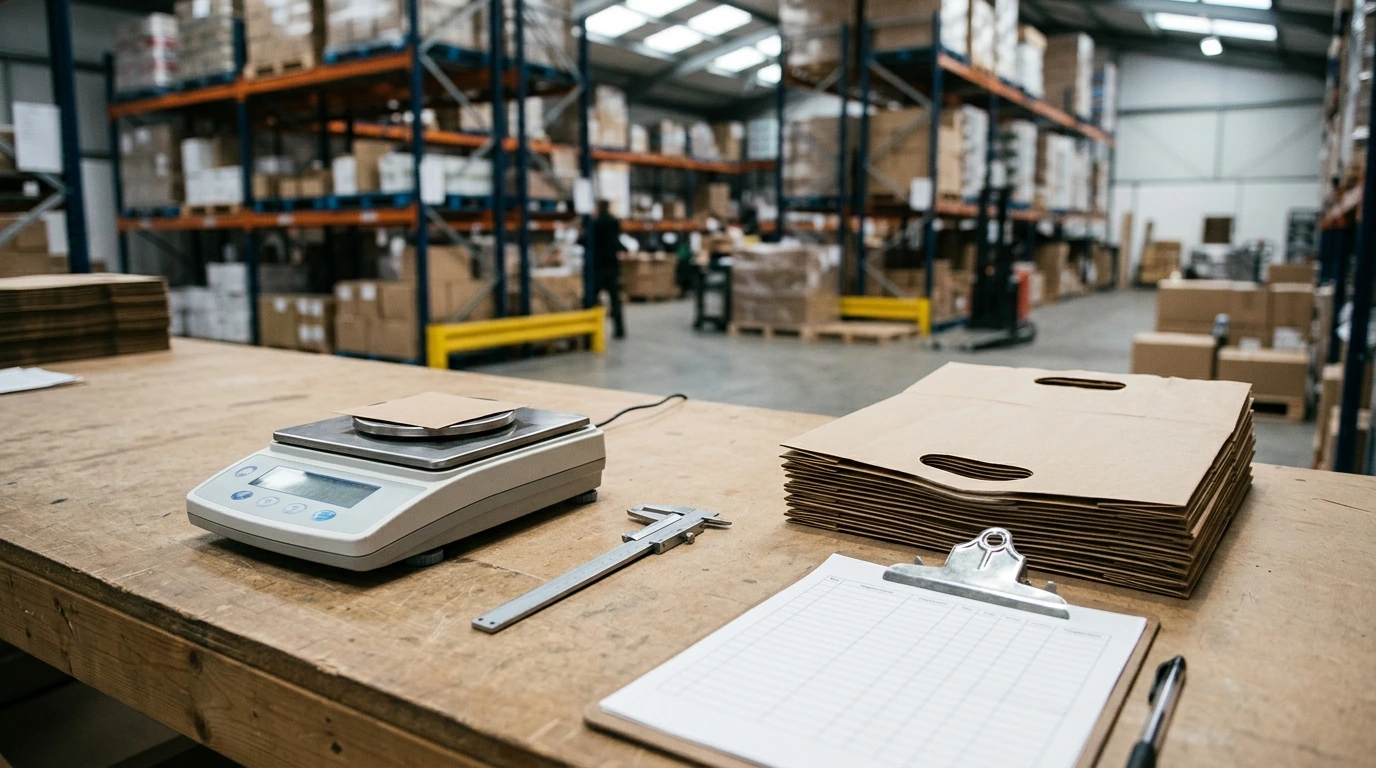
The standard measures grammage, it does not tolerate it: without an agreed tolerance there is nothing to reject at goods-in, and a quote without tolerances cannot be compared with any other. Which lines on grammage, dimensions, colour, sampling and pallet belong in a packaging specification, how many pieces you inspect and what happens when the scales show something other than the order.

PPWR conformity: the data your packaging supplier owes you
Since 12 August 2026 every pack placed on the EU market needs a declaration of conformity. For packaging that carries your brand, your supplier does not issue it; you do, and the supplier owes you the data it is built on. What that data set looks like, which test report belongs to the food-contact declaration, what a BRCGS certificate proves and what nobody can certify about recyclability yet.