Deutsch
 Français
 Türkçe

A printed twisted handle paper bag ordered as a small run and the same bag ordered by the ten thousand are two different products. The small run is bought as a finished bag and printed afterwards. The large run is printed before it has become a bag at all, and that changes what your artwork is allowed to do.
A bakery in Leeds puts two quotes side by side for its carrier bags. One covers a few hundred, the other starts at 10,000, and both show the same brown bag with twisted paper handles and the shop’s logo on the front. The owner reasonably wonders why anyone would commit to the big number when the small one seems to be on offer too.
Search for printed twisted handle bags and you land mostly on shops with an online configurator and a price table. The table implies one bag that simply gets cheaper as the quantity rises. What it rarely says is that the two ends of that table sit on two different printing routes, and those routes decide how much of the bag your design can actually use.
Why does the same bag come as a small run and at 10,000?
Because small runs are printed onto finished bags, while large runs are printed onto the paper before it is folded into a bag. The difference is made on the machine long before it shows up on a price list.
Stock bags get printed after they have been made, usually by screen printing in spot colours or by digital printing. Each bag goes into the machine on its own. That is what makes small quantities possible, it makes every individual bag more work, and it limits the artwork to fixed print areas on the front and back.
Made-to-order bags work the other way round. The paper is printed first and only then converted into a bag. That means the side gussets and the base can carry the design, a pattern can wrap all the way round, and colour can sit in places no machine can reach once the bag is finished.
So the two routes differ less in price per bag than in how much room they leave the design. When comparing quotes, it is worth asking for a second figure alongside the unit price: the area your artwork will actually get.
What printed-before-folding means for your artwork
A made-to-order bag can be designed all the way round. That is its biggest advantage, and it comes with a few conditions worth knowing before anyone opens the design file.
The bag is made from a printed web that is folded and glued along a lengthwise seam. That glue seam usually sits on the back, and the paper overlaps there. Lettering that runs straight across the seam will sit double at that point or look slightly shifted.
The base is the second place to watch. Bags with side gussets and a flat folded base are delivered folded flat, and the tucked-in base leaves a horizontal fold line across the back. A fine detail placed there shows the crease on every bag in the stack, and later on the counter.
The third is any fold at all. Folding is not done to a tenth of a millimetre, and fine lines or text sitting exactly on an edge will visibly wander. Solid areas that run over an edge forgive that. A frame meant to stop precisely at the edge does not.
For the file, that means large areas and blocks of colour can run over gussets and base, while lettering and logos belong on the calm areas of front and back. The usual rules about margins and folds apply here just as they do on any printed packaging. A bag simply adds two more places to respect: the seam and the base fold.
Where should a logo not go on a twisted handle bag?
Not along the top edge, not across the glue seam, and not in the strip the folded base leaves on the back. The top edge is where the handles are fixed inside and where a hand rests while carrying.
Lettering placed just below the top edge ends up half covered by every customer who carries the bag. And that is exactly the moment the street sees it, on the way out of the shop. If the bag is meant to work as an advertisement, the logo belongs a hand’s width lower than looks right on screen.
The second thought concerns the side people actually see. A carried bag hangs against the body, and someone walking the other way often sees the gusset first. A logo that only sits on the front gives that surface away. On a made-to-order bag it can be printed; on a bag printed afterwards it usually cannot.
A check worth doing before any sign-off takes ten minutes. Take a finished, unprinted bag in the size you plan to order, fold it flat the way it will be delivered, and mark the seam, base fold and handle zone with narrow strips of tape. Hold your artwork up beside it. Anything that runs across a strip will sit exactly there in print.
What flexo can and cannot do on kraft
Made-to-order carrier bags in larger runs are usually printed by flexography. For twisted handle paper bags the data sheet lists flexo printing in up to six colours, with Pantone colour matching available. That describes fairly precisely what the process is built for.
Flexo is strong on solid areas, logos, type and clean shapes in defined spot colours. It works with a coarser screen than offset, typically between 28 and 54 lines per centimetre, while offset reaches up to 100. Photographs, soft gradients and very fine detail lose sharpness as a result.
On natural kraft the base colour comes into play. Brown paper is not a neutral surface, colours look darker and warmer on it, and a pale pastel can almost vanish. Anyone who needs a particular effect should choose colour and paper together: natural kraft, recycled kraft, coated kraft and white kraft are all available as papers.
The honest conclusion is simple. A photographic image is the wrong job for a flexo bag in natural kraft. A clean logo in two or three spot colours is the right one, and on kraft it often looks more premium than it would on white.
Which run suits which job?
That depends less on the quantity than on what the design has to do and how long the bag stays in use. Three situations cover almost every enquiry:
- A trial, an event, a first season, a few hundred bags: a finished bag printed afterwards. At these quantities that is the right choice rather than a compromise.
- A photographic design, finishing, premium retail, a few thousand bags: offset printing on a made-to-order bag in heavier paper.
- An everyday counter bag with your own logo, steady demand, five-figure quantities: a made-to-order bag in flexo, designed all the way round.
The middle line is the one most comparisons leave out. Luxury paper bags are printed by offset in CMYK and Pantone colours, on paper typically between 170 and 250 g/m², with finishes such as hot foil stamping, embossing or spot UV. The minimum order is 2,000 bags. That is the bag for designs flexo would struggle with.
One limitation belongs with it. Lamination and film finishes change how recyclable the bag is. Anyone planning to present it as a paper bag should choose the finish with that in mind as well as for the look.
Twisted, flat or die-cut handles barely change the print question
Plenty of enquiries start with the handle, as though the print result depended on it. For printing it matters less than most people expect.
In our range, the twisted handle bag, the flat handle paper bag and the die-cut handle bag share the same 18 standard sizes, the same 70 to 110 g/m² paper weight and the same flexo printing in up to six colours. The handle mainly changes the zone along the top. A die-cut handle removes part of that area; handles fixed inside leave the outside clear.
Where the handle makes a real difference is grip, feel and load. That is a subject of its own with its own mistakes. For the artwork file a simple order is enough: settle the size first, then the design, and choose the handle for use and appearance.
One pattern from enquiries is worth passing on. People who start with the handle tend to fix the size late and then have to rebuild the design for a different area. People who start with the goods going into the bag reach a size faster, and with it a file that is right at the first sample.
What to put in the enquiry
Seven details turn a price request into an enquiry whose quotes can genuinely be compared:
- Size as width × depth × height, ideally from the standard sizes, or with the reason a different one is needed.
- Paper: natural kraft, recycled kraft, coated or white kraft.
- Colours as Pantone references rather than screen colours.
- Printed sides: front, back, gussets, base.
- Handle colour.
- Quantity per design, because every design variant needs its own printing plates.
- Required marks: small compulsory markings usually find their quietest place on the glue seam or base fold, since no design belongs there anyway.
Send those seven and the quotes that come back rest on the same assumptions. Send only “twisted handle bag with logo, please quote” and the numbers that come back describe different bags, which tends to become obvious only when the samples arrive.
In short
- Twisted handle paper bags in small runs are usually finished stock bags printed afterwards by screen or digital printing on fixed print areas.
- On made-to-order carrier bags the paper is printed before folding, so the side gussets and base can carry the design.
- The glue seam, the base fold and the top edge are the three places where lettering and logos should not sit on a paper carrier bag.
- Flexo printing typically works at 28 to 54 lines per centimetre and offset at up to 100, which is why photographic designs belong on offset.
- Colours look darker and warmer on brown natural kraft than on white paper, so colour and paper are chosen together.
- For twisted, flat and die-cut handle bags from the same range, the handle decides grip and load rather than the print result.
Frequently Asked Questions
- Why can printed twisted handle bags be ordered in small runs?
- Because small runs are printed onto finished stock bags, usually by screen or digital printing. Each bag is printed individually, which makes small quantities possible but limits the design to fixed print areas. Larger runs are printed onto the paper before it is folded into a bag.
- Can the gussets and base of a paper bag be printed?
- On made-to-order bags, yes, because the paper is printed before it becomes a bag. On finished bags printed afterwards, the print usually stays on the front and back. Solid areas can run over edges, while lettering is best kept on the calm areas of the bag.
- Where should a logo not go on a paper carrier bag?
- Not right at the top edge, where the handles are fixed and a hand rests while carrying. Not across the glue seam, where the paper overlaps, and not in the area of the fold line the tucked-in base leaves on the back of the bag.
- Is flexo printing suitable for photos on paper bags?
- Only to a limited extent. Flexo typically works at 28 to 54 lines per centimetre and is strongest on solid areas, logos and type in spot colours. For photographic images and fine gradients, offset printing at up to 100 lines per centimetre is the better choice.
- How do colours look on brown kraft paper?
- Darker and warmer than on white paper, because the brown base shows through. Pale pastel shades can almost disappear. Where a particular colour effect matters, colour and paper are chosen together, with natural kraft, recycled kraft, coated kraft and white kraft to choose from.
- What should an enquiry for printed paper bags include?
- The size as width, depth and height, the paper, the colours as Pantone references, the sides to be printed, the handle colour, the quantity per design and the preferred place for compulsory markings. With those details, quotes from different suppliers can actually be compared.
Related Articles
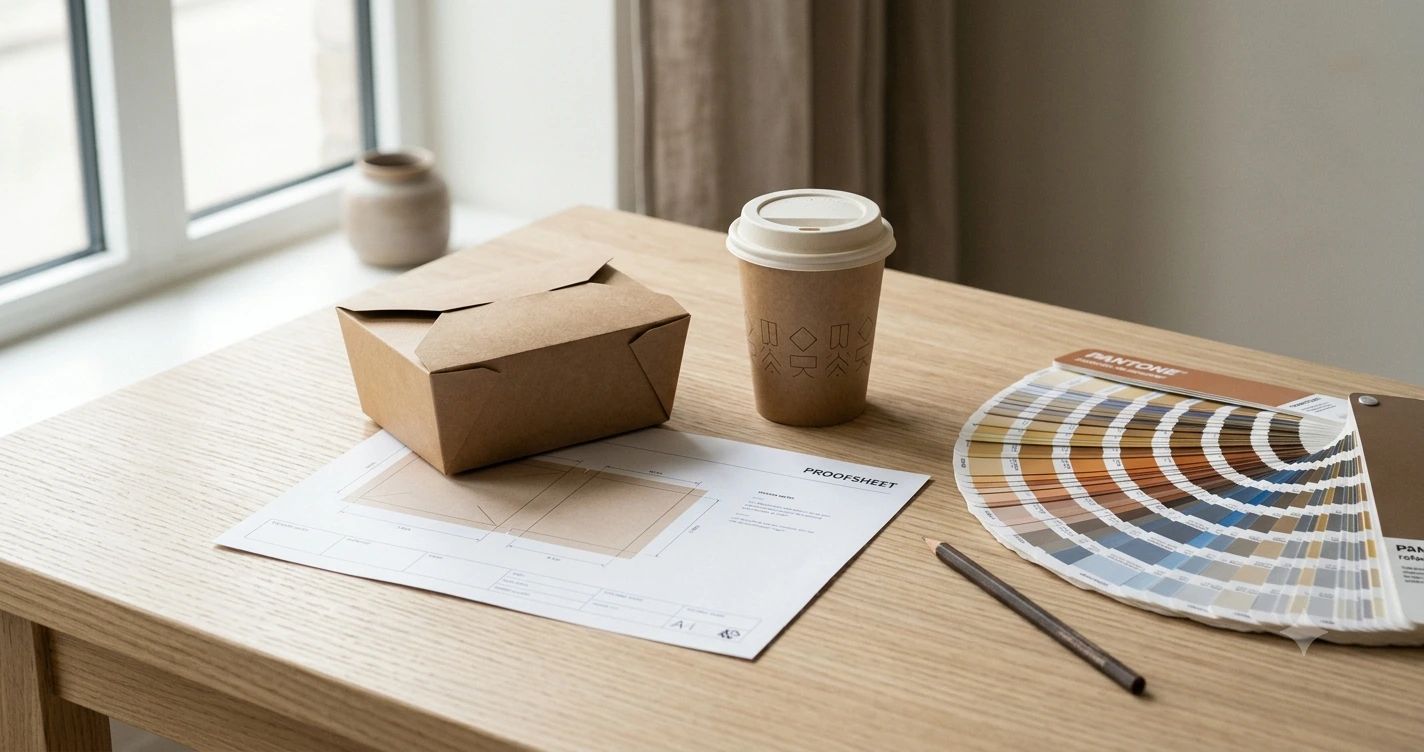
Custom Printed Food Packaging: Getting the Artwork Right
Before a print run starts, a good supplier asks three questions most buyers cannot answer. What they mean, why brown board changes your colours, what stays off the food-contact side, and how finishes quietly add cost.
EU Packaging Rules Since 12 August: What Goes On the Pack
The EU packaging regulation started applying on 12 August 2026. If you sell into the EU, the first part that reaches you is not a filing task. It lands in the artwork of your next print run.
Printed bakery bags: sponsored, co-branded or your own logo?
There are three routes to a printed bakery bag, and only one of them belongs to the bakery. What the free sponsored bag really costs, when your own logo pays off, what to write down before co-branding, what 38 to 70 g/m² paper does to a design, and who licenses the bag when you trade in Germany.
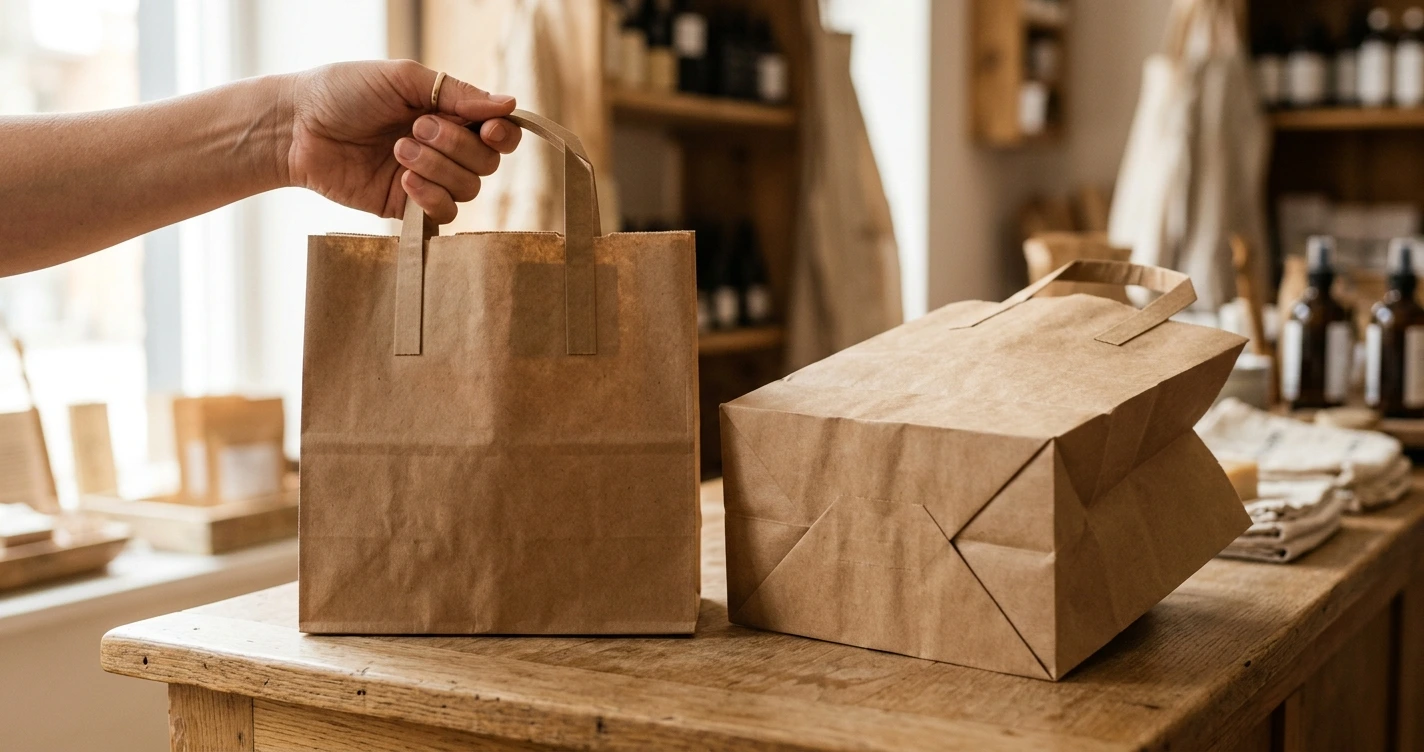
Why Paper Bag Handles Tear and What Weight Ratings Hide
Two nearly identical carrier bags, two wildly different weight claims: the number tells you little until someone explains where bags actually fail. The three failure points, the four factors that decide real capacity, and how to order a bag that survives British weather.