Deutsch
 Français
 Türkçe
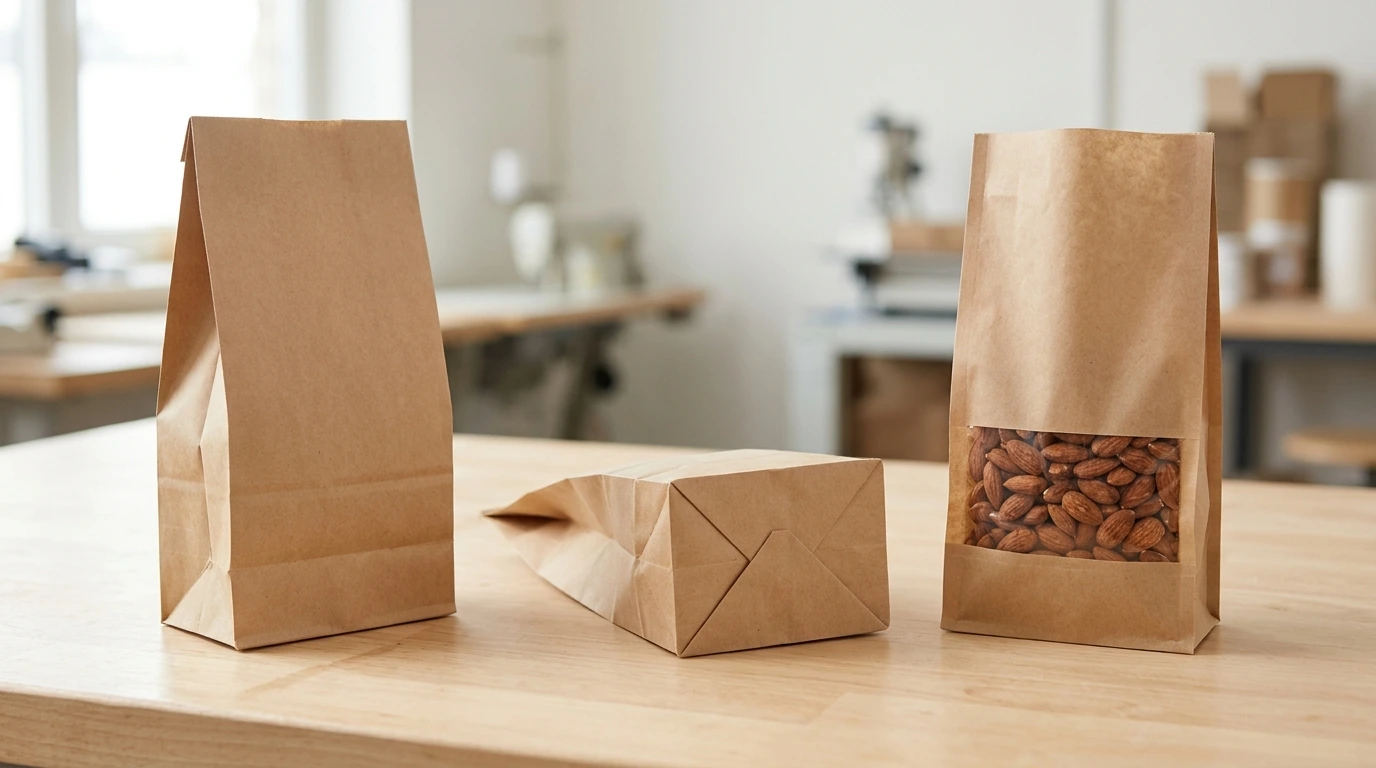
A patisserie in Bristol wants to sell its Christmas biscuits in printed 250 g block bottom bags, types “printed bottom bags” into a search box and has three quotes by the evening. All three are called bottom bags. None describes the same bag: one is film with a zip, one has side gussets, one has a cross-folded base.
That is not the suppliers’ fault but the language’s. “Bottom bag” is an umbrella, and under it sit three constructions that want different goods, are filled differently and are printed differently. Anyone who does not take the term apart ends up comparing quotes that have nothing to do with each other. This guide takes it apart, from the practice of a manufacturer that makes paper block bottom bags and regularly forwards the enquiries for the other two.
“Bottom bag” is not one bag but three
Behind the word sit three constructions: the stand-up pouch made of film, the block bottom bag with side gussets and the cross bottom bag without. The stand-up pouch, often called a doypack, is a film bag with an oval base inserted at the bottom; it stands empty, is usually resealable and is made as a laminate of several films. Its home is coffee, tea, pet food and anything that has to keep aroma or moisture out. The block bottom bag, also known as an SOS bag, is a paper bag with two side gussets and a rectangular, flat-folded base. It stands empty too and is the classic bag for bread, pastries, nuts, flour and sugar. The cross bottom bag, finally, has no side gussets; its base is folded and glued in a cross, it lies flat when empty and only stands once filled. You find it around fruit, around bread rolls and, as a two-layer bag with a glassine liner, around greasy goods.
On our product page the construction of the block bottom bag sits in one line: “Handle-free bag with side gussets and a flat squared base designed to stand upright”. That line separates it from the other two. The cross bottom bag has no gussets; the stand-up pouch is rarely paper. Anyone writing an enquiry should therefore not write bottom bag but one of the three names, or better still name the goods that have to go in. From the goods, the bag follows almost by itself.
Which bottom bag stands empty, and why does that decide the counter?
The block bottom bag and the stand-up pouch stand while empty; the cross bottom bag only stands once filled. That difference decides how fast packing goes at the counter. A bag that stands on its own is opened with one hand and filled with the other, whether by scoop, by tongs or straight off the scales. A bag that lies down needs a hand to hold it and turns into a two-handed job while the scales wait. With twenty customers on a Saturday morning that is the difference between a queue and none.
On the shelf the same thing counts with the sign reversed. A block bottom bag stands with a straight front even when filled, because the gussets take the volume. A cross bottom bag bulges, because it has no volume in gussets, and shows a curved face. Anyone who needs the label or the print on the front gets, with the block bottom, a surface that stays where it is. Anyone who drops rolls into a bag and twists it shut needs none of that and is well served by the cross bottom.
In our production, enquiries for block bottom bags are therefore rarely enquiries about a size and mostly about a workflow. The business has timed how long packing takes and wants to lose the part of it that hangs on the bag.
Why does coffee not stay fresh in a plain paper bag?
Because paper blocks neither aroma nor oxygen, and freshly roasted coffee releases gas that a bag without a valve cannot vent. Coffee sits behind many searches for printed bottom bags, and it is the product the paper block bottom bag suits least. Roasters need a bag with a barrier and a one-way valve, so a stand-up pouch made of laminated film or a paper bag lined with film on the inside. That is no failing of paper. Paper breathes, and with coffee that is precisely the problem.
We say this in every conversation with a roastery, because the alternative is a pallet of bags that smell of cardboard three weeks after filling. The paper block bottom bag is the bag for bread, pastries, biscuits, nuts, flour, sugar, muesli, pasta and confectionery: for anything dry or anything that keeps for a few days. For greasy goods there is a second layer, more on that below. For aroma there is film, and it does not come from us.
The recycling question settles itself at the same point. The plain paper bag goes into paper recycling; the product page notes that recyclability can differ with additional inner layers or coatings. Anyone who wants to promote the bag as paper needs the plastic-free construction and goods that can live with it.
100 g to 2 kg: the fill weight picks the size
The size of a block bottom bag is not chosen in millimetres but by the weight of the goods, and the product page says exactly that. Behind every small and medium size there is a figure in brackets: 75×45×165 for 100 g, 100×57×180 for 250 g, 125×70×250 for 500 g, then 125×70×300 for 1,000 g, 150×80×340 for 1,500 g and 190×95×360 for 2,000 g. A separate line explains the brackets: “Figures in brackets show the recommended fill weight”. That one line prevents most wrong orders.
A bag is not sold by its volume but by what the scales show. The patisserie with its 250 g bags needs the 100×57×180 size, not the larger one that looks nicer empty and stays three quarters empty when filled. The nut roaster selling 500 g takes 125×70×250. Anyone packing 1,000 g of flour takes the same width at 300 mm height. The figures apply to loose goods of ordinary density; light, bulky goods such as popcorn need one step up, dense goods such as sugar one step down. The three large sizes up to 250×150×300 carry no bracket, because they are meant for goods that are counted rather than weighed: loaves, biscuit assortments, gift fills.
The paper weight comes after that. Between 50 and 140 g/m² lies a range that hardly matters on the small bag and is decisive on the 2 kg one: the heavier the fill, the stiffer the paper, so that the base does not give. The carrying capacity of up to around six kilograms named on the product page depends expressly on size, paper weight, construction and weight distribution; it is not a value that holds for every bag.
The side gusset carries the second message
A block bottom bag has five printable faces, front, back, two side gussets and base, and the gussets are the faces that work hardest on the shelf. When bags stand side by side, the customer sees the front only from the front; the gusset is seen walking past, taking the bag out, and from the neighbouring shelf. The front belongs to brand and product. The gusset belongs to what people look for when comparing: variety, weight, ingredients, a colour code for the variant. Anyone selling six kinds of biscuit in the same bag size can keep the front identical and tell the varieties apart on the gusset. That saves printing plates and makes the shelf readable.
The block bottom bag is printed before it becomes a bag. That is why the print reaches all five faces, and why the artwork has to know where the folds lie. A motif that runs over the edge from the front into the gusset works; type that sits exactly on the fold breaks. We regularly see in proofs that the gusset stays blank in the artwork because it looks narrow on screen. On the filled bag it is as wide as the depth, 70 mm on the 500 g size, enough for three lines. Up to six colours are available in flexo with Pantone matching; for a block bottom bag two or three usually do, with the gusset taking one tone and the front the rest.
With white kraft block bottom bags one effect comes on top: on the white surface the colours stand as they do in the file, and the gusset can be laid out as a strong colour block that stands out from the shelf. On brown kraft the same colours come out darker and warmer; that suits bread and nuts and suits a brand built on pastels less. Whether a window belongs in the front is a separate decision, which we have written up in window bags and the front panel decision.
One layer or two: when does the bag need an inner layer?
A block bottom bag needs an inner layer as soon as the goods give off fat or attract moisture. Roasted nuts, puff pastry, butter biscuits, popcorn, anything fried. The single-layer paper bag soaks up the fat and shows it after an hour as a stain on the outside, in the middle of the print. The two-layer version puts a greaseproof paper, usually a glassine-type sheet, inside against the kraft on the outside; the outside stays dry, the print stays clean, and the goods keep their crispness a few days longer. For dry goods such as flour, sugar, rice, pasta and bread the second layer is unnecessary and only makes the bag heavier.
The second layer is the point where the plastic-free question has to be answered honestly. Greaseproof paper is paper; a two-layer bag of kraft and greaseproof stays paper and can be recycled as such, provided it is not too heavily soiled. A film lining on the inside is no longer paper. Both are sold as greaseproof. Anyone who wants the plastic-free construction that the product page lists depending on product requirements has to order it as such and match the goods to it: nuts yes, coffee no.
One note from production that often surprises: the inner layer does not change the height of the bag, but it changes the stiffness. A two-layer 250 g bag usually stands empty more steadily than a single-layer 500 g bag. For a counter that wants to hold the bag open with one hand, that is an argument that has nothing to do with fat.
Which detail is missing from most enquiries?
The weight of the goods per bag; the size follows from it, and without it the other five details stay guesswork. Six details turn a bottom bag enquiry into one that three manufacturers answer with the same quote. The goods and their weight per bag, so that the size follows from the fill-weight table. The construction, block bottom, cross bottom or stand-up, or the sentence “stands empty, made of paper”, which says the same. Single or double layer, derived from the fat content. The paper, brown or white kraft, with or without recycled content. The colours as Pantone references and the faces that get them, gussets expressly included. And the quantity per size and design, because the minimum of 10,000 pieces applies to each version separately, and the lead time of around fifteen to twenty working days after print approval only starts once the artwork is final.
With brown kraft block bottom bags exactly one detail is missing from most enquiries: the weight of the goods. The dimensions are often measured off an existing bag that was once bought for something else. Anyone who writes “250 g butter biscuits, greasy, standing on a shelf” instead gets size, layers and paper weight from that one line, and a quote that is comparable with the other two, provided the other two mean the same bag.
The patisserie in Bristol put two of its three quotes aside in the end: the film pouch, because its biscuits need no barrier, and the cross bottom bag, because it does not stand on the shelf. What remained was the two-layer block bottom bag in the 250 g size, with the variety on the gusset. Whether that is the right one for your goods shows on your scales long before it shows in a quote.
In short
- “Bottom bag” covers three constructions: the stand-up pouch made of film, the block bottom bag with side gussets and the cross bottom bag without; only the block bottom bag stands empty and is usually paper.
- Paper block bottom bags suit dry and short-life goods; coffee needs a barrier and a one-way valve, so film.
- The size follows the fill weight: from 75×45×165 mm for 100 g to 190×95×360 mm for 2,000 g; the paper weight lies between 50 and 140 g/m².
- The side gussets are printable and suit variety, weight and colour code; up to six colours in flexo with Pantone matching.
- Greasy goods need a second layer of greaseproof paper; the minimum is 10,000 pieces per size and design, the lead time around fifteen to twenty working days after print approval.
Frequently Asked Questions
- What is the difference between a block bottom bag and a cross bottom bag?
- A block bottom bag, also called an SOS bag, has two side gussets and a flat, rectangular folded base; it stands up while empty. A cross bottom bag has no gussets, its base is folded and glued in a cross, and it only stands once filled. Both are common in paper; a stand-up pouch, by contrast, is usually a film laminate.
- Can coffee go into a paper block bottom bag?
- Not for retail sale. Paper blocks neither aroma nor oxygen, and freshly roasted coffee releases gas that a bag without a valve cannot vent. Roasters need a bag with a barrier and a one-way valve, so a film laminate or a film-lined paper. The plain paper bag suits bread, pastries, nuts, flour and sugar.
- Can the side gusset of a block bottom bag be printed?
- Yes. The bag is printed before it is folded, so the print reaches the front, the back, both gussets and the base. The gusset suits variety, weight and a colour code; on the 500 g size it is 70 mm wide. Type should not sit exactly on the fold line.
- Which block bottom bag fits 500 g of biscuits?
- The 125×70×250 mm size, listed on the product page with a recommended fill weight of 500 g. For butter biscuits and other fatty bakes, the two-layer version with a greaseproof inner layer keeps the print clean on the outside; for dry biscuits the single layer is enough.
- From what quantity does printing make sense?
- Production starts at 10,000 pieces per size and design, with a lead time of around fifteen to twenty working days after print approval. Whether that pays depends less on the quantity than on how many sizes you genuinely need: if varieties are told apart on the gusset, one design per size is enough. Ask for the fill-weight table before ordering so the size matches your scales.
Related Articles
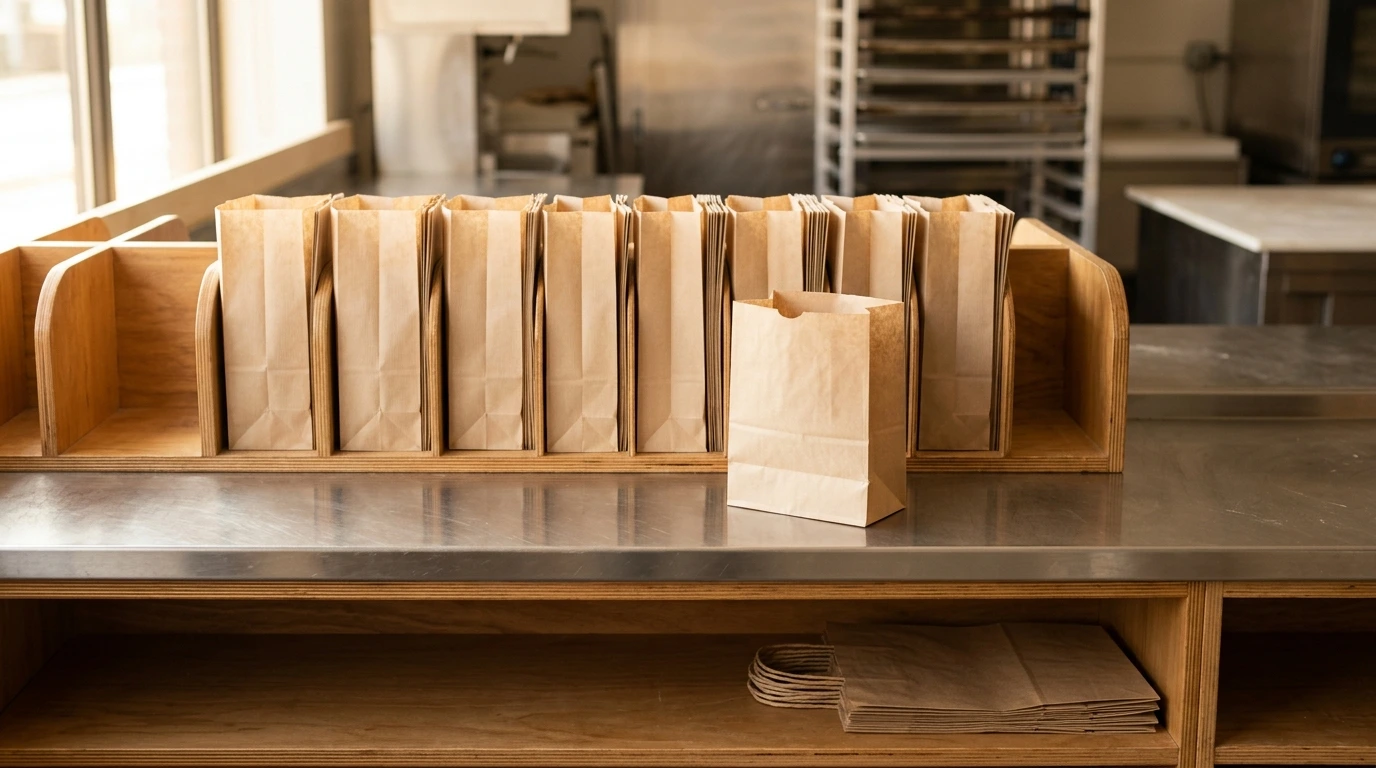
How Packaging Slows a Counter Down
Packaging gets discussed as protection and appearance. Behind a counter it is also a unit of time, and a bag that will not open one-handed costs more in a morning rush than any costing sheet ever shows.
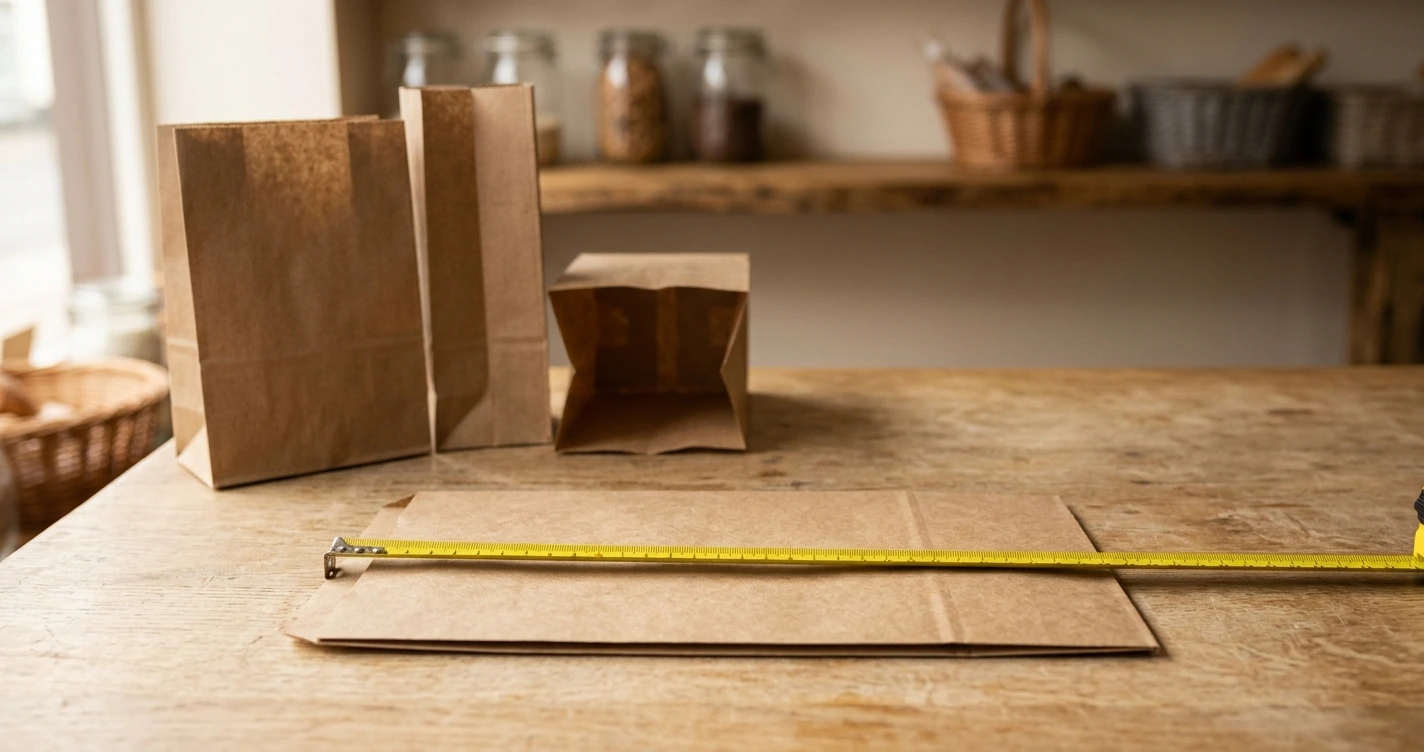
Paper Bag Sizes: Which Size for Which Bakery Product
Size lists are everywhere. What is missing is the line telling you which one fits your product. How to work the size out from what goes in, what separates two numbers from three, and how to measure a bag you already use.
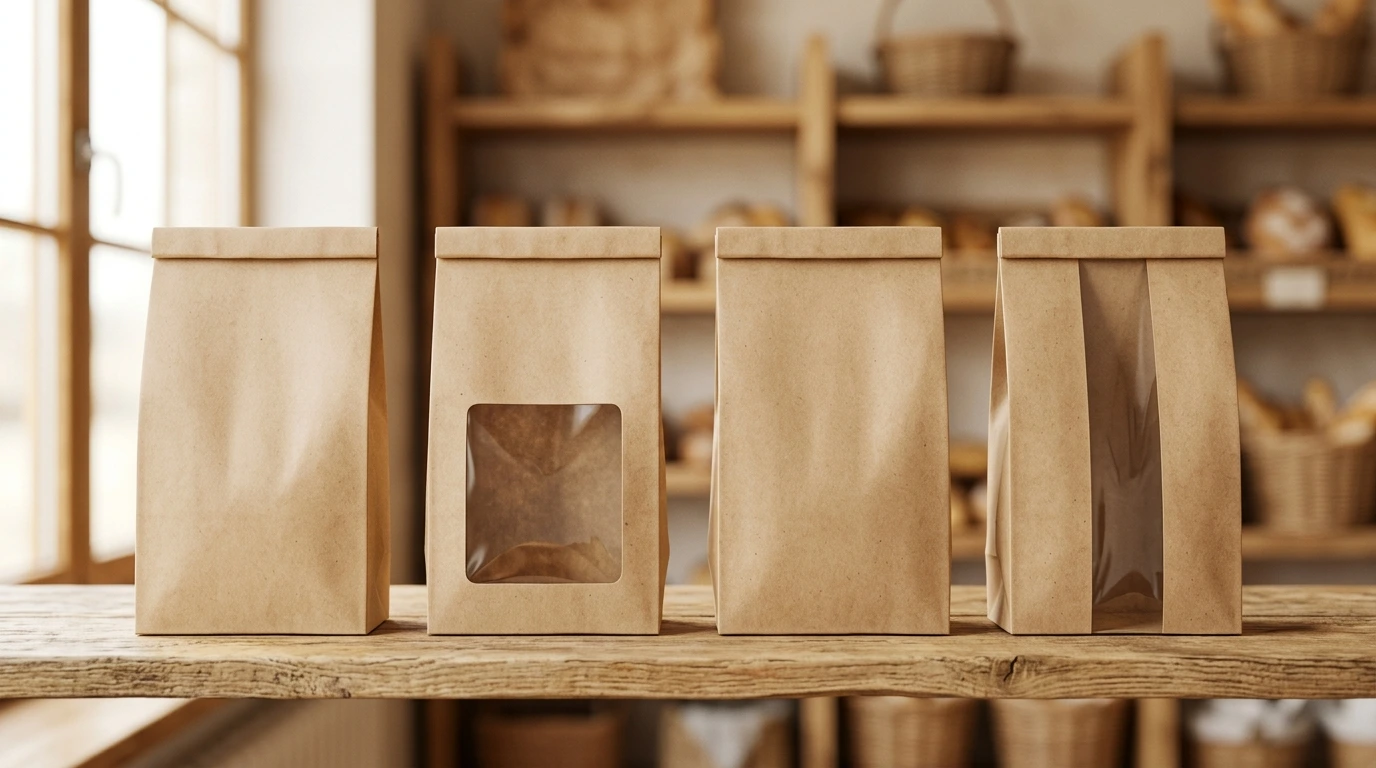
Window Bags and the Front Panel Decision
A window and your print compete for the same surface. Every millimetre you open up to show the product comes off the area that shows your brand. Which one wins depends on what actually sells the product on a shelf.