Deutsch
 Français
 Türkçe
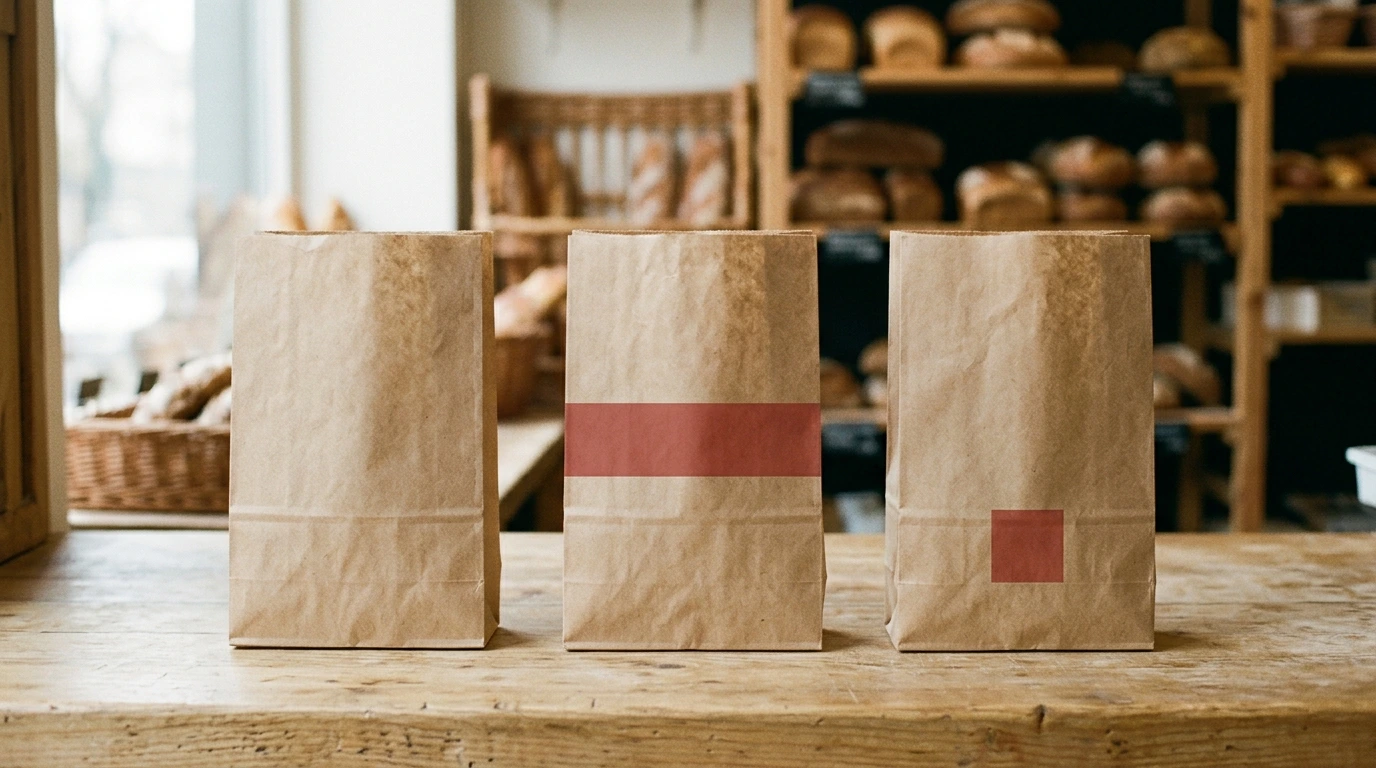
Monday morning at a bakery in Leeds, and on the phone is an agency with an offer that sounds good: bakery bags, free, as many as you need, for three weeks. Only the front belongs to a car dealer. The owner says she will think about it and puts the bag she meant to order next to the phone.
The decision this guide is about sits exactly between those two bags. There are three routes to a printed bakery bag: the sponsored bag that another company pays for, an offer that is standard in German and French bakeries and reaches British counters through retail schemes; co-branding, where you share the space and the cost with a partner; and your own bag with your own logo, ordered from the manufacturer. Each route has a price, and only one of them shows on an invoice. What the other two cost, which paper takes which design, and why the choice is also a licensing question once you trade in Germany, is set out here from the practice of a bakery bag manufacturer.
Three routes to a printed bakery bag, and only one belongs to you
Only the bag with your own logo belongs to your bakery; the other two routes lend you a surface that belongs to someone else. The sponsored bag works like this: a scheme sells the front of the bag to advertisers, has the bags printed and hands them out free to bakeries in a region for as long as the campaign runs. For the advertiser it is a medium that lies on the breakfast table in the morning. For you it is a bag you do not pay for, but do not decide on either.
With co-branding you share the bag with a partner that suits you: the building society on the high street, the car dealer, the drinks wholesaler. Both logos go on the bag, both sides pay a share, and the run is ordered together. With your own bag you order from the manufacturer, choose paper, size and colours yourself and carry the run alone. The three routes differ less in the paper than in who decides about the bag. That is exactly why it pays to compare them not by unit price but by what each of them costs without ever appearing on an invoice.
What does the free bag really cost?
The free sponsored bag is paid for with the surface your customer looks at longest, and with control over paper, size and supply. A bakery bag is looked at twice: briefly at the counter and for a long time at home, where it lies on the table until the last roll is eaten. That second surface is why advertisers pay for it. On the sponsored bag it belongs to the car dealer. Your name, if it appears at all, sits small on the back.
The second cost is the bag itself. Campaign bags are printed for many bakeries at once, so in standard sizes and in one paper grade that suits the average. A bakery that sells filled rolls and therefore needs greaseproof paper, one that uses a taller format for baguettes, or one that needs more small bags in summer than in winter still gets the bag the campaign provides. The third cost is the calendar. Campaigns run in waves; between two waves you need a different bag, and it has to be there at short notice. We see it every spring: enquiries for neutral bags marked urgent, because the sponsored bags ran out before the campaign did.
None of those three costs makes the sponsored bag the wrong choice. For a bakery that would otherwise buy neutral bags and attaches no value to the surface, it is an honest trade: paper in exchange for visibility for someone else. It only becomes wrong when it is mistaken for your own bag.
When is your own logo on the bakery bag worth it?
Your own logo pays off as soon as your bag turns up in customers’ homes more often than your shop window does. That is the case for almost any bakery with regulars. The bakery bag is the only packaging carried every morning into homes where your shop otherwise never appears. Whoever uses that surface to carry a car dealer’s logo gives it away. Whoever leaves it neutral does not use it. Whoever prints their own name on it owns the cheapest advertising a bakery has, because the bag has to be bought anyway.
The counter-argument is the run. At the manufacturer, production starts at 10,000 pieces per size and design, and a bakery rarely needs only one size. Three sizes mean three runs, so three pallets that have to stand somewhere. A bakery that starts with the medium formats, which in our range are all 155 mm high and stack together on the shelf, manages with fewer sizes than expected. A shop handing out a few hundred bags a day has used up 10,000 of one size within a few weeks. So the question is rarely whether the quantity will go, but where it sits until then.
One note from production that changes the sum: the lead time for a printed bakery bag with us is around ten to fifteen working days after print approval. A bakery that sees its sponsored campaign running out has enough time to switch to its own bag, provided the artwork is ready. Without ready artwork it does not.
Co-branding: who decides paper, size and colour?
In co-branding, whoever writes the specification decides, and that should be you: the bag has to work at your counter, not in the partner’s branch. The model is tempting. A local partner takes on part of the run, both logos go on the bag, and the bakery gets a printed bag on terms it would not have alone. In practice it rarely fails on money and often on three details nobody wrote down beforehand.
The first detail is the surface. A bakery bag has a front and a back, and both partners want the front. Fix which logo goes where and how large before the artwork exists. The second detail is the paper. The partner sees an advertising surface; you see a bag that has to survive a filled roll without a grease mark. So the bakery chooses the paper. The third detail is the term. The partner thinks in campaigns, you think in years. Agree what happens if the partner drops out after the first run: you then need artwork that also works without their logo.
One sentence belongs in every co-branding agreement and is almost always missing: in Germany, as soon as your logo is on the bag, you are the producer under packaging law, however large the partner’s logo beside it. In the UK the same instinct applies through EPR, where the brand owner answers for branded packaging. More on that next.
Whose logo, whose duty: who licenses the bag since 12 August 2026?
Since 12 August 2026 a bakery in Germany licenses every bag that carries its own name, logo or brand itself. A sponsored bag with a third party’s logo stays neutral from its side. Under the EU packaging regulation and Germany’s implementing act, a business using service packaging with its own branding is manufacturer and producer of that packaging: it registers as a producer, signs its own contract with a recycling scheme and reports volumes. Pre-licensing by the supplier no longer exists for branded bags. What that triggers in detail, and where the exemption for micro-enterprises sits, is covered in our guide to branded service packaging in Germany.
For the three routes that means: your own bag makes you the producer. The co-branded bag makes you the producer as well, because your logo is on it; the partner’s logo changes nothing. The purely sponsored bag does not carry your name; by the logic of the German registry it is neutral service packaging from your side, and with a scheme based in Germany the pre-licensing can stay there. The registry has not spelled out the case of a third-party logo, though. So get written confirmation from the scheme of who registers and licenses the campaign bags before the first pallet arrives.
In the UK the logic runs on a different track but arrives at a similar place. Packaging EPR makes the brand owner responsible for packaging that carries its brand, once the turnover and tonnage thresholds are met; below them a small bakery reports nothing. A sponsored bag carries the advertiser’s brand, not yours. For a bakery selling into Germany, or one with a German site, the German rule is the one that bites, because it has no thresholds at all apart from the micro-enterprise exemption.
38 to 70 g/m²: what thin paper and paper grade do to a design
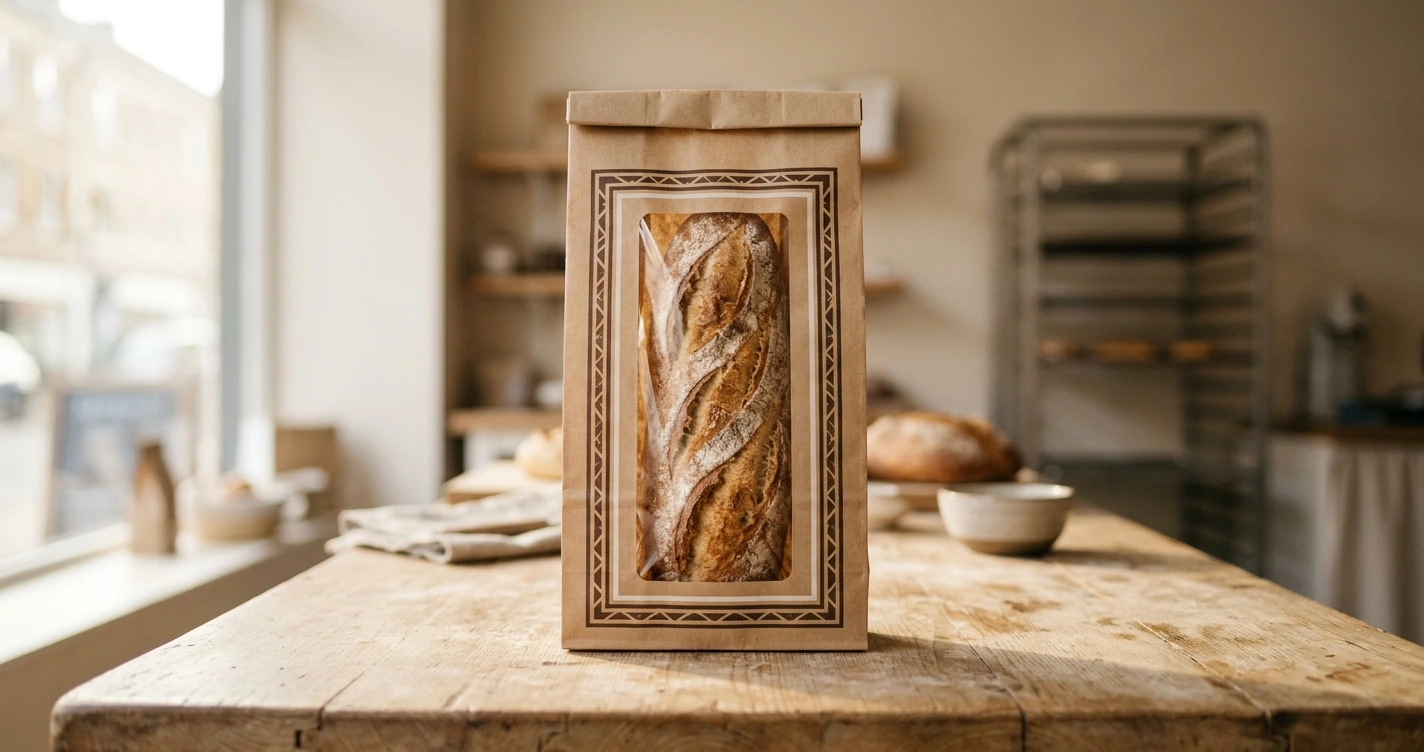
Bakery bags are made from paper between 38 and 70 grams per square metre, and that range decides more about the design than any design idea. On our natural kraft bakery bags page two lines sit next to each other: “Paper weight: 38–70 g/m²” and “Printing colours: Up to 4-colour flexographic printing”. On carrier bags made from 70 to 110 g/m² paper it is six colours. The difference is not a feature but physics: thin paper takes less ink, dries differently and cockles when too much area is printed. A logo in one or two colours looks better on 40 g/m² natural kraft than a full-coverage design in four.
We see it regularly in artwork taken over from carrier bags: dark solid areas, fine gradients, small white type on colour. On the carrier bag it works. On the bakery bag the ink shows through and the type fills in. The campaign bags of the advertising schemes are almost always kept to one or two colours for the same reason.
The grade decides before the design. Natural kraft is rough and brown; colours come out darker and warmer on it, and a pastel almost disappears. White sulphite has a smooth, bright surface on which strong brand colours sit cleanly, but it is not meant for oily goods; the product page expressly recommends greaseproof grades for fatty products. Greaseproof bakery bags take filled rolls, croissants and doughnuts without a mark; the surface is denser and the print correspondingly sharper. Anyone who starts with the design and then looks for the paper has the order backwards. First the goods, then the paper, then the design that paper can take.
What belongs in the enquiry
An enquiry for printed bakery bags needs seven details so that the quote describes the same bag you mean. The size as width, depth and height in millimetres, or the product that has to go in if you do not know the size. The paper grade: natural kraft, white sulphite or greaseproof, depending on the goods. Single-layer, double-layer or side-glued; the product page lists all three constructions, and which one fits depends on whether the bag has to stand, carry or only wrap. The colours as Pantone references, four at most. The sides to be printed. The quantity per size and design, because the minimum applies per version. And the question that has belonged in there since August for anyone trading in Germany: should the bag carry your logo, or stay neutral, perhaps differently from site to site?
With natural kraft bakery bags most enquiries arrive with artwork and without a paper specification. The artwork is usually fine. Whether it is to be printed on 40 or 70 g/m² decides whether it will look the way it does on screen, and only the bakery can give that detail, because only the bakery knows what goes into the bag.
In the end the owner in Leeds stands in front of three bags that barely differ in paper and differ in everything else. The sponsored bag costs nothing and is not hers. The co-branded bag is half hers and, in Germany, would make her fully the producer. Her own bag costs a run, a pallet’s worth of space and, on a German site, a registration, and it is the only one that lies on the breakfast table in the morning with her name on it. Which of them is right depends on her customers and her storeroom, not on our range; this guide describes practice from a manufacturer’s side and is not legal advice for your business.
In short
- There are three routes to a printed bakery bag: a scheme’s sponsored bag, co-branding with a partner, or your own bag from the manufacturer; only the third belongs to the bakery.
- The free sponsored bag is paid for with the front of the bag, with control over paper and size, and with dependence on the campaign calendar.
- In Germany, since 12 August 2026 the bakery is the producer of every bag carrying its logo, co-branded bags included; a purely sponsored bag with a third-party logo is neutral from its side. In the UK the brand owner reports under EPR above the thresholds.
- Bakery bags are made from 38 to 70 g/m² paper and printed with at most four colours in flexo; one- or two-colour designs hold up best.
- Printed bakery bags start at 10,000 pieces per size and design and ship around ten to fifteen working days after print approval.
Frequently Asked Questions
- Are sponsored bakery bags really free?
- In money terms, yes; the advertiser pays for them. You pay with the front of the bag, with the standard size and standard paper of the campaign, and with the gap between two campaigns, when you need another bag at short notice.
- Can my logo sit next to the sponsor’s advert?
- That depends on the scheme; some leave the back free or print a neutral bakery motif. In Germany, as soon as your own logo is on the bag you count as the producer of that packaging since 12 August 2026, however large the advertiser’s logo beside it. In the UK the brand owner is the obligated party under packaging EPR once the thresholds are met.
- From what quantity does your own print make sense?
- At the manufacturer, production starts at 10,000 pieces per size and design. Whether that pays off depends less on the quantity than on consumption: a shop handing out a few hundred bags a day gets through that in a few weeks. The real questions are where the pallet stands until then and whether you can manage with few sizes.
- Which bag for filled rolls and sandwiches?
- Greaseproof paper. Natural kraft and white sulphite are meant for dry goods; butter, cheese and fried fillings mark through them. Greaseproof bakery bags come in the same sizes, and their denser surface actually takes print more sharply.
- Who reports the bag if an advertising partner supplies it?
- A bag without your name is, from your side, neutral service packaging. In Germany a scheme based in the country can keep the pre-licensing with its own supplier; the case of a third-party logo is not spelled out by the German registry, so get written confirmation of who registers and licenses the campaign bags. In the UK, ask the scheme who reports the packaging under EPR and keep the answer with the delivery note.
Related Articles
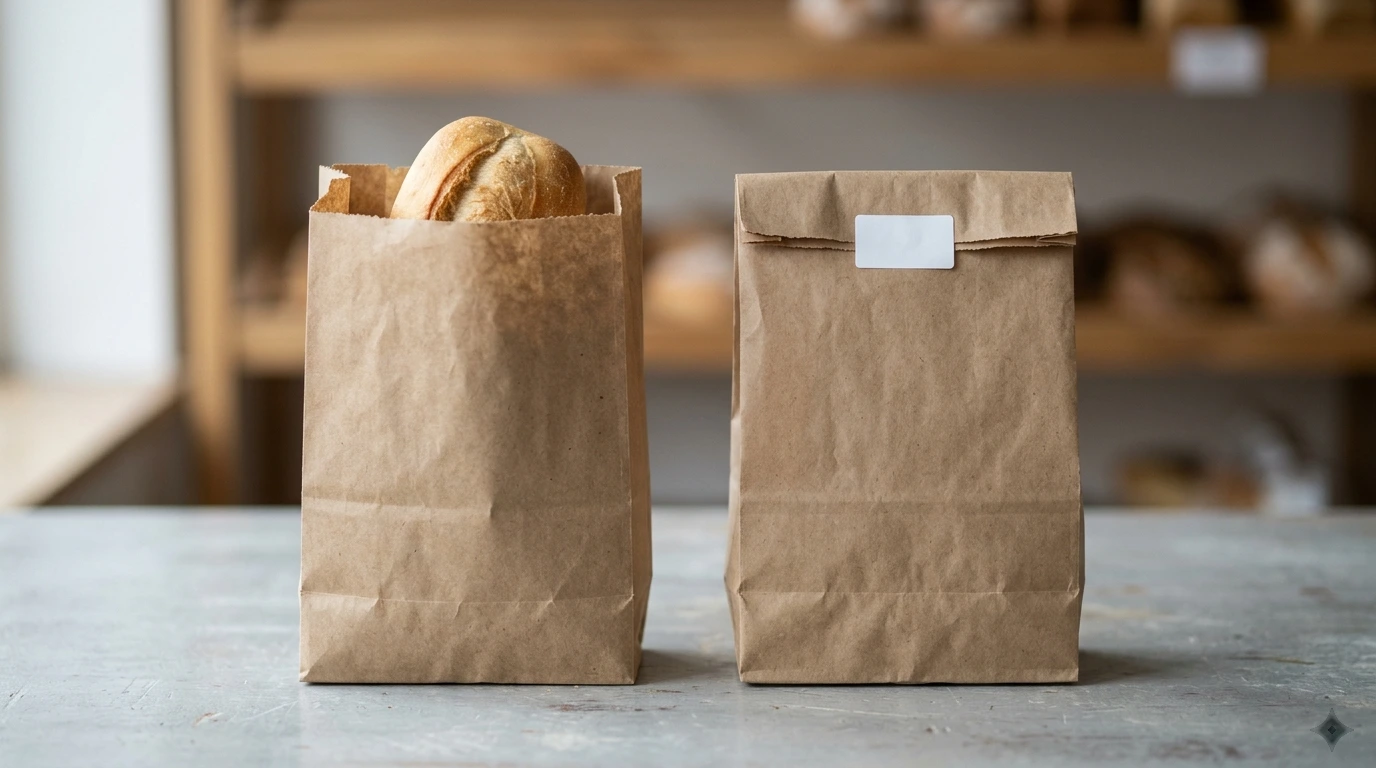
Bagged in Advance: What Has to Go on the Label
Whether your bag needs a full ingredients list is not decided by what is inside it. It is decided by whether the item was bagged before the customer asked for it.
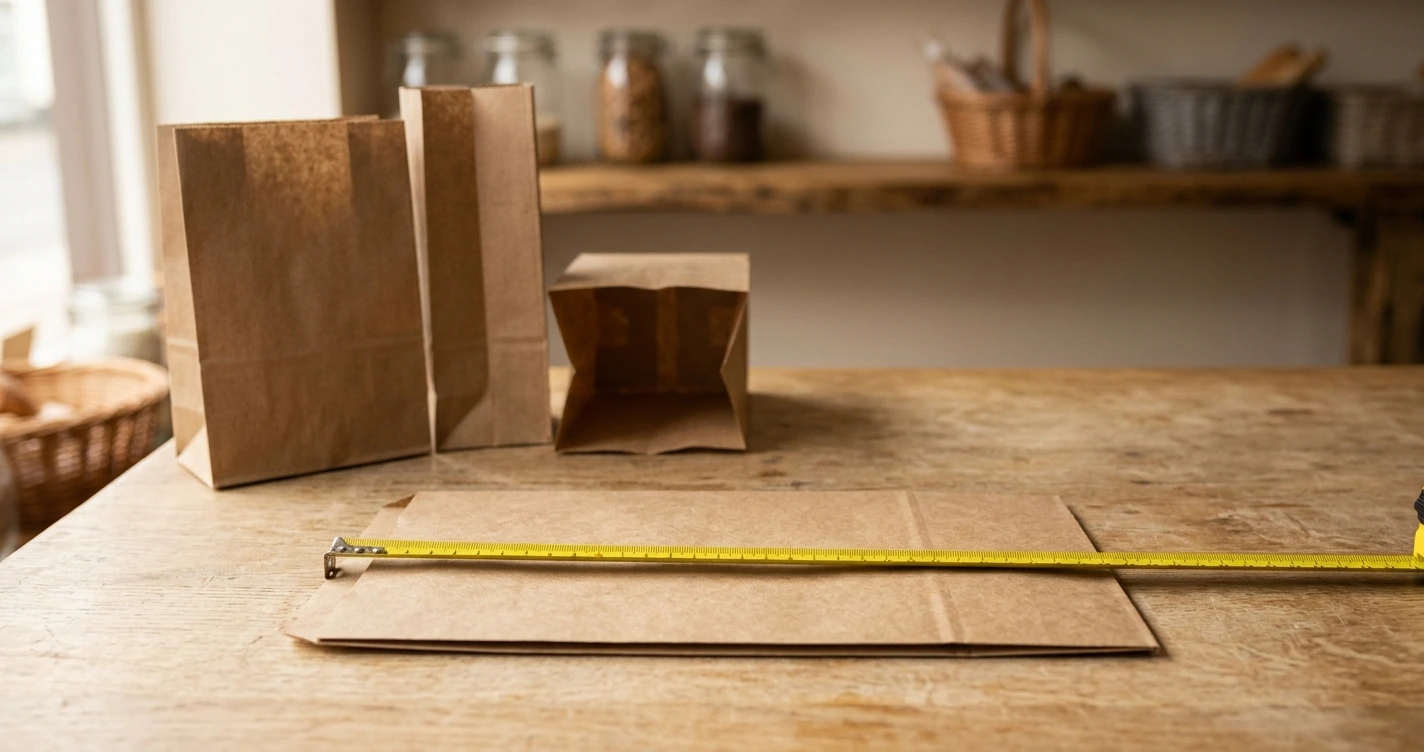
Paper Bag Sizes: Which Size for Which Bakery Product
Size lists are everywhere. What is missing is the line telling you which one fits your product. How to work the size out from what goes in, what separates two numbers from three, and how to measure a bag you already use.

Printed Twisted Handle Paper Bags: Small Run or 10,000
A twisted handle paper bag ordered in a small run and one ordered in tens of thousands are two different bags. One is bought finished and printed afterwards; the other is printed before it has been folded into a bag at all.