Deutsch
 Français
 Türkçe
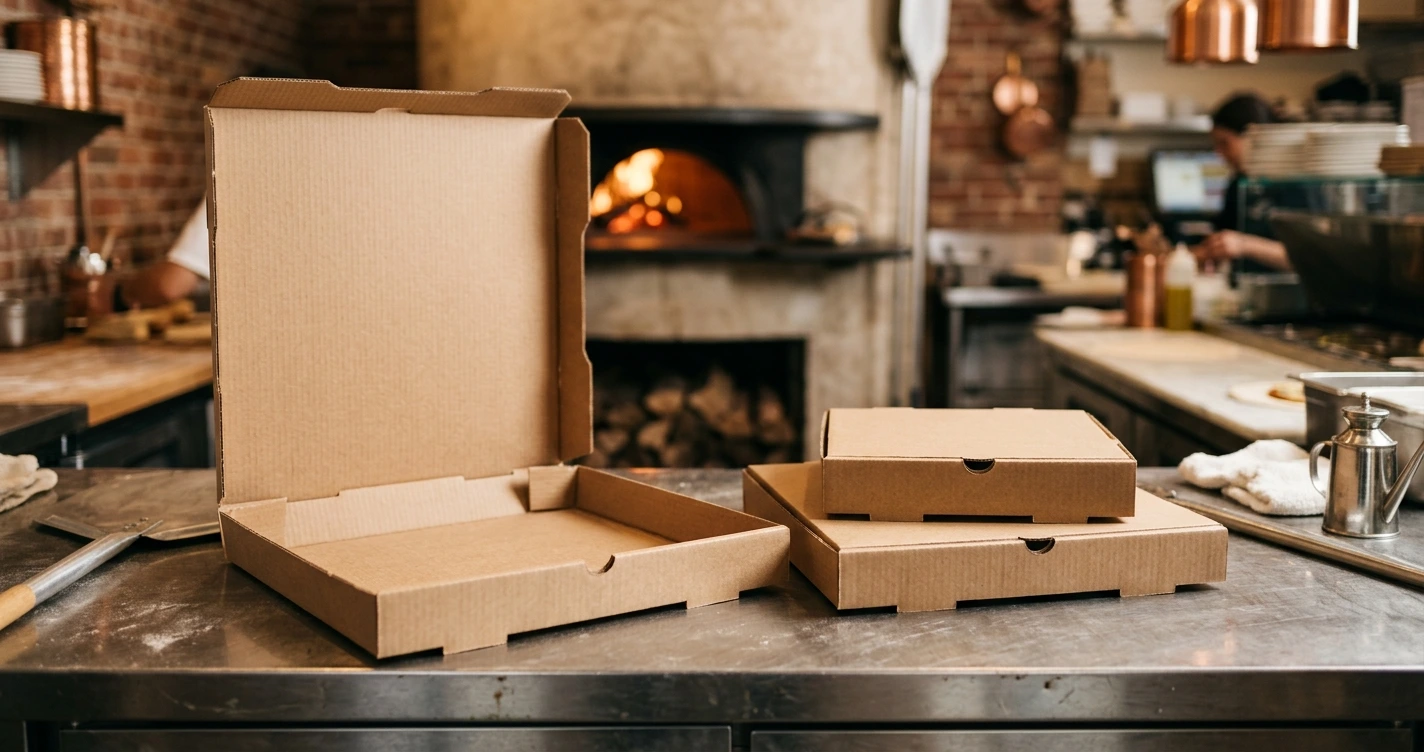
Cheese welded to the underside of the lid. That is usually the first thing a chain tells us about, and by then twenty-five thousand boxes are already sitting in a warehouse.
What happened is nearly always the same. Somebody making a 300 mm pizza ordered a 300 mm box. Sound enough, on paper. Except a pizza spreads in the oven, so the 300 mm base leaves the deck at 315, and the box has exactly 300 mm of room in it. Nothing left over.
Search for pizza boxes and every page that comes back is a size list. Some of them name the box after the pizza outright, as though 32 and 32 were the same number. They are not, and everything that goes wrong afterwards starts there.
What the number on the box actually measures
A box size describes the cavity inside the box. Width, length, height. It has no fixed relationship to the diameter of your pizza beyond one requirement: your pizza has to fit in it with room to spare.
Fitting alone will not save you. With no gap between the crust and the wall, two things happen on the road. Tip the box and the pizza slides until it meets the side, which squashes the rim. Close the lid over a crust that has risen and the cheese finds the board above it.
How much clearance you need belongs to your product. A thick Neapolitan cornicione and a thin, rolled base do not ask for the same margin. That is why there is no single figure here. Anyone who gives you one is guessing on your behalf.
Measure the bake, not the dough
Almost every sizing error we see traces back to this. People measure the dough ball, or worse, the peel. Neither is the product that goes in the box.
What works:
- Bake one of each size on your menu, under normal service conditions rather than carefully.
- Measure it hot, across the widest point. A pizza is never truly round; one axis runs a few millimetres longer than the other.
- Do three or four and take the biggest. One example misleads, because someone stretched it by hand.
- Add your own clearance to that figure, then take the first rung above it.
Fifteen minutes of work, and it stands between you and twenty-five thousand boxes in the wrong size. It also changes the conversation when you enquire. Telling us the baked product runs 354 mm at its widest gets you the right rung first time; telling us you make a 35 cm pizza does not.
Sixteen rungs, four groups
Our standard pizza boxes come in four groups. The order runs width × length × height, all in millimetres:
- Small: 200×200×40 · 220×220×40 · 240×240×40 · 260×260×40
- Medium: 280×280×40 · 290×290×40 · 300×300×40 · 310×310×40
- Large: 320×320×40 · 330×330×40 · 360×360×40 · 400×400×40
- XLarge: 450×450×50 · 500×500×50 · 600×400×50 · 600×600×50
Look at the medium band. It moves in 10 mm steps: 280, 290, 300, 310. That density is deliberate, because most pizzerias live inside that stretch and ten millimetres genuinely matters at that size. Go up into the large group and the gaps widen, with 360 jumping straight to 400.
Why the height holds at 40 mm
Run your eye down the ladder again. Twelve sizes, from the smallest to the 400, all sit at 40 mm. Height only moves to 50 in the XLarge group.
On the warehouse and delivery side that is worth a great deal. Carry three sizes on your menu and all three stack to the same height, so the height of a pile in a courier bag depends on how many boxes are in it rather than which ones. Shelving works out the same way: one calculation covers the lot.
Most off-the-shelf pizza boxes on the market are made at 50 mm. At 40 you get more boxes into the same shelf height and an extra layer into a delivery bag. It reads like a detail. For a site pushing four hundred orders a day it stops being one.
The one rectangle in the range
Fifteen of the sixteen sizes are square. One is not: 600×400×50.
That box exists for Roman-style pizza by the slice, tray-stretched dough and long cuts. Operators selling that kind of product often read the whole ladder, decide nothing fits and close the page, because a single rectangle hides easily among squares. If your product is not round, that one line in the XLarge group is where you are heading.
Custom sizes are possible. Every different size carries its own production set-up though, so when your requirement lands a few millimetres off a standard rung, rounding to it is nearly always the better call.
Vents are a distance decision, not a taste one
Corrugated board already strikes a balance on its own: it holds heat and takes the edge off steam. In a fully sealed box, though, the steam a hot pizza throws off has to go somewhere, and the only place available is under the base.
Ventilation openings can be built in according to box size and delivery requirement. The question that decides it is short: how many minutes does the pizza spend shut in? An order collected from the counter and eaten five minutes later does not want the same box as one riding twenty minutes in a courier bag.
There is a cost the other way, and it deserves saying plainly. Vents let heat out too. A short-radius operator who adds openings saves the base and loses temperature. We went through how steam behaves inside packaging in our piece on fries going soft in delivery; the mechanics are the same in a pizza box, only the timings run longer.
Flexo or offset
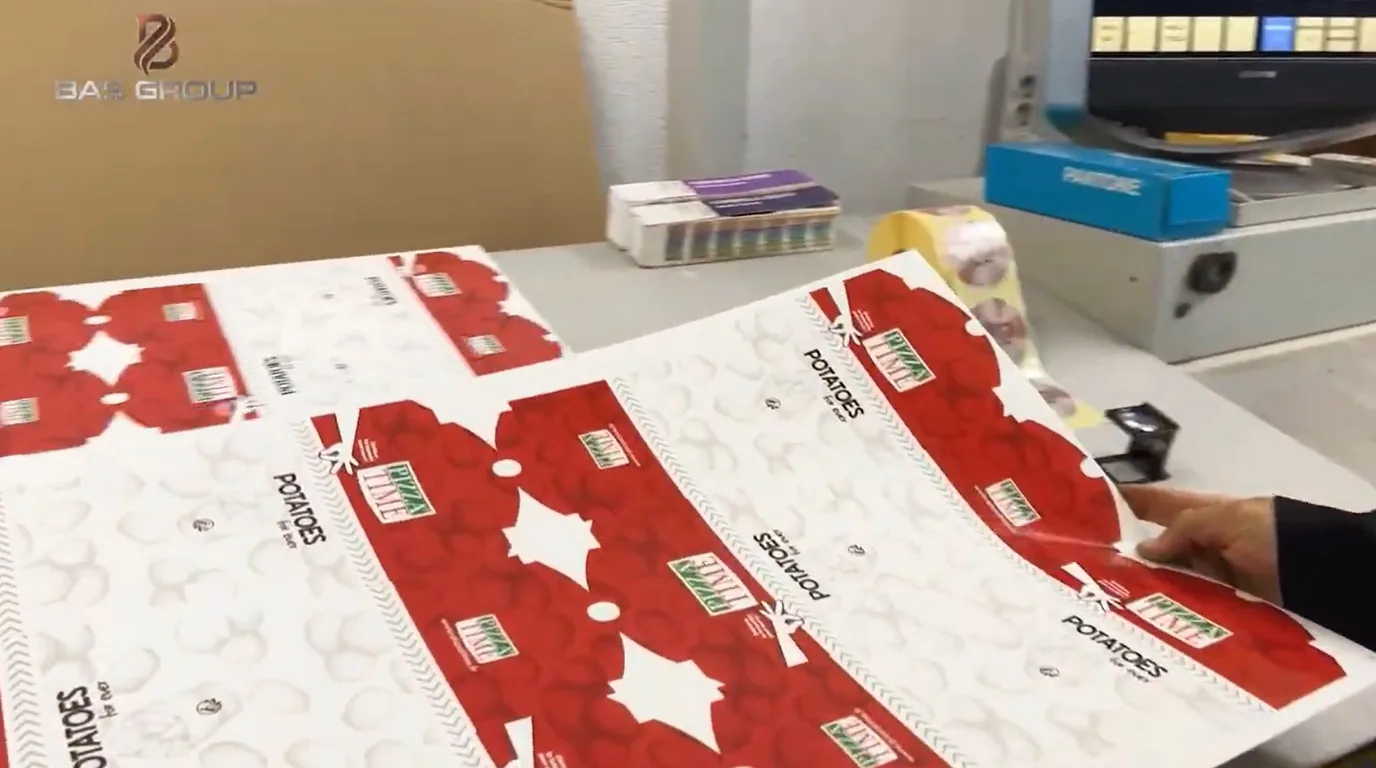
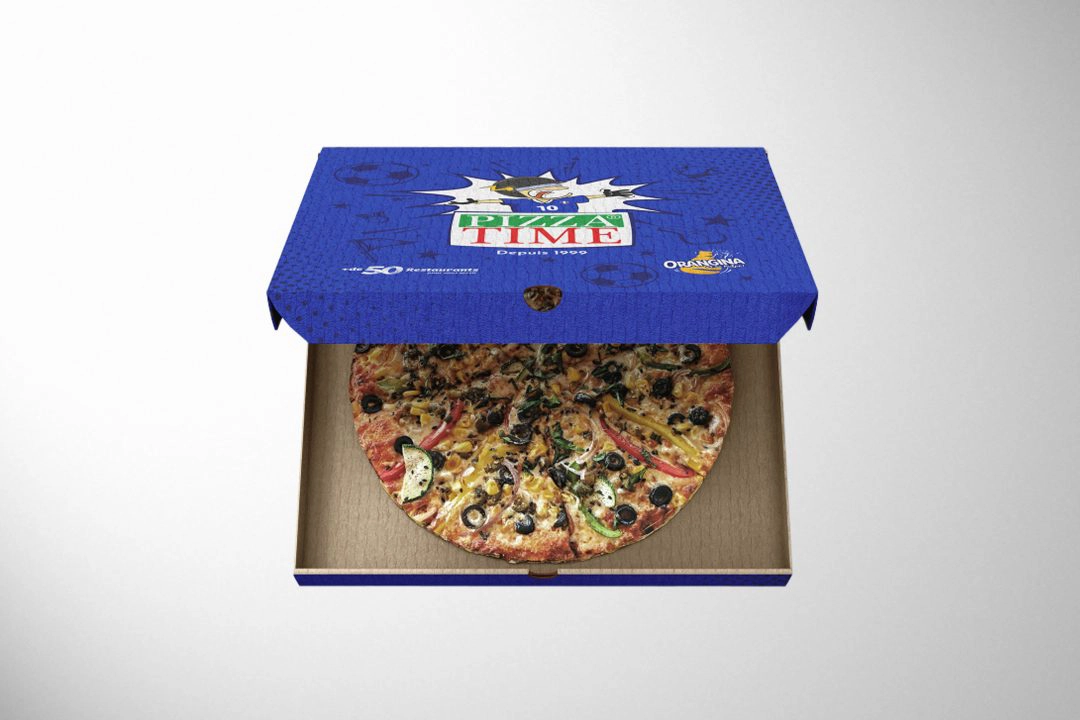
Across most of our range the print method is settled before you ask. Pizza boxes break that pattern: both flexographic and offset printing are on the table, and which one runs depends on your artwork, your quantity and the production specification together.
Practically, that means send the artwork with your enquiry rather than after it. A single-colour logo and a photographic design covering the whole lid do not travel the same route. Operators who supply artwork later tend to go round twice, because the first costing was built on the other method.
Unprinted production is available as well. New sites often brand their two best sellers on the first order and take the third size plain.
Four lines to send before ordering
The list that shortens a quote round is this short:
- The widest measurement of your baked pizza, per size. A measured number, not a menu name.
- Your average delivery time. The vent decision comes out of it.
- Monthly quantity per size. Minimum order is 25,000 and it applies per size.
- The artwork file. Print method is chosen against it.
Production takes roughly 15 to 20 working days after artwork approval. If you are ordering alongside other food boxes, set the schedule up once rather than per item; running them separately hands you two different delivery dates.
When samples arrive, do not judge them empty. Put your own pizza in, close the lid, leave it fifteen minutes and open it. Whether your clearance is right gets answered by the underside of that lid, not by a table.
Frequently Asked Questions
- Is the pizza box size the same as the pizza diameter?
- No. The box size describes the cavity inside the box rather than the width of the pizza. A pizza spreads in the oven, so the baked product comes out wider than the dough ball, and clearance has to remain between the crust and the wall. Measure the baked pizza at its widest point and take the first rung above that figure.
- What are the standard pizza box sizes?
- There are sixteen standard sizes in four groups. Small runs from 200×200×40 to 260×260×40, medium from 280×280×40 to 310×310×40, large from 320×320×40 to 400×400×40, and XLarge from 450×450×50 to 600×600×50. The order is width × length × height, all in millimetres.
- Why is the height always 40 mm?
- All twelve sizes across the small, medium and large groups sit at 40 mm, and the height only rises to 50 mm in the XLarge group. The practical effect is that different sizes stack to the same height, so the height of a stack in a courier bag depends on how many boxes it holds rather than which sizes they are.
- Is there a rectangular pizza box?
- Yes, though the ladder holds exactly one rectangular size: 600×400×50. It covers Roman-style pizza by the slice, tray-stretched dough and long cuts. Because a single rectangle is easy to miss among square sizes, many operators assume the range has nothing for them.
- Do I need ventilation holes?
- Delivery time decides it. In a sealed box the steam from a hot pizza condenses under the base, so vents earn their place on longer runs. Over short distances, extra openings simply cool the pizza down. Ventilation can be incorporated according to box size and delivery requirement.
- What is the minimum order on pizza boxes?
- The minimum order is 25,000 units and it applies per size. Production takes roughly 15 to 20 working days after artwork approval. Printing may run flexographic or offset depending on artwork, quantity and production specification together, which is why sending the artwork with your first message shortens the quote round.
Related Articles
Chicken Box Sizes Beyond Piece Count
Sizing a fried chicken box usually starts with six pieces or nine, and stops there. Weight of a bone-in portion, what the coating does with its own steam, and whether the food gets eaten one-handed matter just as much.
Ghost Kitchen Packaging: Three Brands, How Many Boxes?
Ghost kitchen packaging usually gets discussed as a question of which box. The harder question is how many separate lines one kitchen can actually carry, and that is settled by minimums and shelf space rather than by the menu.
How to Keep Fries Crispy for Delivery: It's the Steam, Not the Cold
Why chips turn soggy on the delivery run, which packaging actually helps — open scoop or vented box — and the 20-minute test any shop can run before committing to a pallet.
What Your Packaging Supplier Needs Before They Can Quote
Three suppliers, three prices, three different bags. Most packaging quotes are unusable because the enquiry described a logo instead of a product. Here is the brief that gets you comparable numbers.