Deutsch
 Français
 Türkçe
The pallet of branded cups has been in the Berlin storeroom since Tuesday, and that same afternoon the German tax adviser forwards a chamber of commerce circular: anyone using service packaging under their own logo has been the producer since 12 August 2026. The circular means this pallet, shipped for a coffee brand from Leeds.
The cup has not changed. Its legal address has. Until the summer, a German wholesaler could take on the licensing of service packaging and the business at the counter only had to register. Since August a single feature decides whether that route is still open: whether your name, logo or brand is printed on the packaging. This guide sets out what that means for a café, a kebab shop or a bakery operating in Germany, which packaging it catches, and where the one exemption sits that almost everyone reads wrongly. It is written from the practice of a manufacturer that has answered the same question every day since August, mostly from businesses that sell into Germany from elsewhere.
Why your logo has triggered a producer duty since 12 August 2026
Since 12 August 2026 it is not the packaging that makes you the producer in Germany, but your name, logo or brand printed on it. On that date the EU Packaging and Packaging Waste Regulation, the PPWR, became directly applicable across the Union, and Germany replaced its Packaging Act with an implementing act, the VerpackDG. The regulation works with two roles that rarely appeared in the life of a takeaway before. The manufacturer is whoever makes packaging or has it made under their own name; that role carries the technical documentation and the declaration of conformity. The producer is whoever first makes the packaging available in a member state; that role carries registration, membership of a recycling scheme and volume reporting.
With printed service packaging both roles land on the same business: yours. You had the cup made with your logo, so you are the manufacturer. You hand it to your customers filled, so you are the first to place it on the German market. Germany's Central Packaging Registry puts it without detours: if the service packaging carries the name, logo or brand of the business, that business is manufacturer and producer, regardless of whether the supplier is based in Germany or abroad. A supplier's name printed alongside yours changes nothing about that.
The same producer definition now applies in every member state. Germany's LUCID register is simply where it is recorded; Ireland records it with Repak, the Netherlands with Verpact. Since August, customers have asked us whether printing the logo smaller would help. Size is irrelevant. Presence is what counts.
Neutral or branded: which bag makes you the producer?
Any service packaging carrying your name, logo or brand makes you the producer; the neutral bag from the same paper does not do so automatically. Service packaging is packaging filled at your premises and handed over directly: the coffee cup, the bakery bag, the kebab box, the carrier bag at the till. Until the summer the pre-licensing shortcut applied to all of it, and for all of it the registry now sets three cases side by side.
In the first case the packaging carries your branding. Then you are manufacturer and producer, as above. In the second case the packaging is neutral and you buy it from a supplier based in Germany, whether a maker, an importer or a wholesaler. That supplier is then the first party in the German supply chain and therefore the producer; it can take on scheme membership as before, and you remain responsible only for registering. In the third case the packaging is neutral but arrives directly from abroad, from another EU country or from outside the EU. Then you are the first party in Germany, therefore the producer, and no pre-licensing is possible.
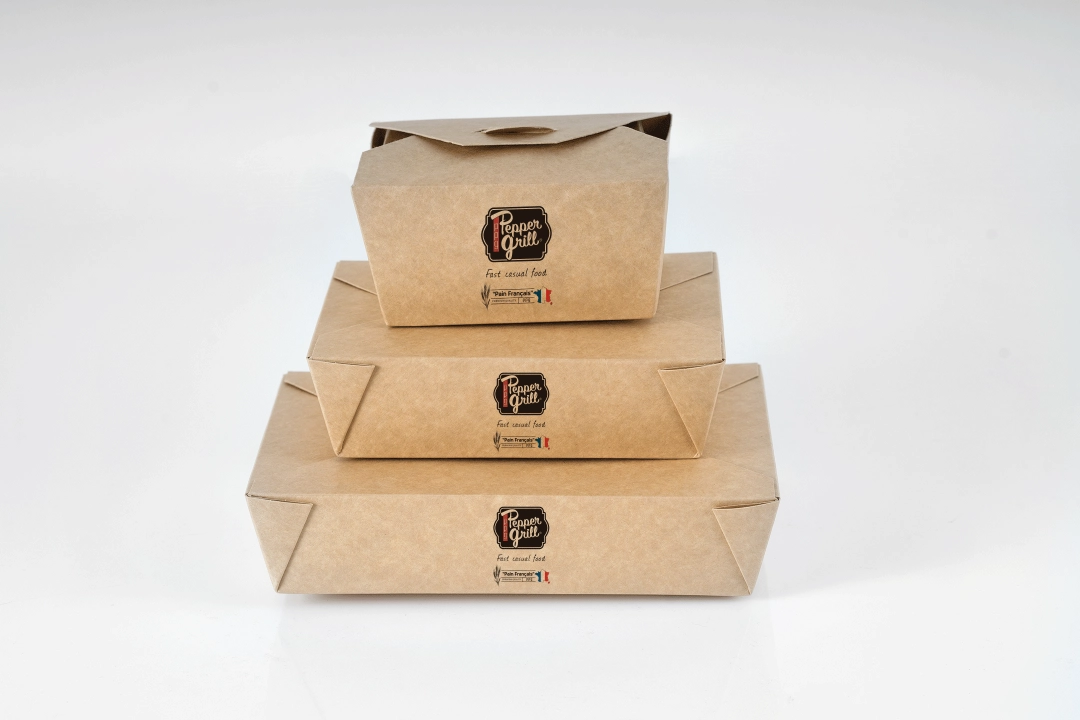
On our cups page there is a line that used to be a production question only: “Full-surface custom printed or unprinted production available”. Since August the same line describes two legal positions. The unprinted cup, bought through a German intermediary, leaves the producer role with the intermediary. The printed cup brings that role to you, wherever it was made. That holds for custom printed paper cups exactly as it does for bakery bags, food boxes and carrier bags.
When does pre-licensing still work?
Only for neutral service packaging bought from a supplier based in Germany. The VerpackDG still allows the duties to be shifted up the chain in narrowly defined cases, and expressly not for businesses that order service packaging with their own name, logo or brand. A café that buys unprinted cups from a German wholesaler and finds the pre-licensing note on the invoice is still doing everything right. A café that asks the same wholesaler to print its logo on those cups has changed roles with that order.
What stays with you in every case is registration in the LUCID packaging register. It could not be delegated before August and it cannot be delegated now. The difference lies in the entries: a business using only neutral, pre-licensed goods keeps registering with the corresponding checkbox; a business using branded goods registers as a producer, listing packaging types and brand. How the registration runs step by step, and which supplier document you need for neutral goods, is covered in our guide to Germany's LUCID register, updated in September for the new position.
One misunderstanding comes up regularly. Some businesses believe pre-licensing has been abolished altogether. It has not. It has fallen away for branded packaging and, for neutral packaging, been tied to where the supplier sits. Together that gives a rule of thumb worth remembering: your logo pulls the duty to you, a foreign supplier pulls it to you as well, and only the neutral bag from a German supplier leaves it where it lay before.
For businesses in the UK the instinct is not new. Under the UK's packaging EPR, the brand owner answers for branded packaging and reports it, subject to turnover and tonnage thresholds. The German rule follows the same logic with one difference that matters: there is no tonnage threshold. A brand on five thousand cups a year triggers the role just as a brand on five million does.
Micro-enterprises: why the exemption only works with a German supplier
The micro-enterprise exemption applies only if your packaging supplier is based in the same member state as you. A micro-enterprise, under the EU recommendation, has fewer than ten employees and an annual turnover or balance sheet total of no more than two million euros. A franchisee counts only if the franchisor holds less than 25% of its capital and exercises no controlling influence; otherwise the franchisor's figures are added in.
If your business meets those thresholds and has its branded bags made by a supplier in Germany, the regulation treats that supplier as manufacturer and producer. A bakery with six employees buying printed bags from a printer in Cologne stays outside the duties. The same bakery ordering the same bags directly from a manufacturer in Turkey is manufacturer and producer, because the supplier is not in the same member state. For purchases from outside the EU there is no such exemption, and for neutral goods from Germany none is needed, because there the supplier is the producer anyway.
We write that although it argues against our own direct business. For a small takeaway with six staff and no other registration duty, the more sensible decision since August may be to buy branded goods through a German intermediary, or to stay neutral for now. A business that does not run that sum acquires a registration it would not have had with a different order.
For everyone ordering directly from abroad, from us or anyone else, one more thing has shifted. Before August a foreign supplier could also take on pre-licensing for neutral service packaging. Since August the German business is the first party in the chain and carries the producer duties itself, while the foreign maker carries the manufacturer duties: technical documentation and declaration of conformity. Germany's single-use plastic fund already uses the same first-party logic. A business that thinks both reports together collects the unit weights once and uses them twice.
What to do now: registration, scheme contract, declaration of conformity
The list below puts the duties in the order they arise in the business, from the shelf to the report.
- Inventory: Go through your service packaging and mark every item carrying your name, logo or brand: cups, bags, boxes, carrier bags, printed napkins. Everything neutral goes on a second list, with the supplier's country beside it.
- Registration: Check your LUCID entry. A business that declared exclusively pre-licensed service packaging and now uses branded goods adds the packaging types and the brand and registers as a producer. Registration remains free.
- Scheme contract: Sign a contract with a German recycling scheme for the branded packaging, and do it before the next hand-over to customers. Without membership the affected packaging may not be distributed.
- Volume report: Get the weight per item from your supplier. Annual quantity times unit weight gives the report; without unit weights it becomes an estimate.
- Technical documentation and declaration of conformity: Request the documents for the packaging from your supplier: material build-up, grammage, statements on PFAS and heavy metals, test reports. The declaration runs in your name; the data comes from production.
- Marking: Check whether the print file contains the markings required since August. That belongs in the next print approval, not on a sticker.
For existing stock the rule is simple. Packaging placed on the market before 12 August 2026 may be used up; no sell-off period is provided because none is needed. The European Commission has clarified that goods already at the retailer or at the business on that date count as placed on the market. The July pallet is therefore no problem. The pallet delivered in September belongs to you as producer, even if you ordered it in May. The delivery date decides, not the order date.
Logo or no logo: the honest sum
Whether the logo on service packaging is still worth it depends on whether the registration is new for you or already running. Three situations come up most often in practice.
A business already registered as a producer, because it runs an online shop with shipping boxes or sells its own products on a shelf, gains one more packaging type inside an existing report. For that business the effort barely changes. A multi-site operator, a chain, and anyone whose brand has to be visible on delivery platforms usually does not face the question at all: the bag without a logo is not an option there, so the registration becomes part of the business. And the small takeaway with no other duties faces the real trade-off. For it the logo has cost, since August, not only the print but a scheme contract, an annual report and a folder of documents.
Some of our customers have chosen neutral cups since August. That is no loss for them. The bag then carries the goods rather than the brand, and the brand stays on the counter, the menu and the delivery app. Others have kept the logo deliberately and taken the registration for what it is: an hour of work and a contract that needs attention once a year afterwards. Both are sensible decisions. The only unreasonable one is to keep treating branded goods as if the wholesaler had licensed them.
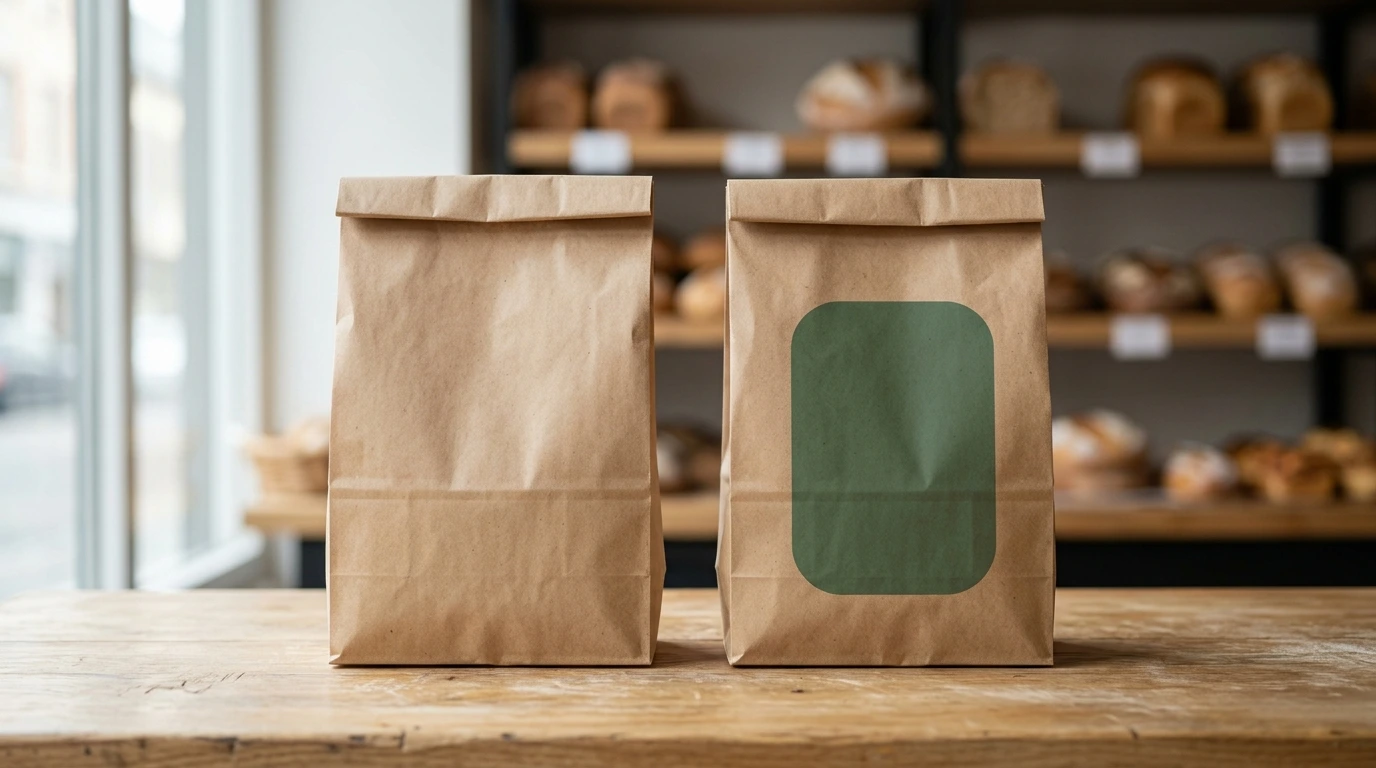
With natural kraft bakery bags we now see both routes side by side: the same bag, the same size, once with a logo for the branches and once neutral for the market stall that runs as its own small business.
Questions to put to your supplier
Five questions have separated, since August, a supplier that has understood the new position from one that is sitting it out. Is your company based in Germany, and do you still take on pre-licensing for neutral goods with a note on the invoice? Do you deliver the technical documentation and the data for the declaration of conformity with every printed item? Is the unit weight per item on the data sheet? Does the artwork contain the markings required on packaging since 12 August 2026? And: can you produce the same packaging either neutral or branded, so that we can decide site by site?
A business that gets those answers in writing can put its registration in order in an hour. One that does not carries a risk it did not have before August. This guide describes practice from a manufacturer's perspective and is not legal advice for your business; whether you count as a micro-enterprise and which of your packaging is affected depends on your figures and your supply chain.
In short
- Since 12 August 2026 a business using service packaging with its own name, logo or brand in Germany is manufacturer and producer of that packaging.
- Pre-licensing by the supplier remains only for neutral service packaging bought from suppliers based in Germany.
- Micro-enterprises with fewer than ten employees and no more than two million euros in turnover are exempt only if the supplier sits in the same member state.
- Producer duties are LUCID registration, scheme membership and volume reporting; manufacturer duties are technical documentation and declaration of conformity.
- Packaging placed on the market before 12 August 2026 may be used up without a deadline; the delivery date decides.
Frequently Asked Questions
- Does it count if only my supplier's name is printed on the bag?
- No. What matters is whether your own name, logo or brand is on the packaging. A bag that carries only the supplier's name is neutral from your point of view. If both names are printed, the responsibility stays with you; the additional supplier name changes nothing.
- I use only five thousand cups a year. Am I still the producer?
- Yes, the quantity is irrelevant. As soon as your logo is on the cup you are manufacturer and producer. The only exemption is for micro-enterprises with fewer than ten employees and no more than two million euros in turnover, and even then only when the supplier is based in the same member state.
- I am a UK business selling into Germany. Does this apply to me?
- It applies to whoever first places the packaging on the German market. If your German customer orders the packaging under their own brand, they are the producer and will ask you for the technical documentation and unit weights. If you supply neutral packaging directly from the UK, your German customer becomes the producer as the first party in the German chain. UK packaging EPR follows a similar brand-owner logic, but with turnover and tonnage thresholds that Germany does not have.
- Do I have to change my LUCID registration if I switch to neutral bags?
- The registration stays, the entries change. A business that now uses only neutral, pre-licensed service packaging from a German supplier adjusts its packaging declaration accordingly. The quantities of branded stock still handed out this year belong in this year’s report regardless.
- Who issues the declaration of conformity if the manufacturer is in Turkey?
- The declaration runs in the name of the business that ordered the packaging under its own brand, so in yours. The data behind it, material build-up, grammage, test reports on PFAS and heavy metals, comes from the manufacturer. Ask before ordering whether those documents come with the delivery; a supplier who cannot provide them has been a risk since August.
- Can I use up the branded bags delivered in July?
- Yes. Packaging placed on the market before 12 August 2026 may be used without a sell-off period. Goods that were already with you or with the retailer on that date count as placed on the market. The delivery date is decisive, not the date of the order.
Related Articles

EU Packaging Rules Since 12 August: What Goes On the Pack
The EU packaging regulation started applying on 12 August 2026. If you sell into the EU, the first part that reaches you is not a filing task. It lands in the artwork of your next print run.
Selling Cups into Germany: Who Pays the Single-Use Plastic Levy
A German café buying cups from a domestic wholesaler never meets Germany’s single-use plastic fund. Once cups travel straight from a supplier abroad to a German business, someone becomes the producer, and the levy is charged on the weight of the whole cup.

Germany's LUCID Packaging Register, Explained for Food Businesses
Selling food or running a site in Germany? Even businesses buying pre-licensed cups and boxes must register in LUCID, and since 12 August 2026 anyone ordering service packaging with their own logo is the producer. Who is affected, which checkbox counts, and which supplier paperwork you need.

PPWR conformity: the data your packaging supplier owes you
Since 12 August 2026 every pack placed on the EU market needs a declaration of conformity. For packaging that carries your brand, your supplier does not issue it; you do, and the supplier owes you the data it is built on. What that data set looks like, which test report belongs to the food-contact declaration, what a BRCGS certificate proves and what nobody can certify about recyclability yet.
Printed bakery bags: sponsored, co-branded or your own logo?
There are three routes to a printed bakery bag, and only one of them belongs to the bakery. What the free sponsored bag really costs, when your own logo pays off, what to write down before co-branding, what 38 to 70 g/m² paper does to a design, and who licenses the bag when you trade in Germany.